






By Ben Musanje
The Uganda Wildlife Authority (UWA) has assumed leadership of the National One Health Platform (NOHP) from the Ministry of Water and Environment (MWE), in a transition aimed at strengthening Uganda’s coordinated efforts to prevent and respond to diseases affecting humans, animals and the environment.
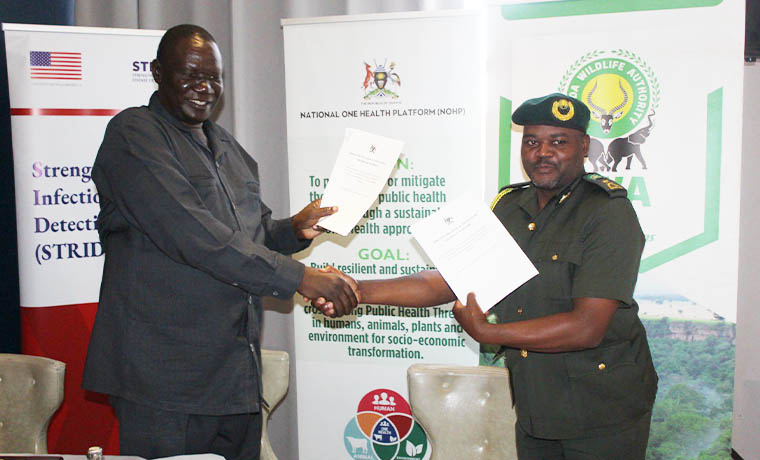
The handover, held on October 28 at Golden Tulip Hotel in Kampala, marks a new phase in the country’s implementation of the One Health approach, which recognizes the interconnectedness of human, animal and environmental health and the need for different sectors to work together to address shared health threats.
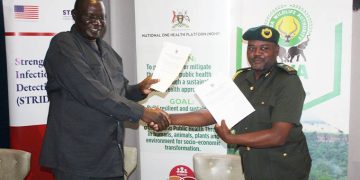
The Ministry of Water and Environment, which has been leading the platform, formally handed over responsibility to UWA, with the outgoing chairperson, Stephen David Mugabi, Commissioner for Environment Sector Support at MWE, representing the Permanent Secretary.

Mugabi handed over the leadership to UWA Executive Director through Mr. Chemonges Mongea Sabilla, Commissioner for Legal and Corporate Affairs and Board Secretary, who represented the incoming leadership.

Speaking at the ceremony, Mugabi reaffirmed the ministry’s commitment to the One Health approach, noting that Uganda formally endorsed the framework in 2016 in recognition of the strong relationship between the health of people, animals and the environment.
“Government of Uganda formally endorsed the One Health framework in 2016. This was a visionary step, recognising that the health of our people, animals and environment are linked,” Mugabi said.
He explained that the endorsement paved the way for the establishment of the National One Health Platform to provide coordination and strengthen the country’s response to public health threats emerging from the interaction between humans, animals and ecosystems.
The Ministry of Water and Environment’s participation in the platform is rooted in its responsibility to sustainably manage and protect the country’s environment and natural resources, which play a critical role in preventing and managing health risks associated with human-wildlife interactions and environmental changes.
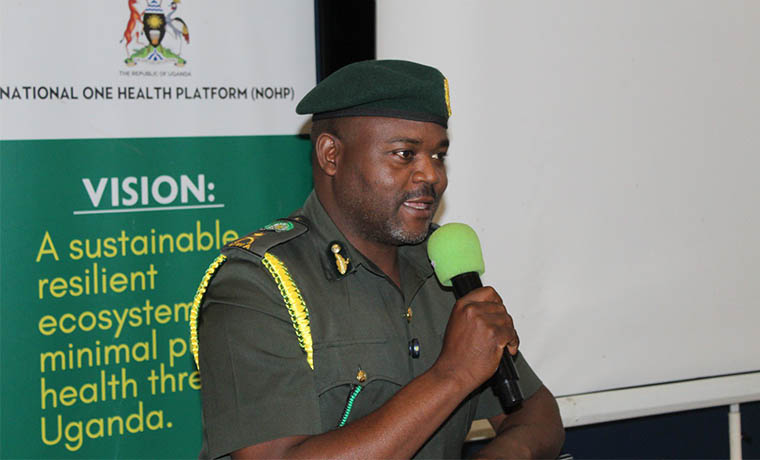
Taking over the leadership, Sabilla said UWA would build on the achievements of the outgoing leadership by strengthening collaboration among sectors whose mandates intersect in protecting public health, biodiversity and ecosystems.
“Wildlife, people, domestic animals and the environment exist in an interconnected system. Strengthening partnerships across these sectors is essential to protecting biodiversity, preventing disease transmission and promoting sustainable coexistence,” he said.
Eight priorities to shape the new leadership
Under its incoming leadership, the platform has outlined eight priority areas to guide its work over the coming year, with particular emphasis on strengthening preparedness, financing, research and institutional coordination.
Among the priorities is finalising and submitting a competitive proposal to the Pandemic Fund to mobilise resources for strengthening Uganda’s capacity to prevent, detect and respond to future disease outbreaks.
The platform also intends to diversify its funding sources to ensure sustainable financing for One Health interventions, while promoting scientific research and innovation to improve understanding of emerging health threats.
Other priorities include strengthening strategic partnerships across government institutions and other stakeholders, as well as institutionalising coordinated mechanisms for outbreak prevention and response.
The incoming leadership also plans to fast-track the development and adoption of a comprehensive One Health Policy to provide a stronger framework for collaboration and implementation across the different sectors.
At the local level, the platform intends to expand and equip district and protected-area One Health teams to strengthen surveillance, early detection and response to potential health threats.
Improving information sharing and coordination among human, animal and environmental health surveillance systems is another key priority, recognising that timely exchange of information is essential in identifying and containing disease outbreaks.
Strengthening the link between wildlife and public health
UWA’s assumption of the platform’s leadership brings wildlife conservation more prominently into the coordination of Uganda’s One Health agenda.
Interactions between wildlife, domestic animals and people can create pathways for disease transmission, making collaboration between wildlife authorities, veterinary services, public health institutions and environmental agencies essential.
The transition also highlights the importance of protecting natural ecosystems and promoting peaceful coexistence between communities and wildlife as part of broader efforts to reduce health risks.
As Uganda continues to strengthen its preparedness against emerging and re-emerging diseases, the National One Health Platform provides a coordination mechanism through which different sectors can combine their expertise, resources and surveillance systems.
The leadership transition from the Ministry of Water and Environment to the Uganda Wildlife Authority therefore brings together two complementary mandates in pursuit of a common objective: protecting human health, animal health and the environment through coordinated action.
Ultimately, the One Health approach recognises that preventing the next disease outbreak cannot be the responsibility of the health sector alone. It requires the combined efforts of institutions responsible for people, animals, wildlife and the ecosystems they share. (For comments on this story, get back to us on 0705579994 [WhatsApp line], 0779411734 & 041 4674611 or email us at mulengeranews@gmail.com).