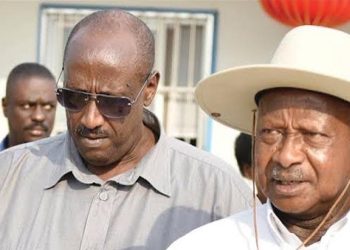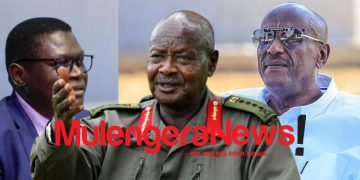







A controversial power-sharing paper associated with Gen Salim Saleh has reopened old wounds within the Democratic Party (DP), exposing the secrecy surrounding its cooperation agreement with the National Resistance Movement (NRM) and raising fresh questions about whether political elites are once again negotiating the country’s future behind closed doors.
The 137-page working paper on consociational democracy, seen by Mulengera News, authored by Prof Ogenga Otunnu in collaboration with his boss Gen Saleh, pulls no punches on the way earlier political cooperation arrangements between the NRM and both DP and Jimmy Akena’s Uganda People’s Congress (UPC) were negotiated, warning that deals made privately by party leaders cannot deliver lasting democratic legitimacy when the people they claim to represent are left in the dark.
The paper, which was presented during a two-day political parties’ retreat in Jinja on October 15–16, 2026, acknowledges that the NRM’s cooperation arrangements with DP and UPC contributed to national cohesion and stability, but also questions whether the ordinary party members and communities whose political interests were being negotiated were ever given a meaningful say.
“Nonetheless, these elite cooperation arrangements have been negotiated in private, without the knowledge or consent of party members and/or the communities they claim to represent,” the document states.
The authors go further, warning that “backroom deals between political giants may produce temporary stability” but cannot deliver the durable democratic legitimacy and inclusion required for genuine national unity.
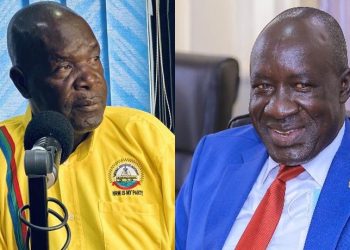
The language strikes a nerve in DP, where Museveni’s July 2022 cooperation agreement with party president general Norbert Mao, who is now serving as the minister for Justice and Constitutional Affairs for the second term, remains one of the most contentious political decisions in DP’s recent history.
When Mao, also Laroo Pece MP signed the agreement with Museveni, the move triggered fierce resistance from some DP members, who questioned how their party could enter into a far-reaching political arrangement with the NRM without broader consultation.
Mao defended himself, insisting that he had briefed the party’s National Executive Committee (NEC). But the dispute exposed deep divisions over whether a few leaders could make consequential political decisions on behalf of an entire party while its members waited to learn what had been agreed in their name.
Now, with the Gen Saleh’s paper revisiting that agreement, the old controversy has acquired a fresh dimension, and the question is no longer just whether the 2022 deal was good or bad for DP, but whether the secrecy surrounding such agreements can ever produce the national unity their architects promise.
The paper does not explicitly accuse Mao personally of failing to consult DP members. Rather, it criticizes the manner in which the NRM-DP and NRM-UPC arrangements were negotiated, placing them within a wider argument that political leaders cannot build durable unity by shutting out the people they claim to represent.
That warning comes at a delicate moment, as political leaders explore a new consociational democracy arrangement intended to manage Uganda’s political divisions through power-sharing and accommodation.
At the Jinja retreat, leaders of almost all political parties discussed the proposed framework against the backdrop of post-election tensions and renewed calls for national dialogue. But the paper’s own assessment of earlier agreements presents the new initiative with an uncomfortable test: will the people expected to support the arrangement be consulted before political leaders settle its terms?
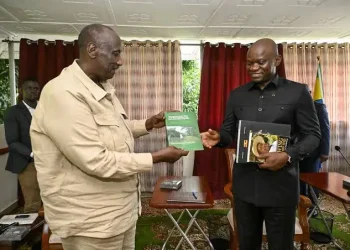
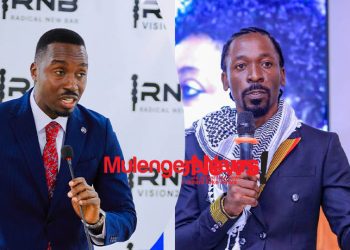
The controversy has also become harder to separate from Mao’s recent confirmation that Museveni’s brother Gen Saleh is leading discussions concerning detained opposition figures Dr Kizza Besigye and Erias Lukwago.
Speaking at a press conference at DP offices on Balintuma Road receny, Mao confirmed that discussions were under way to address the political tensions surrounding the cases, while maintaining that judicial proceedings should continue.
Although the discussions concerning Besigye and Lukwago are separate from the 2022 NRM-DP agreement, they have added to the scrutiny surrounding the wider dialogue process. Opposition actors and supporters want clarity about who is involved, what is being discussed and whether the people whose political future is at stake have a meaningful voice in the process.
DP at Heart, a faction of the Democratic Party, has also questioned whether opposition parties adequately consulted their members following the Jinja retreat. In a statement issued on October 31, the group said the two-week period given to the opposition leaders to consult their subjects had expired without the proposed arrangement being publicly explained to opposition supporters.
The group’s intervention adds to the growing debate, but the deeper warning comes from the Saleh-Otunnu paper itself, that agreements reached in private may calm political tensions for a while, but they cannot guarantee lasting public confidence if the people affected are excluded from the process. (For comments on this story, get back to us on 0705579994 [WhatsApp line], 0779411734 & 041 4674611 or email us at mulengeranews@gmail.com).