








By Mulengera Reporters
The new GoU impact assessment report that was undertaken by National Planning Authority (NPA), in order to advise on how Uganda Development Bank (UDB) can be reformed and strengthened to significantly impact the realization of Uganda’s long-term development aspirations contained under the Vision 2040 and NDP4 (2025-2030), has made revolutionary recommendations.
One of the recommendations is the need to very quickly get UDB to have collaboration programs and undertakings with its peer GoU-funded Development Finance Mechanisms (DFMs). These DFMs include the Microfinance Support Centre, the Agricultural Credit Facility and Uganda Development Corporation (UDC).

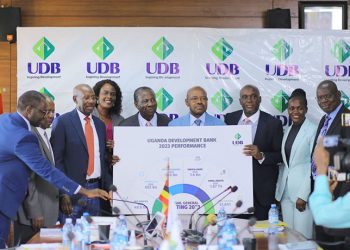
Whereas the Patricia Ojangole-led UDB is charged with deepening private sector participation through availing cheaper long-term development financing, UDC majorly handles equity acquisition-related interventions, which quite often has involved the Corporation acquiring shareholding in private business projects, for and on behalf of the GoU.
The NPA impact assessment report established that although 89% of ordinary Ugandans recognise or are aware of UDB’s existence, awareness about the Bank’s products, mandate and eligibility criteria remains alarmingly low.

Awareness and existence recognition levels stand at 92% among business owners, which is very good. But still awareness or clarity of the Bank’s mandate, products, eligibility and loan application processes remains alarmingly low even among business owners.
The NPA impact assessment evaluation report further showed that limited information was contributing to access barriers by up to 40%, complex procedures by up to 16% and limited branch network by up to 12%. Limited branch network-related constraints can be mitigated through deliberate deepening of digitization and automation.
The report proposes simplification of UDB loan application/access processes besides increased dissemination of clear communication materials sensitizing the public about UDB products. That once all these are undertaken, access to UDB financing will increase and thereby bringing on board new borrowers, in order to accelerate private sector participation while deepening inclusion.
Besides having purposeful collaborations with local government units, trading associations and cooperatives to emancipate underserved communities in upcountry areas, the NPA report demands intensification of community outreach initiatives to increase visibility and brand awareness for UDB.
Under inter-DFM collaboration, the NPA report establishes that 65% of DFM borrowers served under or through MSC, ACF and UDC are aware of UDB. The report authors assert that this constitutes an untapped potential, which the UDB management must harness to achieve greater impact.
That through collaborating and having joint visibility with peer DFMs, UDB will end up being known, understood and appreciated by the 35% DFM-reliant businesses that were found to have zero awareness about the Bank.
That all this can be achieved through UDB undertaking joint awareness campaigns, co-branded outreach programs, shared referral systems, coordinated programming, co-financing and integrated customer support services with UDC and other peer DFMs.
The NPA-authored impact assessment report also raises concern over average turnaround time for loans processing; making it clear that the last four years’ improvement from 75 to 49 days still falls short of the Bank’s own internal target of 45 days.
To mitigate this challenge, greater digitization and automation plus stronger client engagement mechanism are strongly recommended in the assessment report. (For comments on this story, get back to us on 0705579994 [WhatsApp line], 0779411734 & 041 4674611 or email us at mulengeranews@gmail.com).