







By Ben Musanje
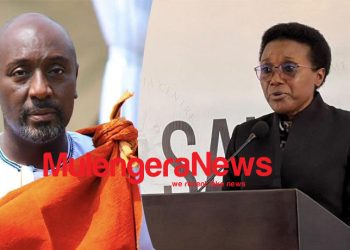
People’s Front for Freedom (PFF) Secretary General Ibrahim Ssemujju Nganda has called on lawyers in Uganda to take a more active role in defending the rule of law, saying the legacy of former Uganda Law Society president and politician Sam Kalega Njuba demands more than annual remembrance.
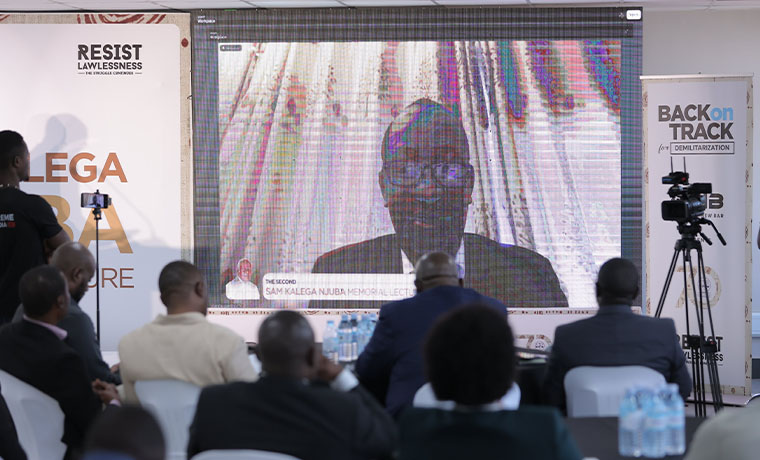
Ssemujju made the remarks on September 24, 2026, while delivering the keynote address virtually at the second annual Sam Kalega Njuba Memorial Lecture held at the Uganda Law Society offices on John Babiiha Avenue in Kampala.
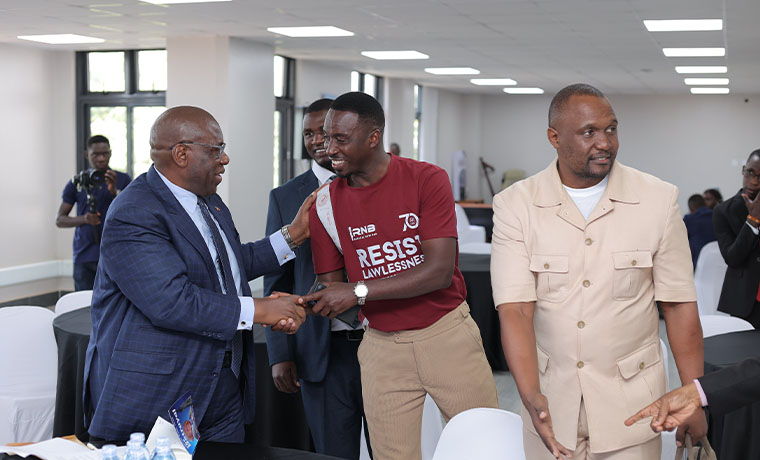
The lecture was attended by former Supreme Court Justice Dr Esther Kitimbo Kisakye, Uganda Law Society President Isaac Ssemakadde, members of the legal fraternity and other invited guests.

Ssemujju recently confirmed of being in e temporal exile said his connection to Njuba was largely shaped by their political work, noting that he succeeded the late politician as Member of Parliament for Kyadondo East in 2011.

Njuba, who died in 2013, was a prominent lawyer, politician and former Justice and Constitutional Affairs minister in the first National Resistance Movement government. Ssemujju also recalled Njuba’s involvement in the NRM external wing in Nairobi during the 1980s.
He described Njuba as part of a generation of public officials who viewed public office primarily as a responsibility to serve rather than an avenue for personal benefit.
To illustrate the difference between the political leadership of Njuba’s generation and the current public sector, Ssemujju cited what he described as changing standards around government expenditure and privileges.

He said that during Njuba’s time as a minister, ministers were required to purchase, maintain and fuel their official vehicles, while also hiring and paying their drivers.
Ssemujju contrasted this with allocations in the 2026/27 national budget, saying Shs161 billion had been provided for vehicles for new MPs, Shs236 billion for vehicles for ministers and other senior government officials, while Shs515 billion had been allocated for fuel and Shs232 billion for vehicle maintenance.
He also cited Shs1.048 trillion allocated for allowances for domestic field visits and Shs207 billion for foreign travel.
The former Kira Municipality Member of Parliament further raised concerns about Uganda’s debt obligations, saying the 2026/27 budget stands at Shs84.3 trillion, with Shs36.9 trillion expected to be financed through borrowing.
He said Shs33.6 trillion, equivalent to about 40 percent of the budget, would go towards debt servicing.
Ssemujju also referred to an ongoing investigation into allegations that $14 million, equivalent to about Shs51 billion, intended for debt servicing was diverted into private overseas accounts. The allegations have not been established as fact.
He used the figures to argue that the cost and privileges associated with public office have changed significantly since Njuba’s generation.
Ssemujju said Njuba demonstrated his approach to public service by retiring from elective politics after representing Kyadondo East in the Sixth Parliament, before later returning to contest the seat under the Forum for Democratic Change.
He said Njuba eventually handed the constituency to him in 2010 and rejected the suggestion that one of his children should inherit the parliamentary seat.
According to Ssemujju, Njuba also contributed financially to his campaign and helped him win the Kyadondo East seat in the Ninth Parliament.
Njuba and the legal profession
A significant part of Ssemujju’s address focused on Njuba’s record as a lawyer and his commitment to the rule of law.
Ssemujju recalled that after Njuba’s death, he criticised the Uganda Law Society in an article published by The Observer, arguing at the time that the organisation had failed to uphold the principles for which Njuba had stood.
He cited the 2013 attempt to impeach then-Kampala Lord Mayor Erias Lukwago as one of the episodes that shaped his earlier criticism of the Law Society.
Ssemujju alleged that the Law Society at the time facilitated the process by participating in the election of a representative to the Kampala Capital City Authority council, allowing the impeachment proceedings to proceed.
The impeachment was subsequently nullified by the courts.
He also referred to other historical controversies involving judicial appointments, including the appointment of Justice Anup Singh Choudry and the reappointment of former Chief Justice Benjamin Odoki to the Supreme Court, arguing that the Law Society should have taken a stronger position.
Ssemujju said his perception of the Law Society has since changed under its current leadership.
He praised Ssemakadde and what he described as the “Radical New Bar” for defending the professional rights of lawyers and challenging actions that he said undermine the independence of the legal profession.
He cited the case of Erias Lukwago, who he said is currently in detention, as an example of the challenges facing lawyers and opposition figures.
Ssemujju also referred to the detention and prosecution of lawyer Eron Kiiza and the circumstances surrounding the legal representation of opposition politician Dr Kizza Besigye.
Several of the claims concerning individual arrests, treatment and alleged actions by security agencies remain matters of dispute or ongoing legal proceedings.
Call to lawyers
Ssemujju urged lawyers to draw lessons from Njuba’s record and confront threats to the rule of law collectively.
He recalled that Njuba himself faced arrest and mistreatment during the regime of former President Idi Amin after attempting to represent a person whom Amin’s soldiers did not want represented.
Ssemujju said Njuba documented some of those experiences in his autobiography, The Betrayal – As Ugandans Are Taken for a Ride.
He also recalled Njuba’s decision to enter the judiciary as a chief magistrate at a time when the judicial system had been severely disrupted following the expulsion of Asians from Uganda.
For Ssemujju, the central lesson from Njuba’s life is that lawyers cannot protect their profession by focusing only on their individual safety.
He challenged members of the legal profession to use their collective strength to defend constitutionalism and the rule of law.
“The people subverting the rule of law are human and are scared of our collective strength,” Ssemujju said.
He urged lawyers to move beyond speeches at memorial events and translate the values associated with Njuba’s legacy into collective action.
The second annual memorial lecture was held to commemorate Njuba’s contribution to Uganda’s legal, political and public life, with this year’s address placing particular emphasis on the relationship between the legal profession, public accountability and the defence of the rule of law. (For comments on this story, get back to us on 0705579994 [WhatsApp line], 0779411734 & 041 4674611 or email us at mulengeranews@gmail.com).