

![NO ONE HAS THE POWER TO FIRE HIM! Ex-Omuhikirwa [Who Fought M7 in 2016] Dares Tooro Clan Leaders Over Rwomiire Sacking, Says Only King Oyo Could Fire Him](https://mulengeranews.com/wp-content/uploads/2026/09/Steven-Kaliba-Ateenyi-75x75.jpg)







By Ben Musanje
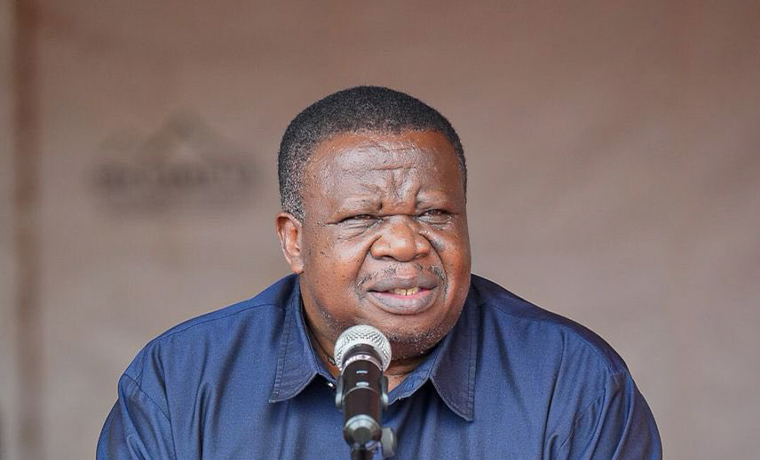
Minister for Water and Environment Maj Gen (Rtd) Kahinda Otafiire has directed Dr Barirega Akankwasa, Executive Director at National Environment Management Authority (NEMA) to urgently restore River Rwizi and intensify action against individuals and entities responsible for polluting water sources feeding Lake Victoria, warning that environmental destruction will not be tolerated under his leadership.
Speaking during his inaugural address at the ministry headquarters in Luzira where Dr Akankwasa was in presence together with other heads of agencies under Ministry of Water and Environment, Otafiire identified the degradation of River Rwizi as one of the most visible examples of environmental decline requiring immediate intervention.
The minister recalled that River Rwizi was once a major water source for Mbarara and surrounding communities, noting that residents including himself used to swim in the river and depend on it for various domestic needs.
He said he was shocked during a recent visit to find the river significantly reduced, adding that he initially thought its course had been altered. According to Otafiire, the deterioration of the river was largely the result of destruction of water catchment areas and environmental degradation.

River Rwizi goes through Mbarara Municipality. The municipality covers an area of 51.5 km2 while the river catchment area stretches out 8,200 square kilometers.

The minister stressed that environmental destruction should never be confused with development, arguing that degradation of natural resources ultimately undermines the welfare of communities that depend on them.
He directed officials responsible for water resources management to prioritize restoration of River Rwizi and ensure that interventions are implemented within the shortest possible time.
Otafiire warned that he expected tangible results from the restoration programme and made it clear that failure to address the river’s decline would not be acceptable.

The minister also turned his attention to pollution affecting Lake Victoria and the growing dependence on water abstracted from Katosi to supply Kampala and surrounding areas.
He explained that pollution in sections of the lake closer to Kampala had forced authorities to increasingly rely on water sourced from Katosi, significantly increasing operational costs due to the distance over which the water must be transported and treated.
According to Otafiire, environmental degradation and pollution have made water treatment more expensive while exposing communities to potential health risks.
He accused polluters of endangering public health by contaminating water bodies relied upon by millions of Ugandans and said authorities must take decisive action against those responsible.
The minister maintained that no individual or institution has a right to pollute the country’s lakes, rivers and wetlands, arguing that such actions threaten both present and future generations.
He further linked water pollution to wetland destruction, noting that wetlands play a crucial role in filtering water before it enters lakes and rivers. Their continued degradation, he said, has weakened natural purification systems and increased the risk of contamination.
Otafiire called for stronger enforcement of environmental protection laws and pledged full support to agencies tasked with restoring degraded ecosystems and protecting critical water sources.
The restoration of River Rwizi and protection of water catchments are expected to form part of the key priorities of his tenure at the Ministry of Water and Environment. (For comments on this story, get back to us on 0705579994 [WhatsApp line], 0779411734 & 041 4674611 or email us at mulengeranews@gmail.com).



![NO ONE HAS THE POWER TO FIRE HIM! Ex-Omuhikirwa [Who Fought M7 in 2016] Dares Tooro Clan Leaders Over Rwomiire Sacking, Says Only King Oyo Could Fire Him](https://mulengeranews.com/wp-content/uploads/2026/09/Steven-Kaliba-Ateenyi-350x250.jpg)