







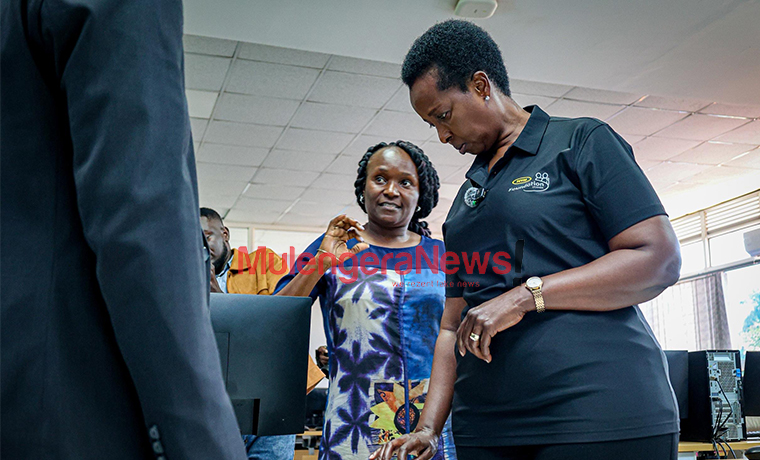
 Allen Kagina inspecting the computer keyboards designed for blind and visually impaired users.
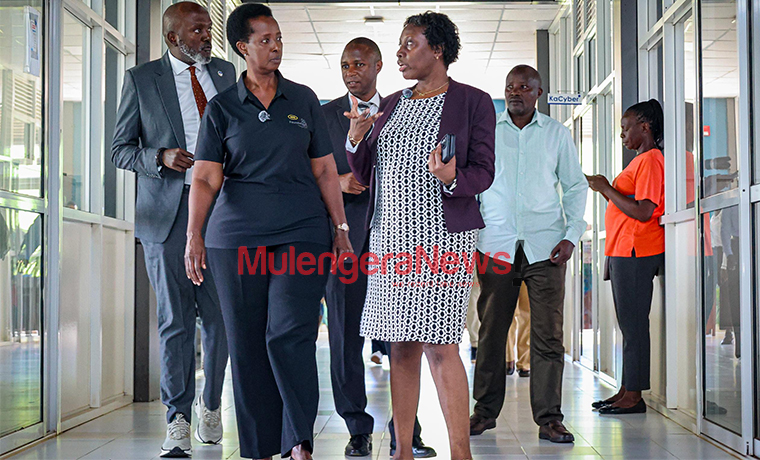 Allen Kagina and Flavia Opio touring the National Innovation Hub.
By Mulengera Reporters
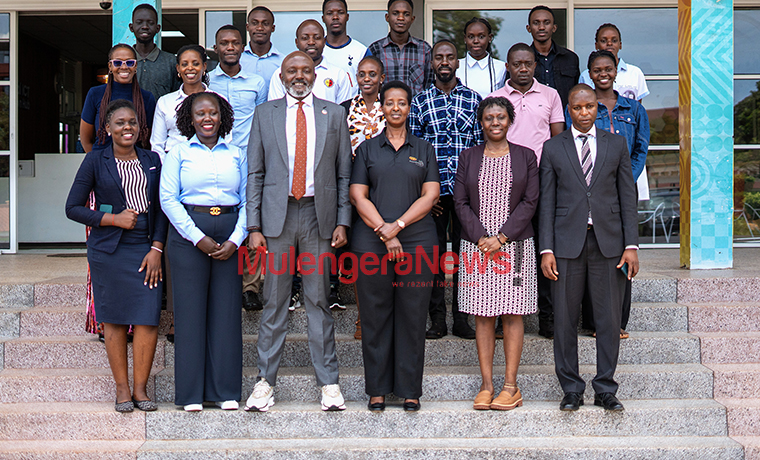
Uganda’s 2024 Census is uncomfortable reading: 16.1 percent youth unemployment among those aged 18 to 30, over 10 million young people outside work or training, and 700,000 new job-seekers entering the labour market every year. It was against this backdrop that Ms. Allen Kagina, Trustee – MTN Foundation Board of Directors, stood inside the National ICT Innovation Hub in Nakawa on Tuesday and said, quietly but clearly: this is working.

The MTN ACE Tech Programme — supported by MTN Uganda and implemented by Centenary Technology Services (Cente-Tech) — has since 2022 invested in the Hub’s infrastructure, equipped it with industry-grade tools and built a pathway for digital skilling, incubation and acceleration. The Hub is Uganda’s premier publicly-owned technology facility.

Of the 32,125 individuals skilled since 2022, 19,781 were male, 12,248 female, and 96 differently abled. Ninety percent of advanced technical trainees found employment or launched a venture within six months of graduating — tracked through the programme’s independent M&E framework.
What Kagina Saw
Kagina’s assessment was specific, not effusive. She pointed to the computer laboratory first — for many trainees, their first access to a proper, connected workstation. “That is the difference between a young person who has potential and one who can act on it,” she said. The video conferencing suite she framed as a market access tool: Uganda’s National BPO Policy, launched in February 2025, targets 150,000 jobs by 2030 by positioning Uganda as Africa’s outsourcing hub in a global BPO market worth over USD 250 billion. That policy depends on young people who can service international clients from Kampala. This facility gives them the infrastructure to do it.

| “A young professional with the right skills can serve a client in London or New York from this building. The conferencing suite is not a convenience. It is a job-creation tool.”
— Allen Kagina, Board Member, MTN Uganda Foundation |
The IoT lab that hosts MTN-funded 3D printing machines she described as collapsing the most expensive part of the innovation journey — the gap between an idea and a working prototype. And the full sequence — computers, conferencing suite, fabrication lab, podcast studio, smart glass auditorium — she called a deliberate pipeline: “You learn. You collaborate. You build. You tell your story. You pitch. That is what an enabling environment looks like.”
Three Voices, One Verdict
Flavia Opio, Head of the National ICT Innovation Hub, was direct: “Before this programme, we had the mandate but not the means. MTN Uganda’s investment has made it possible for us to actually be the infrastructure Uganda’s Digital Transformation Roadmap and NDP IV need — not just carry the name.”
Steven Kirenga, General Manager for Product and Business Development at Centenary Technology Services, pointed to the ten operational processes his team built into the Hub — covering innovator onboarding, incubation management, data compliance, and more — as the real legacy of Phase 1. “Equipment can be replaced. Processes define what an institution can do. We did not just equip this Hub. We gave it an operating system.”
| “The brief from MTN Uganda was clear: build something that lasts, works, and makes Uganda proud. Every pillar of the Digital Transformation Roadmap has a corresponding activity in this building. You don’t skill 32,000 people without a system. We proud of the collaboration.”
— Steven Kirenga, General Manager, Product & Business Development, Centenary Technology Services |
NDP IV sets a target of 884,962 new jobs annually through 2030, alongside a specific commitment to reduce youth unemployment from 16.1 to 12.9 percent. The formal sector alone cannot deliver that. The knowledge economy, BPO, and digital entrepreneurship must absorb the gap — and they can only do so if the talent pipeline exists. “MTN Uganda is not waiting for someone else to solve the part it can solve,” Kagina said. “What I saw today is serious investment, sustained over years, measured honestly.”
Phase 2: The Regions Are Next
With Phase 1 complete, the programme has entered Phase 2 — regional expansion to cities including Gulu, Kabale, Busitema and Soroti. Both the Digital Transformation Roadmap and the BPO Policy explicitly require innovation infrastructure beyond Kampala.
For the 32,000 others changed by Phase 1, Phase 2 carries a simple meaning: what happened to them was not a one-off. It was a model. And models, when they work, should scale.
About the MTN ACE Programme: The MTN ACE Tech Programme is a corporate social investment initiative supported by MTN Uganda. It is implemented by Centenary Technology Services (Cente-Tech) and benefits the National ICT Innovation Hub. The programme has operated since 2022, delivering infrastructure, digital skills training, incubation, and acceleration support aligned with Uganda’s NDP IV, Digital Transformation Roadmap, and National BPO Policy.