






By Aggrey Baba
The call to have the Indian community of Uganda, recognized as one of the local tribes has returned to the national debate, backed by State Minister for Privatisation and Investment and former Koboko district Woman MP, Evelyn Anite, who says the move would finally acknowledge the community’s long-standing contribution to the country’s economy and culture.
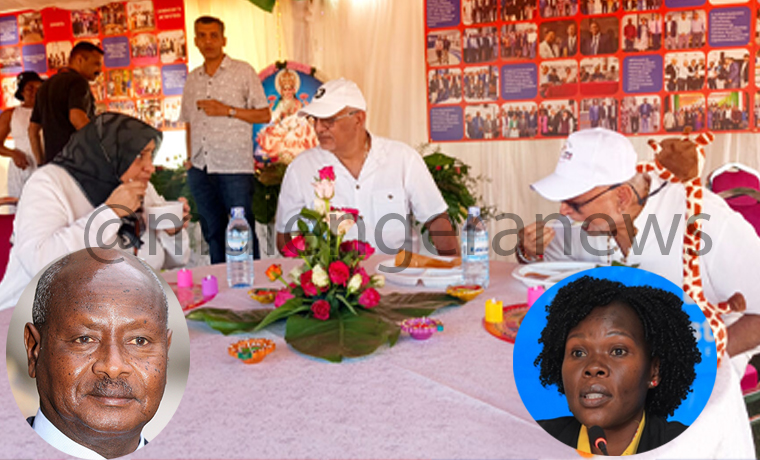
Speaking during the Diwali Festival of Lights at Speke Resort Munyonyo recently, Anite described Uganda’s Indian community as an integral part of the country’s economic story” and said it was time to accord them official tribal status, noting that President Yoweri Museveni is expected to engage the NRM Parliamentary Caucus on the proposal soon.
Anite said the Indian community contributes heavily to Uganda’s manufacturing and investment sectors, which together account for more than a quarter of the national GDP. She added that the group, estimated at 35,000 people, remains the country’s largest single bloc of investors, employing thousands of Ugandans and helping to stabilise key industries from finance and construction to retail and hospitality.
Anite said the Indians are not just investors, but part of the Ugandan community, adding that they have built factories, created jobs, and boosted Uganda’s economy for over a century, and that it’s only fair that the country recognizes them formally.

The proposal to list the Indian community as Uganda’s 66th tribe is not new. It was first raised in 2017, and again in 2021 when members of the Indian Association met with President Museveni at State House. The group has long argued that formal recognition would end their status as foreigners and guarantee nationality for children born in Uganda, many of whom have never lived elsewhere.

For the Indian community, the call is more about belonging than politics. Most of Uganda’s Indians were born and raised in the country and speak local languages fluently. Their forefathers first arrived in the 1890s as labourers recruited by the British to construct the Uganda Railway from Mombasa to Kampala. When the project ended, many stayed behind and became traders, small-scale manufacturers, and later industrialists.
By the early 1970s, they had become the backbone of Uganda’s commerce, until the 1972 expulsion by then President Idi Amin forced more than 80,000 Asians to flee within 72 days. Their return after Amin’s fall in 1979 marked the start of a new chapter, one defined by reintegration and rebuilding.
Today, families like that of businessman Sudhir Ruparelia stand as symbols of the community’s resilience and deep ties to Uganda.
Sunday’s Diwali celebrations, hosted by Ruparelia in partnership with the Indian High Commission, offered a colorful display of those ties, drawing Ugandans, diplomats, and members of the international community to Munyonyo for a day filled with food, fireworks, and performances celebrating unity and diversity. (For comments on this story, get back to us on 0705579994 [WhatsApp line], 0779411734 & 041 4674611 or email us at mulengeranews@gmail.com).