








By Aggrey Baba
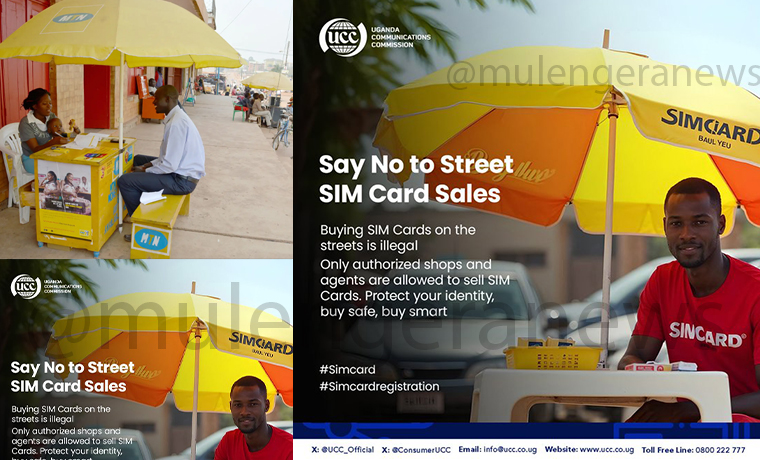
Buying SIM cards from street vendors is illegal and exposes Ugandans to serious risks, the Uganda Communications Commission (UCC) has warned in a fresh campaign aimed at promoting digital safety and responsible telecom use.
UCC says that only authorized shops and licensed agents are permitted to sell SIM cards in Uganda. These official sellers are registered, trained, and equipped to properly verify customer identities before activating any number, a process that street vendors often skip or falsify.
Over the years, street sales of SIM cards have become a common practice, particularly in busy urban areas like taxi parks, bus terminals, trading centers, and roadside kiosks.
Vendors typically operate under brightly colored umbrellas or tents marked with “SIMCARD” signage, luring unsuspecting customers with quick, registration promises. However, the UCC is warning that this convenience comes at a dangerous cost.

When a SIM card is sold without following proper registration procedures, including biometric verification using fingerprints and a valid National Identification Number (NIN), the buyer’s personal information may either be left unsecured or linked to false identities, leaving room for criminal activity and puts law-abiding citizens at risk of being implicated in fraud or cybercrime without their knowledge.

UCC says many people may not realize that by purchasing SIM cards from street vendors, they are breaking the law and compromising their own digital security. The law requires that all SIM cards be issued through approved telecom outlets under strict registration guidelines designed to protect users and ensure accountability in the telecom sector.
SIM cards tied to false information are regularly deactivated by mobile operators during periodic audits, meaning that a number bought from the street could stop working suddenly, causing the user to lose access to mobile money, banking apps, and other essential services connected to the line.
The Commission is encouraging the public to always insist on buying SIM cards from legitimate agents, usually found at telecom service centers, authorized kiosks, or mobile outlets listed by the major telecom companies.

These agents use biometric equipment to capture the customer’s photo and fingerprints and link the SIM card to their national ID details, a safeguard meant to protect both the buyer and the country.
The ongoing public awareness campaign under the message “Say No to Street SIM Card Sales” is part of the Commission’s broader efforts to promote safe digital practices in Uganda.
In the long run, UCC says enforcing strict rules on SIM card sales will strengthen digital identity protection, help law enforcement trace criminal activity, and support national security.
The Commission is also calling on telecom companies to monitor their agents more closely and take action against those engaging in illegal sales.
Members of the public who encounter unlicensed SIM card dealers are encouraged to report them through UCC’s toll-free line 0800 222 777, or by emailing info@ucc.co.ug.
As mobile phone use becomes more central to daily life, for communication, money transfers, education, business, and healthcare, the UCC says that every user has a responsibility to protect their identity. (For comments on this story, get back to us on 0705579994 [WhatsApp line], 0779411734 & 041 4674611 or email us at mulengeranews@gmail.com).