







 By Mulengera Reporters
Ope Zihalirwa (aged 23), Atosha Mitima (27), Nelly Lugulu (26) and Wanyi Katwanyi (30) are all refugees from DR Congo and they live on Isingiro district’s Nakivaale Refugee Settlement for survival; where they do different things to make ends meet. The camp is home to tens of thousands of refugees and it’s one of the major and most known refugee settlements in Uganda.
The GoU has won global recognition and acclaim for its generous refugee management program and policy which allows them to own property like land and engage in all manner of economic activities that Ugandan citizens do. In total, Uganda has over 1.5m refugees living and operating in the country. And at the OPM, the GoU has a whole department exclusively dedicated to doing refugees management-related work. The department is headed with a civil servant at the rank of Commissioner.
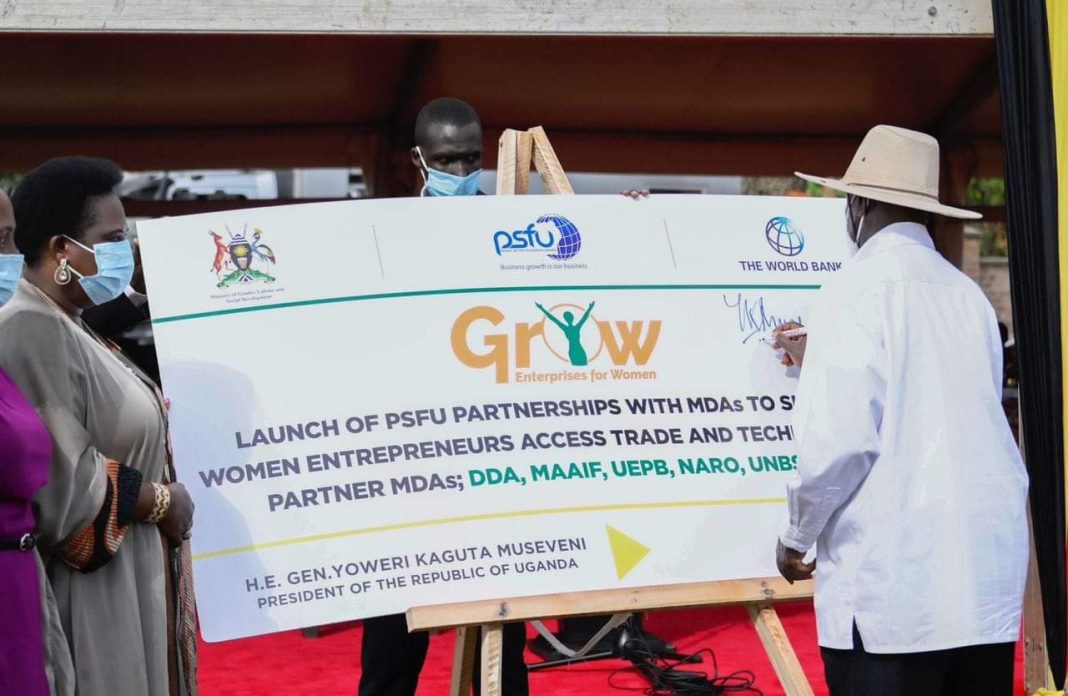
So, the different social economic transformation programs of the Uganda government have had to be inclusive of refugees while reflecting the reality that these are now part and parcel of the population living and operating in Uganda. So, the World Bank-funded female entrepreneurs-emancipation intervention called GROW project has had to have a significant component dedicated to empowering female refugees struggling to go into self-employment.
The GROW project is meant to last for five years and is worth Shs819bn (USD217m). Female refugees have benefited through being supported to resuscitate their businesses which were battered during COVID besides being enrolled on vocational skilling programs at the various vocational training institutions which have been certified and accredited to offer the appropriate training to thousands of women entrepreneurs across Uganda.

The above referenced female refugees are among the thousands meant to directly benefit from the GROW project intervention from within the settlements where they live inside Uganda having left or run away from their respective countries of origin for one reason or another.

THE DETAILS: In the case of Mitina, Katwanyi and Lugulu, the trio is based in Nakivaale Refugee Settlement in Isingiro where they lucratively operate a crafts shop of their own. They resorted to this after abandoning the hawking business they used to do in the Nakivaale Settlement. There is a lot of farming in the Refugee Settlement and the three ladies used to hawk 2nd hand hoes whose proceeds they would share.
But however much they worked, the money was never enough to cater for their families’ most basic of needs. They and their families always lived in great deprivation as there was never enough provision.
As they scratched their heads on what to go into, they learnt of the GROW project intervention which fortunately had a component dedicated to accelerating female entrepreneurs among female refugees. They immediately enrolled and became part of the larger group that was to undergo training by YMCA Comprehensive Institute based both in Wandegeya and Buwambo.

They specialized on learning how to make crafts out of leather and rubber; car tires. They became experts at making things like leather sandals (aka lugabire) out of simple material like car tires; and these can fetch them between Shs5,000 and Shs30,000 per pair depending on the quality and who the buyer is. This enables them make sales of roughly Shs300,000 per day of which Shs200,000 is profit.
The three refugee ladies, from DR Congo, are very grateful to the GoU for the GROW project initiative because this daily earning of Shs300,000 from sales at their crafts shops is way much better than the peanuts they used to earn from hawking stuff throughout the Nakivaale Refugee Settlement. Gratefully, some of the things they make are on high demand and yet they don’t face much competition.
Their products include leather wallets, hand packs, back packs, leather shoes and belts just to mention a few. They say their life has greatly been transformed and they can’t thank the GoU enough for the GROW project intervention. There are clear indicators that the skilling they acquired from the GROW-funded training at YMCA has enabled them earn and support their families better. They say they have been able to leverage the Shs200,000 profit they make every day to diversify into several other business lines.
NOT ONLY THEM: The trio’s experience isn’t theirs alone; as its replicated in the stories shared by other similarly-placed refugees. The 23-year-old Zihalirwa is currently earning and living well as a professional photographer, photo and video editor courtesy of the GROW-funded hands-on training she underwent at YMCA.
The young lady from DR Congo also lives in Nakivaale Refugee Settlement in Isingiro and the GROW intervention transformed her from a despised low-earning woman who used to hawk biscuits, baby dolls and sweets around into a very successful professional photographer fully employed at a group photo studio where shareholders on average make between Shs500,000 and Shs4,000,000 per month.
Zihalirwa says she is able to significantly contribute to this collective monthly income or revenue to their group photo studio simply because of the GROW-funded life-changing training she had at YMCA in Kampala where she reminisces being exposed to modern photography equipment, skills, ethics, dos and donts which govern the photography trade.
She is now able to take excellent photos and edit them real quickly and is grateful to reveal that the skills engagement with the GROW-funded training exposed her to have turned her into a celebrity and the most sought-after photographer in the entire Nakivaale Refugee Settlement. She says life was always hard and she had actually lost hope of ever making it in life even after she had abandoned the sweets to become a vendor of second hand clothing throughout the Nakivaale Refugee Settlement.
Yet that isn’t all about GROW project and the Nakivaale Refugee Settlement. There is also 36-year-old Resty Nyamwiza whose cosmetology capabilities improved and her life changed forever after participating in GROW-enabled training at YMCA. The mother of four operates her own salon in Rwendezi Cell Masha Sub County in Isingiro district where she was only able and used to do only simple hairstyles on fellow women. Because hairstyling is simple, a lot of people do it which leads to high competition.
She is grateful the GROW project training enabled her to circumvent that competition by enabling her acquire unique additional skills and begin offering services which her would-be competitors were unable to render. The game-changing decision she made to sign up for the training enabled her learn more sophisticated hairstyles for fellow ladies besides learning male haircuts which has since turned out to be a gold mine for her. She these days does male haircuts at Shs2,000 per head and in a day, she works on not less than 10 men.
This translates into a daily income of Shs20,000 at the very minimum; which has distinguished her into one of the top-earning self-employed women entrepreneurs in her locality. Nyamwiza says she can never run out of business because on a bad day women customers don’t come (since their hair isn’t styled daily), she is sure to survive on men hairstyling errands.
And she is optimistic that if things continue the way they are, she will in the not-so-distant future be able to enlarge her salon into a beauty parlor and be able to cash in doing several other things for her customers. Her biggest motivation is to enlarge her salon into a beauty parlor and subsequently be able to fulfil her dream of employing several other fellow women. (For comments on this story, get back to us on 0705579994 [WhatsApp line], 0779411734 & 041 4674611 or email us at mulengeranews@gmail.com).