





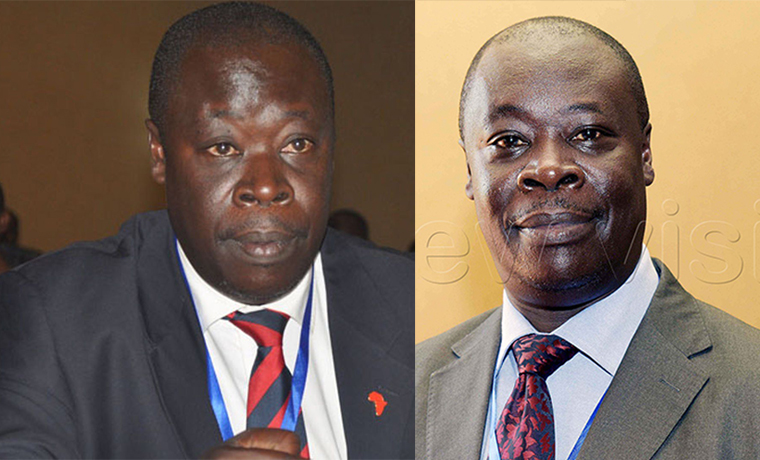

By Mulengera Reporters
In 2019, a criminal complaint from MTN Uganda instigated the DPP to institute charges against logistics company ThreeWays Shipping Company Ltd’s shareholders/directors namely Oscar B Baitwa and Geoffrey Bihamaiso along with four other individuals.
The Company had been the logistics services provider, shipping into the country stuff for MTN, for many years but the relationship soured when the two directors and the other four individuals were accused of conspiracy to commit fraud and steal up to more than $3.8m (roughly Shs15bn) to the detriment of MTN Uganda.
The MTN complaint was that ThreeWays had, in connivance with two telecom employees, put in 125 fictitious invoices claiming and going on to receive payment for goods and services it actually didn’t supply to MTN.
The 125 fictitious invoices, over which Bihamaiso impliedly accepted responsibility during a Forest Mall meeting with one of the MTN managers Charles Masanso, were leveraged over a period of three years.

The two companies had been in a contractual relationship for more than 10 years, a period during which hundreds of invoices were raised and based on to process payment. The money was paid over the three years from the MTN accounts in Stanbic Bank to those of ThreeWays.

The two MTN employees who the ThreeWays directors were alleged to have conspired with were senior logistics officer Naphtali Were and accounts payables officer John Paul Basabose who enabled the supplier to keep getting his payment-claiming invoices cleared through the MTN payments system over the three years’ period.
The duo is supposed to have collaborated with ThreeWays’ employees Faridah Senkumba and Waiswa Kafuko to effect their mischief and subsequently share the proceeds. These four were originally Oscar B Baitwa & Geoffrey Bihamaiso’s accomplices and co-accused over the $3.8m that was stolen out of the MTN coffers over the period of three years before the company’s internal controls were able to detect the same.
The DPP had originally preferred charges against the six but Were died during pendency of the case trial and subsequently the DPP proclaimed a Nolle Presque and discontinued prosecution or dropped charges against Senkumba and Kafuko. John Paul Basabose, a former Accounts Payables Officer at MTN, was convicted on his own admission after entering a plea bargain deal with DPP.

Ironically, the prosecutor never opted to use any of these as prosecution witnesses to give evidence against the two ThreeWays directors. And it’s partly this omission by the DPP that the trial Judge Lawrence Gidudu relied upon to acquit the two accused persons (Bihamaiso & Baitwa) in his 14 pages’ judgment proclaimed on 30th April 2025.
Otherwise the DPP representatives (Abigail Agaba & Gloria Inzikuru both of them chief state attorneys) had made out their case and proved that through the 125 invoices, a total of $3.8m had landed on ThreeWays Company’s bank account over the period of three years. And that the money was received, controlled and utilized by the two directors who were shown to be the “brain and nerve center” of the recipient company.
This was stolen money as ThreeWays received it without any claim of right. It was never their money and this was demonstrated to Court and the Judge accepted as much though controversially in the end acquitted the two accused persons!
The DPP lawyers also demonstrated that the company knew and acknowledged this by first of all refunding $300,000 and offering to engage in negotiations with MTN Uganda whose top management they later on faulted (even as part of their evidence in court) for insisting on having them prosecuted for theft and receiving/being in possession of stolen property as opposed to amicable settlement outside Court. (One wonders what they wanted negotiations about if they indeed had no knowledge of prior wrongdoing).
To prove existence of awareness and knowledge or intent/mensrea on part of the two directors (who provided exit and became the conduit through which the Telecom lost it’s hard-earned $3.8m), evidence was tendered by the prosecution side showing that the panicky ThreeWays directors, on realizing that MTN had become aware of money being lost through the fictitious invoices (airway bills and delivery notes), quickly contacted Charles Masanso (the officer who had been assigned to follow up) and took him out for lunch at Forest Mall where he was offered a bribe of $150,000 in order to silence and get him not to vigorously pursue the complaint on behalf of his employer (MTN).
To prosecution, all this was indicative of the fact that the two directors were fully aware of everything and were actually owning up. Prosecution referred Justice Gidudu to his own 2017 decision in Uganda vs. Jeff Lawrence Kiwanuka where the veil of incorporation had to be lifted to prevent the directors from hiding behind the veil of incorporation to escape personal liability even where it had been proved that they, and no one else, were the ‘brain & nerve center’ of the company on whose behalf they were mandated to make all the decisions. Curiously, the judge disregarded what the prosecution was saying around this issue.
Prosecution also brought bank staffers Ann Mary Akello, Jacqueline Nandutu and Rogers Mwesigye whose evidence proved that the two directors were the sole signatories to ThreeWays bank account to which the $3.8m was fraudulently transferred in bits over the three-year period.
The judge instead felt inclined to agree with the submissions of defense lawyers (Henry Kunya & Henry Kyalimpa) and held that the doctrine of common intention wasn’t sufficiently demonstrated to adequately implicate the two directors.
He demanded to know why prosecution didn’t bother getting John Paul Basabose, Faridah Senkungu or even Waiswa Kafuko to serve as witnesses whose evidence could have corroborated everything and properly implicated the two directors. The judge said it was a mistake for the DPP not to use any of the trio as a corroborating witness.
The judge, who finds that ThreeWays unjustly benefited from the $3.8m deprived from MTN Uganda, also faulted the DPP for not tendering the audio recording MTN employee Charles Masanso claimed to have recorded (for his own consumption) capturing the lunch meeting conversation at the Forest Mall Lugogo from where a bribe of $150,000 was allegedly offered to him. That without corroboration all the prosecution evidence, against the two accused persons/directors, was merely speculative and not sustainable as to secure a conviction against the two accused persons who undeniably received and utilized property or money to which they had no claim of right.
The judge held that there is no way the two accused persons, who were proved to have received and dispensed the money on the bank account of ThreeWays, a company they managed and had full control of, could be convicted for receiving stolen property (which they did) unless the DPP had paraded their original accomplices Faridah Nankumba, Waiswa Kafuko and John Paul Basabose to give evidence directly implicating them. That there was failure by the DPP to establish the doctrine of common intention to implicate the two directors!
The judge further asserted that failure to get the trio become corroborating witnesses made the prosecution evidence very speculative and not adequately helpful as to secure a conviction. The judge goes on to assert that possibly fear to implicate top officials charged with signing off and authorizing payments at the complainant telecom company might have informed the DPP’s decision to commit this very glaring omission-namely not calling these witnesses.
In the end, the judge holds that it’s true the act of theft (as defined under the Penal Code Act) occurred but on the MTN account where the money originated from. That the impugned theft was technically committed by MTN staff who fraudulently enabled the transfer of funds onto ThreeWays Ltd’s bank account and not by the directors and the principal signatories who received and expended the money!
That the actual fraud and theft of the money was committed at the point of dispatch of the cash (namely the MTN bank account) where the two directors (who eventually received and utilized the stolen money) were not in control or exercised no control at all.
Justice Gidudu’s ruling, which legal pundits now want the DPP to appeal against in the Court of Appeal, by implication means that it’s okay for anyone to be in possession of and even going ahead to utilize stolen money for as long as they didn’t participate in the actual act of theft or stealing of the same.
This is the reason why the ThreeWays directors, who undeniably received and made use of the impugned funds for & on behalf of the company they controlled, are walking away scot-free, without being sanctioned in way and this is all happening at the expense of an investor who the High Court of Uganda has left with no remedy at all even after establishing that that investor’s cool $3.8m was unfairly deprived of him without any justifiable cause and in favor of an accused person(s) who had no claim of right whatsoever to that money or property contained therein.
There is already nervousness that, as it was in the Ham Kiggundu/DTB bank case a few years ago, this latest ruling by Justice Lawrence Gidudu is going to negatively impact investor confidence in Uganda as an investment destination. The truth is that investors always go to a country because they are certain that that country’s judicial system will be relied upon as a fair, prudent and impartial arbiter in case of disputes which are inevitable in the practice of business and commerce in any jurisdiction.
Imagine being an investor whose employees connive with one of your suppliers and as a result you are made to lose roughly $4m/almost Shs20bn. You complain to the authorities and the criminal trial goes on for more than 5 years and it all ends in such a very unhelpful judgment!
None of the employees who enabled and facilitated all this deprivation and occasioned such colossal loss of money gets prosecuted. And even the supplier who actually benefited from the fraudulent funds’ transfer doesn’t get sanctioned at all and it all ends in having to lose so much money at the hands of an indifferent judicial system after waiting, to know your fate, for so long.
How does that impact an investor on the verge of making the big decision to invest in Uganda? What are the implications of the judicial system rendering judgments that cause observers to perceive it as lacking when it comes to effectively arbitrating business disputes? (For comments on this story, get back to us on 0705579994 [WhatsApp line], 0779411734 & 041 4674611 or email us at mulengeranews@gmail.com).