







By Mulengera Reporters
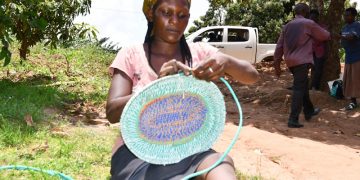
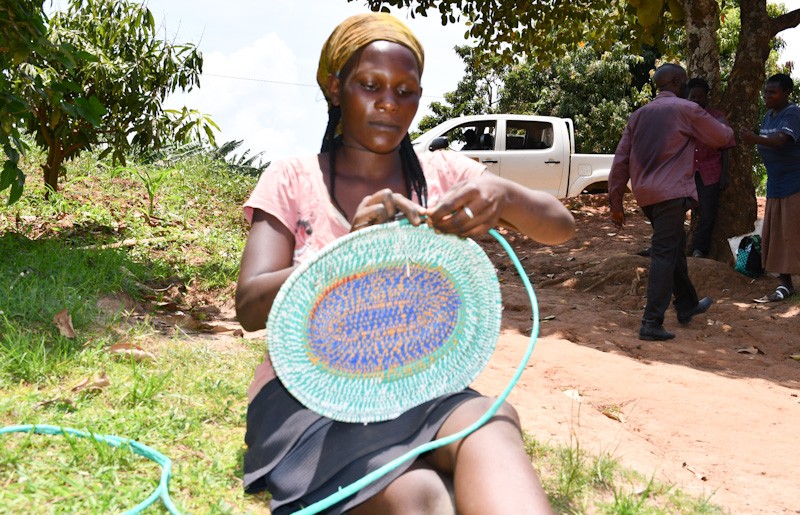
Her hands are busy interlacing. Her attention equally appears to follow through a similar rhythm being created as her hands, a locally made needle, polythene thread and grass (harvested from the wetland) interconnect to craft a beautifully knight basket. Her attention, however, is interrupted. The sound of the vehicle and simultaneous greetings from a team of officials from the Ministry of Water and Environment (MWE) and the technical team from Sheema District suddenly bring her activity to a halt.
“You are welcome,” a 21-year-old Shildah Nabimanya, a resident of Nyakambu ward, Masheruka Town Council, Sheema district, said with a smile as she ushers us to take seats. Shortly, she continues with her business. The atmosphere here is hazy and threatening to rain anytime. We are visiting Nabimanya ─ a mother of two ─ at her family home, just to understand how she is progressing with the alternative livelihood that she, together with other community members, received from the government of Uganda, under the Building Resilient Communities, Wetland Ecosystems and Associated Catchment Areas in Uganda Project. The Government of Uganda (GoU), Green Climate Fund (GCF), and United Nations Development Program (UNDP) fund the project.
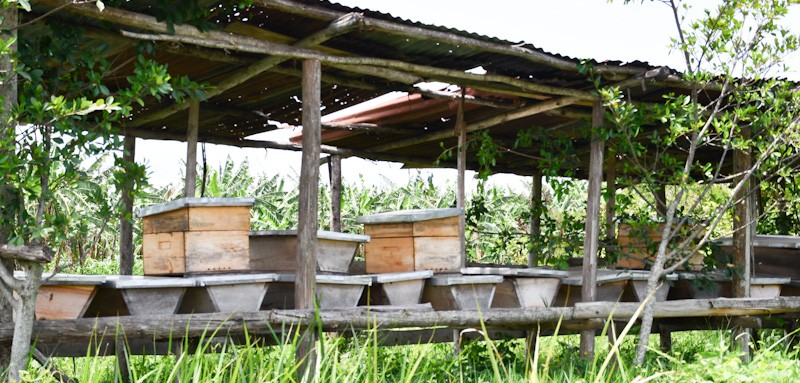
Nabimanya is a member of Masheruka Environmental Restore Wetlands and Disaster Monitoring Committee and Cadres Association- a cooperative of 76 people (now 100) founded in 2014 to support government conservation initiatives in Sheema district. The group has ten youth (including Nabimanya), forty women and fifty men. In 2019, the group received 25 beehives. This alternative livelihood would later become a landmark not only in ensuring the Nyakambu wetland is free of encroachment, but also in improving the livelihoods of community members whilst making them more resilient to climate change impacts.
25 beehives the group received in 2019
According to Nabimanya, the group has since harvested honey multiple times, with each harvest giving them a twenty-litre jerry can. A jerican of honey costs up to Ushs450,000 (approximately USD121). In the first three seasons, the group earned USH 1,350,000 (USD 365). This money has since been transformed into a credit facility. With it, members are able to borrow and return with interest. Nabimanya, like many of the members, has borrowed from the group to help not only meet basic needs but also support her businesses, such as tailoring and crafts.

“This fund has helped us a lot because every member has access to the fund. Personally, I have been able to borrow to support my businesses. I have been able to use the fund to buy materials for my tailoring business and meet family needs as well,” she said. Her husband, Nabimanya, says he is happy with the support they are receiving from the group, more so that it has enabled them to expand their household income. From the tailoring business, Nabimanya gets Ushs 20,000 per day, giving them an estimated annual earnings of Ushs 7m (USD1,945).
Following the demise of her father, Nabimanya dropped out of school. She dropped from Primary Seven. She then joined the group in which her mother, Ms. Monica Muhirwe, is a member. Although she is benefiting from the beekeeping business, Nabimanya, with support from her mother, decided to enrol for a tailoring course using funds borrowed from the group, gained skills and started up a tailoring business as well as craft work. She also does craft work and makes baskets out of materials harvested from the wetland.
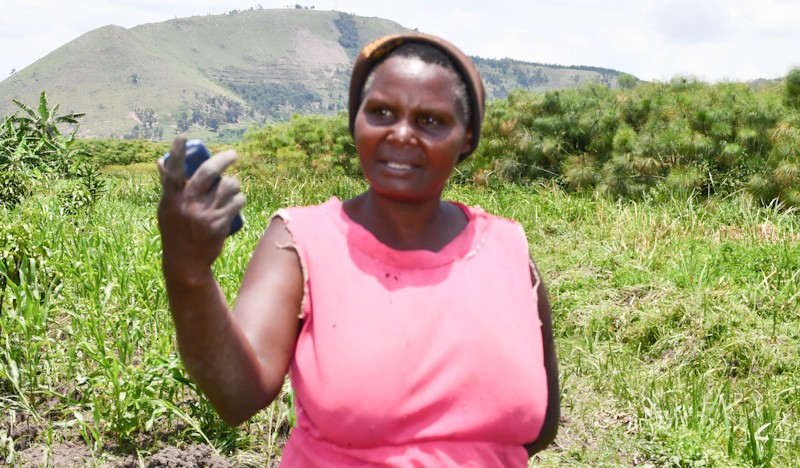
According to Nabimanya, women are benefiting from the project more, especially since they are now able to sustain their households, as women are at the forefront of household welfare. “I can assure you women are very happy with this project because they can borrow money and meet family needs like salt, soap and even sauce. Some have gone as far as doing piggery farming, goat rearing, using the funds accessed from the groups,” she said. Her view is supported by a fifty–year–old widow, Ms. Enid Kyomugisha, and a mother of four (2boys and 2girls). “The project is helping us a lot, for me as a widow. I don’t know what I would have done if it were not for this credit facility,” Kyomugisha notes.
Ms. Enid Kyomugisha, a mother of four, speaks about the benefits she is receiving from the project as a widow.
Whilst, Nabimanya is happy and optimistic of a bright future, challenges accessing adequate funds to meet her dream, continue to worry her. She believes she can do a lot more, but the limited funds are hindering her from achieving her full potential. Nabimanya hopes to become a model in promoting conservation as she demonstrates that wetlands can co-exist with humans and that wetlands can provide more than the community can imagine.
“I want to demonstrate to other youth that as future leaders and stewards of natural resources, we can do better in ensuring sustainable use of natural resources than degrading them. There are many youth who have dropped out of school, like me, who think they can only get their livelihood through degrading wetlands. I think this is wrong. I believe that if supported to engage in other alternative activities, we can make more money. For me, returning to the wetlands is no option. I want to work hard and expand my tailoring business. I want to share my skills with other youth in my community. In turn, we can be able to dissuade many from environmental degradation. My appeal to the government and development partners is that people like me can be mobilised and given more financial support to develop more resilience so we can adapt to climate change impacts,” Nabimanya contends.
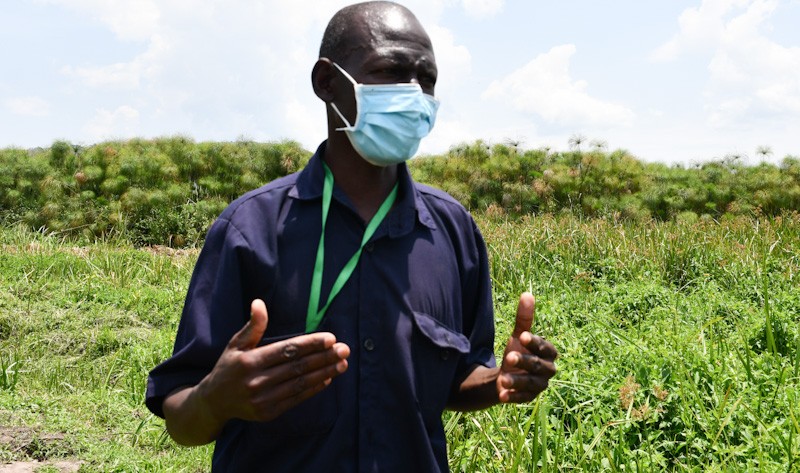
Mr. Julius Tumusiime, Chairperson of the group, explains the benefits community members are getting from the Nyakambu wetland.
Indeed, wetland degradation is no longer fashionable among Nyakambu community members, going by the current level of benefit they are enjoying. Mr. Julius Tumusiime, the Chairperson of Masheruka Environmental Restore Wetlands and Disaster Monitoring Committee and Cadres Association, agrees that the level of benefit is extremely exciting. Both men and women have a responsibility to monitor the utilisation of the restored Nyakambu wetland, giving every community member a chance to benefit from the restored ecosystem, according to Tumusiime.
For instance, the community members neighbouring Nyakambu wetland are now able to harvest up to 400 Trucks of grass per year. The grass is sold to outside communities for mulching banana plantations. Each lorry costs UShs180,000 (USD 49), meaning every year the community earns approximately UShs 72m (USD 19,460) annually, a case that was not possible previously before Nyakambu was restored. This has tremendously improved the agricultural productivity.
In addition, the community also harvests 500 containers of mudfish daily. Each container contains up to 150 mud fish. Each container can produce approximately 5 sticks when packaged. Each stick containing 30 mud fish is sold at Ushs 2800 (USD 0.75).
This, as well, gives a daily community earning of Ushs 7m (USD 1,891.8), giving an annual earning of Ushs 2,352bn (USD 635,675). The regeneration of the ecosystems at Nyakambu wetland and the current benefit community members are enjoying, therefore, build a strong case why the government of Uganda has embarked on restoring all degraded wetlands. (For comments on this story, get back to us on 0705579994 [WhatsApp line], 0779411734 & 041 4674611 or email us at mulengeranews@gmail.com).