






By Ben Musanje
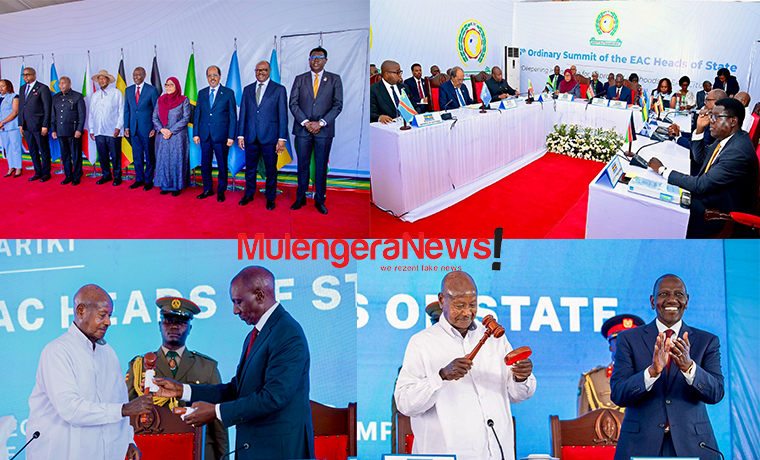
Ugandan President Yoweri Kaguta Museveni was on Saturday, 7 March 2026 officially taken over as chair of the East African Community (EAC), replacing Kenyan President William Ruto. The leadership change took place during the EAC Summit of Heads of State and Government in Arusha, Tanzania. Museveni thanked Tanzanian President Samia Suluhu Hassan for hosting the summit and expressed appreciation to the outgoing chair for guiding the EAC over the past year.
In his first address as chair, Museveni outlined his main priorities, focusing on unity, economic growth, and security. He said that the success of East Africa depends on stronger cooperation among member states. A bigger regional market is crucial, he noted, because businesses need enough buyers to expand, produce more goods, create jobs, and generate government revenue. Failing to integrate economies, he warned, could lead to slow growth, limited opportunities, and more young people leaving the region in search of work.
Museveni also emphasized political integration as a way to strengthen strategic security. He explained that East Africa must coordinate defenses across land, air, and sea, and even prepare for challenges in space. He added that the region’s size, population, and resources give it the potential to protect its people and compete globally. According to him, internal markets are just as important as foreign markets for attracting investment and sustaining economic growth.

During his address, Museveni reflected on Africa’s history, explaining how past leaders missed opportunities to unite and modernize. This allowed colonization, the slave trade, and exploitation to take hold. He praised the resilience of African populations who survived centuries of hardship and the role of Pan-Africanists and liberation movements, including those in Tanzania, Ghana, and South Africa, in achieving independence. By 1994, most African nations had gained freedom, with South Africa becoming a symbol of victory over oppression.

The president also appealed to the youth of East Africa to focus on unity and development rather than unrest. He recounted meeting young people claiming expertise in organizing riots and encouraged them to put their energy into building the region’s future. He warned that discord and division would harm development and limit opportunities for millions of people.
Museveni highlighted the need for member states to fully implement the EAC charter and roadmaps for regional cooperation. He also called for commitment to broader African initiatives such as the Common Market for Eastern and Southern Africa (COMESA) and the African Continental Free Trade Area (AfCFTA). He stressed that integration is not optional but essential to avoid marginalization and ensure East Africa can compete in the global economy.
He concluded that East Africa has the potential to create prosperity and secure strategic safety if countries unite politically and economically. Strong integration, Museveni said, will help the region protect itself, expand businesses, provide jobs, and improve living standards for millions. He urged immediate action, reminding member states that a united East Africa can achieve far more than nations acting alone.

By putting unity, economic growth, and security first, Museveni’s leadership as EAC chair seeks to strengthen the region, empower its people, and secure East Africa’s future in a competitive world. (For comments on this story, get back to us on 0705579994 [WhatsApp line], 0779411734 & 041 4674611 or email us at mulengeranews@gmail.com).