





By BM
In a bold and clarifying message, the Electoral Commission (EC) has outlawed all fundraising and donation activities in places of worship during the ongoing election period, warning that such acts amount to indirect voter bribery and compromise the integrity of Uganda’s democratic process.
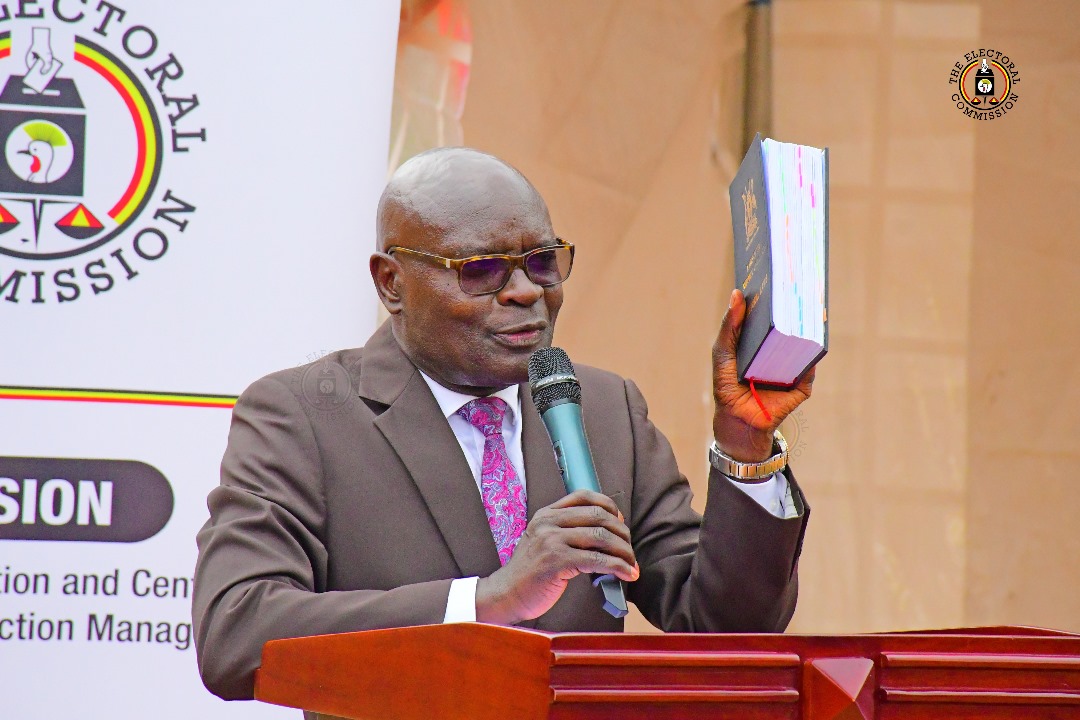
During a press briefing in Kampala, EC Chairman Justice Simon Byabakama urged religious leaders and political aspirants to refrain from using churches, mosques, or community gatherings as platforms for fundraising or donations.
He explained that under the law, such acts could be interpreted as attempts to influence voters.
Byabakama acknowledged that elections naturally require substantial resources for example, to facilitate agents, fund transport, and run campaigns.

However, he clarified that only funds used for campaign logistics are permitted.
Giving money to voters with the intention of swaying their electoral choices, he said, was strictly prohibited and constituted a breach of electoral laws.
He further pointed out that political parties are allowed to raise money to support campaign operations, including fuel, mobilization, and agent facilitation.
What is not allowed, he emphasized, is the distribution of money or donations that could be perceived as influencing voter decisions under the guise of charity or development support.

In a move aimed at reinforcing the directive and fostering cooperation, the EC also revealed plans to hold consultations with the Inter-Religious Council of Uganda (IRCU).
The meeting is intended to engage faith leaders on the importance of maintaining neutrality in places of worship during the election period and ensuring that their platforms are not exploited by political aspirants for campaign advantage.
The Commission believes that working with the IRCU will help raise awareness among religious institutions across the country and strengthen compliance with the new directive.
Byabakama said such engagement was essential in protecting the dignity of both faith and electoral processes.
He warned that turning places of worship into donation grounds during campaigns could pressure aspirants into giving money, which might then be viewed as vote-buying.
In a strong legal caution, Byabakama added that any candidate or political agent found engaging in such donation or fundraising activities within religious institutions could be charged with voter bribery, which is a criminal offense.
He said such incidents would be referred to the police for investigation and prosecution, underscoring that electoral malpractice would not be tolerated.
The EC addressed concerns about religious institutions missing out on vital contributions during this period.
Byabakama advised that religious fundraising activities be postponed until after the elections.
He reasoned that if certain religious buildings or projects had remained incomplete for several years, pausing donations for four months would not cause significant harm.
The EC’s directive forms part of a wider effort to protect the neutrality of religious spaces and ensure a level playing field for all candidates.
The Commission emphasized that upholding the sanctity of both the electoral process and houses of worship was critical for Uganda’s democracy.
Observers from civil society welcomed the move, viewing it as a necessary step to curb vote-buying and reduce the influence of money in politics.
However, some religious leaders expressed concerns that the ban might negatively affect development initiatives that rely on contributions from well-wishers, including political figures.
Despite the mixed reactions, the Electoral Commission insisted on compliance, stating that the law must be upheld by all stakeholders whether political actors, religious leaders, or voters.
Justice Byabakama concluded by appealing to Ugandans to avoid actions that could undermine the credibility of the elections, stressing that safeguarding electoral integrity was a collective responsibility.
As the countdown to Uganda’s most competitive election in years continues, the EC’s directive has redrawn the boundaries between politics and the pulpit and put candidates on notice: the vote is not for sale. (For comments on this story, get back to us on 0705579994 [WhatsApp line], 0779411734 & 041 4674611 or email us at mulengeranews@gmail.com).