





By Dr. Julius Babyetsiza
Uganda’s aspiration to transform its economy into a $500 billion economy within the next decade represents one of the most ambitious development goals in the country’s history. Achieving such a transformation requires more than macroeconomic reforms and large-scale infrastructure investments. It requires the systematic mobilization of grassroots productive capacities across the country. One approach that offers this potential is the resource mapping model advanced by Global University Business Club Limited (GUBCCo), which proposes that sustainable economic transformation must begin with identifying and organizing resources at the village, parish, and sub-county levels.
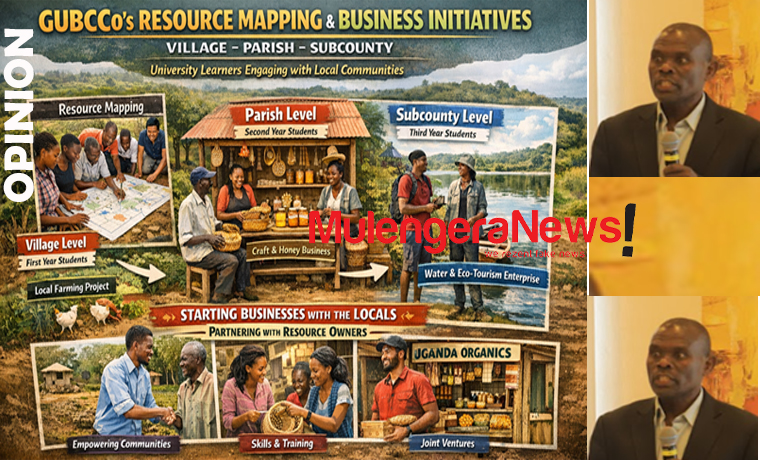
Resource mapping, in the GUBCCo framework, involves a systematic identification of the natural, human, institutional, and infrastructural resources available within a community. These include agricultural products, land, water sources, artisanal skills, local enterprises, tourism sites, and social institutions. Through GUBCCo’s proposed structure, where university students in Years One, Two, and Three conduct resource mapping exercises at the village, parish, and sub-county levels respectively, these resources are systematically documented and analyzed to identify business opportunities and appropriate development interventions as shown in the infographic below. The immediate outcome is the generation of locally grounded enterprise initiatives, but the broader impact is the creation of powerful multiplier effects across multiple sectors of society.

In the economic sector, the direct impact of resource mapping is the identification of productive assets that may previously have been underutilized or overlooked. Communities begin to recognize their economic potential by understanding what they possess and how these resources can be organized into productive ventures. For example, a village that maps high levels of banana production may identify opportunities for banana flour processing, juice production, or fiber extraction. This initial recognition of opportunity stimulates entrepreneurship and enterprise formation.
As enterprises emerge, employment opportunities expand, household incomes increase, and local markets grow. Over time, the multiplier chain unfolds: resource identification leads to enterprise creation; enterprise creation leads to employment; employment increases purchasing power; and increased purchasing power stimulates broader economic activity. When replicated across thousands of communities, this process contributes to national economic diversification and growth, as such, an essential component of Uganda’s journey toward a $500 billion economy.
Requiring resource mapping at the village, parish, and sub-county levels by every university, undertaken by students in Year One, Two, and Three respectively, will ensure that no sector is left lagging behind. For instance, public health sector also benefits significantly from resource mapping. During the mapping process, communities identify health-related resources and risks, including water sources, sanitation facilities, health centers, and environmental hazards such as stagnant water or poorly managed waste sites. The direct impact is improved knowledge about the distribution of health risks and health services within the community. This knowledge enables targeted public health interventions. For example, identifying contaminated water sources may lead to the construction of protected wells or boreholes.
As these interventions take effect, sanitation improves, waterborne diseases decline, and community health outcomes improve. The multiplier effect becomes evident as healthier populations are able to participate more actively in economic activities, children attend school more regularly, and household healthcare expenditures decrease. In the long term, improved public health strengthens the quality of human capital, which is indispensable for sustained economic transformation.


Resource mapping also strengthens governance by enhancing citizen participation in development planning. When communities collectively identify and document their resources, they become more aware of their development priorities and more capable of engaging with local government institutions. This process transforms citizens from passive recipients of government programs into active participants in development decision-making. The immediate outcome is greater transparency in local planning processes, as community members possess documented evidence of local needs and opportunities.
Over time, this participation strengthens accountability mechanisms within local governance structures. The multiplier chain unfolds through participatory mapping leading to informed citizen engagement, which in turn strengthens accountability and improves policy implementation. The long-term structural outcome is a governance system that is more inclusive, responsive, and evidence-based. These are qualities that are critical for sustaining large-scale economic transformation.
Infrastructure development and mobility also benefit from the insights generated through resource mapping. One of the most common constraints to rural economic development in Uganda is the lack of adequate transport infrastructure linking production areas to markets. Resource mapping makes these gaps visible by highlighting the locations of agricultural production zones, markets, processing centers, and transport routes. The direct impact is the identification of infrastructure deficits such as poor feeder roads, limited storage facilities, or weak transport connectivity.
With this information, local governments and development partners can prioritize infrastructure investments that directly support productive activities. For example, a resource map that identifies a major coffee-producing area may justify the rehabilitation of feeder roads connecting farmers to processing facilities and markets. Improved mobility reduces transportation costs, increases market access, and stimulates trade. Over time, improved connectivity integrates rural economies into regional and national markets, strengthening Uganda’s competitiveness in regional and global value chains.
Another critical dimension of the multiplier effect relates to investment and capital formation. Investors often hesitate to commit resources in regions where reliable information about economic opportunities is limited. Resource mapping helps to address this challenge by generating credible data about local resources, production potential, and enterprise opportunities. The immediate effect is improved visibility of investment opportunities. When investors have access to clear documentation of local resources and value chains, their confidence increases. This leads to greater capital inflows into productive sectors such as agriculture, agro-processing, tourism, and manufacturing.
As enterprises expand through new investments, employment increases, supply chains strengthen, and productivity improves. Over time, communities with well-documented resources become attractive destinations for both domestic and international investors. This accumulation of capital contributes significantly to industrialization and long-term economic growth.
The true strength of the GUBCCo resource mapping model lies in the interconnected nature of these sectoral impacts. Economic growth improves public health by increasing household income and enabling greater investment in health services. Improved governance ensures that infrastructure investments align with community priorities and productive sectors. Enhanced mobility attracts investment by reducing logistical barriers and improving market access. Investment, in turn, fuels further economic expansion and job creation. Each sector reinforces the others, creating a powerful cycle of development that amplifies the impact of the initial resource mapping exercise.
When implemented systematically across Uganda’s villages, parishes, and sub-counties, the GUBCCo model has the potential to transform potential grassroots knowledge into a national development engine. Each mapped resource, each identified enterprise opportunity, and each community-driven initiative becomes part of a larger economic ecosystem. Thousands of micro-level enterprises collectively contribute to national productivity, employment creation, and export growth.
Uganda’s ambition to achieve a $500 billion economy will ultimately depend on how effectively the country mobilizes its local resources and entrepreneurial potential. The resource mapping model championed by GUBCCo demonstrates that the path to national prosperity needs to begin at the community level. By systematically identifying and organizing local resources, Uganda can unlock the latent economic potential embedded within its villages and communities. In doing so, the country can build a development model in which grassroots productivity forms the foundation of national economic transformation. Bowling together. The writer, Dr Julius Babyetsiza, is the founder Global University Business Club Limited (GUBCCo), and Inclusive Policy Dialogue (IPD) Joint Chair. (For comments on this story, get back to us on 0705579994 [WhatsApp line], 0779411734 & 041 4674611 or email us at mulengeranews@gmail.com).