






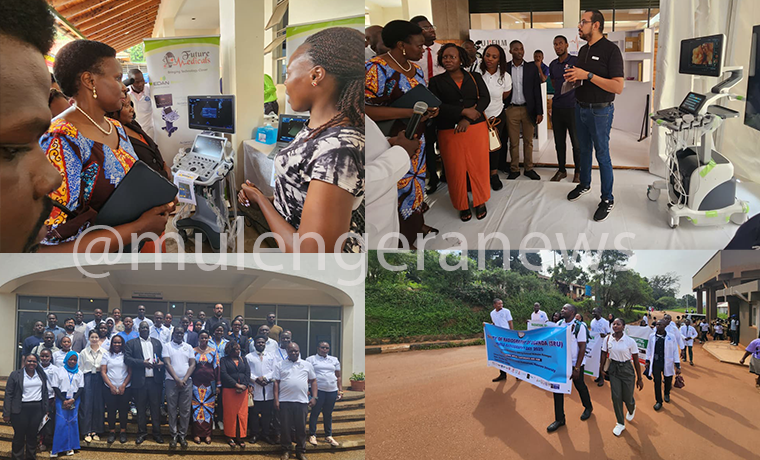


The Society of Radiographers of Uganda has urged the government to expand funding for diagnostic imaging services, recruit more qualified professionals, and crack down on unqualified practitioners who continue to exploit patients in unregulated facilities across the country.This call was made during the commemoration of World Radiography Day held at Makerere University College of Food Science and Nutrition Auditorium.This year’s celebration, held under the theme “Medical Imaging Professionals Partnering for a Healthier Future,” began with an awareness walk from Wandegeya to Makerere University and brought together stakeholders from government, academia, and the private health sector.
Speaking at the event, Micah Muhangi, the President of the Society of Radiographers of Uganda, said the country cannot achieve accurate diagnosis and safe imaging services without more investment and regulation.
“We are trying to do awareness about the profession,” Muhangi said. “When you are worked on by a person who is not qualified, you end up spending more, taking wrong drugs, and sometimes even changing your medical history because of wrong diagnosis.”
Muhangi revealed that the Society has resolved to introduce a radiation safety officer’s fee to ensure that all facilities operating X-ray and CT scan machines adhere to safety standards.
“These professionals ensure that the machine is not harming the patient and is being used in the right way,” he said.
“We are proposing a fee of about 2.4 million shillings, renewable every two years, to support these safety officers.”
He also called on government to increase the budget for recruitment of radiographers and other imaging technologists.
“Right now, some hospitals have only one person running ultrasound, X-ray and CT scan at the same time,” Muhangi said.
“That’s why the service in government hospitals is often slow—because our people are few and exhausted,” he added.
Muhangi emphasized that CT scans in private facilities cost almost twice what government hospitals charge, making affordability a serious concern.
“In government hospitals, a CT scan costs about 120,000 shillings, but in private clinics, the cheapest is 200,000,” he noted. “Government should equip and staff its facilities so that ordinary Ugandans can get affordable services.”
Muhangi further appealed to Ugandans to seek proper diagnosis before taking any medication.
“Before you take any medicine, at least first have some tests done,” he said. “Medicine is about finding the cause; when you know the cause, you get the right treatment.”
Prof. John Charles Okiria, the Chairperson of the Uganda Allied Health Professionals Council, warned the public against unqualified individuals masquerading as medical imaging professionals.
“Currently in town, we have people sitting in verandas with small computers claiming to diagnose 60 diseases and prescribe treatment. Those are quacks,” Prof. Okiria said. “There is no such a machine that can detect diseases like that.”
He urged the public to verify licenses before receiving any diagnostic service.
“Health is not a gamble for everybody,” he stressed. “If you are not qualified to take imaging services, this is a no-go area.”
Prof. Okiria emphasized that accurate diagnosis is the foundation of effective treatment.
“The accuracy and precision of diagnosis for better treatment is a result of precise investigations,” he said. “Once you identify the disease and its cause, then the clinician can prescribe accurately.”
He said the council is ensuring professional and ethical standards through continuous professional development (CPD) and regional oversight.
“We continuously hold meetings and trainings like this to refresh our personnel,” Prof. Okiria said. “Patient care is a calling, not a business.”
Delivering a message from the Permanent Secretary of the Ministry of Health, Dr. Diana Atwine, the Commissioner for Laboratory and Diagnostic Services, Dr. Susan Nabadda, reaffirmed government’s commitment to upgrading imaging standards and embracing tele-radiology.
“Medical imaging bridges the gap between clinical suspicion and diagnosis,” Dr. Nabadda said. “Whether it’s an X-ray in a rural health center or an MRI in a referral hospital, the results must lead to timely and accurate treatment.”
She acknowledged that Uganda’s imaging standards are outdated, dating back to 2012.
“We have promised ourselves that by the end of 2025, we must have new standard guidelines that guide modern imaging,” she said.
Dr. Nabadda revealed that the Ministry has established a tele-radiology center at Mulago, which supports regional hospitals that lack radiologists.
“Images captured in regional hospitals are sent electronically to Mulago, where standby radiologists help read and return results,” she explained. “This ensures patients in remote areas also get accurate diagnoses.”
She also called for integrity and professionalism among radiographers.
“Technology alone cannot deliver quality care,” she cautioned. “It needs commitment, skill, and ethics. Please uphold your integrity and professionalism—patient care depends on it.”
Midari Awuche, the Northern Regional Coordinator for the Society of Radiographers of Uganda, highlighted challenges affecting the profession, including low pay, limited recruitment, and brain drain.
“We are still few in number, and our remuneration varies widely,” Awuche said. “Government uptake of graduates is very low, especially those with bachelor’s degrees.”
He said the shortage of qualified staff has created space for unskilled workers to infiltrate the profession.
“Because we are few, quacks have taken up some positions, especially in rural areas, damaging the image of our profession,” he added.
Awuche urged government to absorb more professionals and promote awareness of the field in schools.
“Many students don’t know that radiography is the science behind scans,” he said. “We act as the eye of medicine—we see what others cannot see.”
He noted that poor motivation and limited opportunities have forced many professionals to seek work abroad.
“There’s a lot of brain drain in radiology,” Awuche said. “Every month, professionals move out of the country looking for greener pastures because government has not absorbed them.”
The World Radiography Day is celebrated globally every 8th November, marking the 1895 discovery of X-rays by German physicist Wilhelm Röntgen. (For comments on this story, get back to us on 0705579994 [WhatsApp line], 0779411734 & 041 4674611 or email us at mulengeranews@gmail.com).