





By Aggrey Baba
The Electoral Commission’s recent decision to revise the 2026 general election roadmap has triggered a sharp response from political parties, with opposition groups criticising the move while NRM has welcomed it.
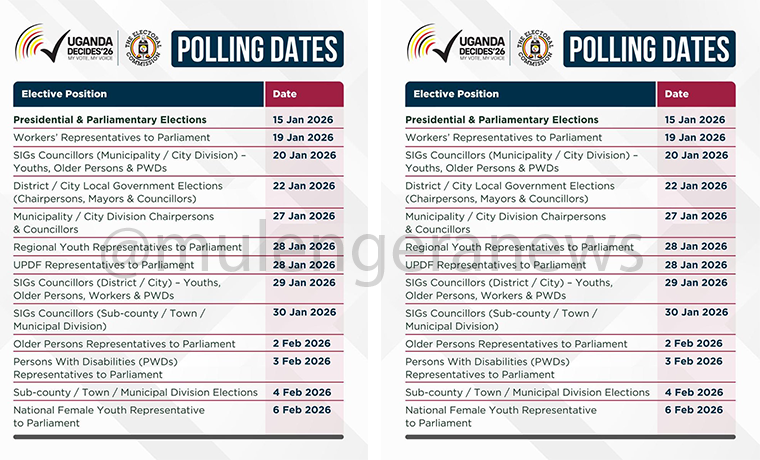
The adjustments affect nomination dates for presidential, parliamentary, and district chairperson positions.
According to the initial roadmap, presidential nominations were scheduled for October 2–3, parliamentary nominations for September 17–18, and LC5 chairpersons between September 3–12.
However, under the new plan, presidential nominations will now take place earlier, on September 23–24, while MPs will be nominated later, on October 15–16. District chairpersons are to be nominated between September 8–10.
NUP Secretary General, David Lewis Rubongoya, said the changes disrupt party planning and introduce unnecessary uncertainty, explaining that political parties had already aligned their activities and logistics to the previously announced schedule, and the Commission’s continued adjustments make it difficult to maintain a consistent campaign strategy.

He further expressed concern that the EC did not consult parties before revising the roadmap, despite having had five years to prepare for the election.

Kira Municipality MP, Ibrahim Ssemujju Nganda who also doubles as the spokesperson for the newly formed People’s Front for Freedom (PFF), also voiced concern over the adjustments.
He pointed out that such changes have historically been made to benefit the ruling NRM, and this time was no different.
He added that the revisions create practical challenges for candidates and parties, including the need to rebook venues, transport, and campaign services. He warned that failure to consult political actors not only undermines confidence in the process but also suggests that EC itself is uncertain about its own programme.
In contrast, the National Resistance Movement welcomed the revised roadmap.
Dr. Tanga Odoi, chairperson of the NRM’s Electoral Commission, said the changes were helpful and would enable the party to conduct its internal processes more efficiently, confirming that the party is already on course with its preparations, including nominations for local council positions, which are expected to take place on August 14.
The son of Tororo soil added that the extended timelines would help the party address any outstanding disputes from the primaries and organise its flag bearers without pressure.
Justice Simon Byabakama, chairperson of the Electoral Commission, explained that the initial roadmap had been overly ambitious, saying that conducting nominations for MPs and councillors on the same days would have caused logistical challenges at EC offices. The revised dates, he explained, were introduced to spread out the workload and avoid administrative congestion.
He stressed that the changes were not due to disorganisation, but rather a practical decision to improve the overall management of the nomination process. Byabakama confirmed that the nomination forms and guidelines are already available at district offices and that the presidential dates had not been changed.
The Commission’s position is that the adjustments will ensure a smoother nomination exercise, but the opposition continues to question the timing and the lack of prior consultation. With campaigns intensifying ahead of the 2026 elections, the credibility and independence of the Electoral Commission remain a central concern for several political actors.