







By BM
The National Identification and Registration Authority (NIRA) has called on Ugandans to collect their national identity cards, revealing that more than five million IDs have already been produced and dispatched to districts across the country.
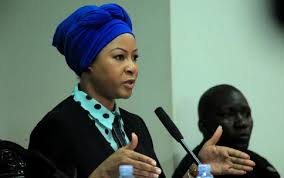
During a press conference at the Police Headquarters in Naguru, Claire Ollama, the registrar of NIRA, explained that while production and distribution are progressing steadily, citizen response in collecting their cards has been slow.
She noted that the mass enrollment exercise had shown impressive results and that feedback from citizens was beginning to come in, indicating that many Ugandans were now starting to receive their national IDs.

Production, she said, was in high gear, with over five million cards produced and sent to districts nationwide.

Ollama provided detailed figures for each district to illustrate the progress.
She reported that Abim had received 8,141 cards, Adjumani 27,000, Agago 11,800, Alebtong 25,000, Amolatar 14,000, Amudat 9,000, Amuria 13,000, Amuru 15,000, Apac 17,700, Arua 16,000, and Arua City 43,500 cards, continuing with a comprehensive list covering the entire country.
The Registrar also mentioned that Ugandans abroad had cards ready, including 200 for Australia, 50 for Belgium, and 546 for Kenya.

Despite the extensive distribution, Ollama expressed frustration over the low collection rates, noting that citizens had been asking where their cards were.
She explained that the cards were already in the districts and that, citizens needed to go to their local NIRA offices to collect them.
Ollama emphasized that because registration occurred over a period of time, it was impossible for everyone to receive their cards on the same day, describing the issuance as a process.
She urged district leaders and citizens to inform people in their areas that their national identification cards were ready for collection, stressing that the cards should be picked up promptly.
The registrar also unveiled the new national ID card format, highlighting its improved security features.
She explained that the new cards had engraved images to prevent tampering and included ghost images within the card for added verification.
She added that a glittery image was visible when the card was tilted, which could also be seen under purple light in banks.
A barcode had been incorporated to help detect fake cards, as machines would immediately reject any forged card.
Ollama noted that the new cards were more inclusive for visually impaired citizens, as the names were embossed so that blind people could feel and identify them.
She also warned against using middlemen to process national IDs, stating that citizens did not need anyone else to register or verify their information.
Ollama reminded the public that NIRA’s services were free and encouraged citizens not to pay for registration or replacement forms.
She gave an example of someone selling forms for 10,000 shillings, even though printing a page cost only 300 shillings, urging people to print forms themselves or collect them directly from NIRA offices.
Ollama stressed that NIRA staff were public servants recruited to serve citizens, urging the public to confidently approach offices for guidance and services.
She concluded by urging Ugandans to collect their cards promptly, noting that the success of the national ID project depended on citizens’ active participation.
She described the national ID as a key to services, opportunities, and citizenship, and emphasized the importance of collecting it. (For comments on this story, get back to us on 0705579994 [WhatsApp line], 0779411734 & 041 4674611 or email us at mulengeranews@gmail.com).