








By Ben Musanje
For decades, Yivu Secondary School, government aided institution at Yivu SS Village, Alikua Parish , Alikua Sub-County in Maracha district battled an invisible enemy that wrecked lessons, fuelled unrest, and quietly endangered its students: a chronic lack of safe water.
What seemed like a simple shortage spiraled into a full-blown academic and social emergency, until a new solar-powered water project transformed the school almost overnight.
Modest Bandale, the school’s Director of Studies, has lived through the worst of it. With only one borehole, shared by both students and the surrounding community learners often queued for hours or trekked to unsafe streams to fetch water.
Those desperate trips opened the door to disease outbreaks, community conflicts, and risky encounters, particularly for girls who were exposed to harassment and unhealthy relationships on their way to distant water points.

Discipline collapsed as students slipped out of school under the pretext of fetching water, returning late or not at all. Even basics like cooking meals on time became impossible, throwing the entire school program into disarray.
Bandale recounts how the school’s hygiene deteriorated so badly that uniforms stayed dirty, toilets were unusable, and illnesses like dysentery, cholera, diarrhea, and schistosomiasis surged. At times, the school nurse worked nonstop as hundreds of learners battled water-related ailments. The school’s academic rhythm and its reputation were under strain.
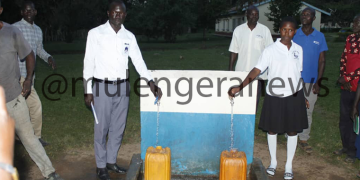
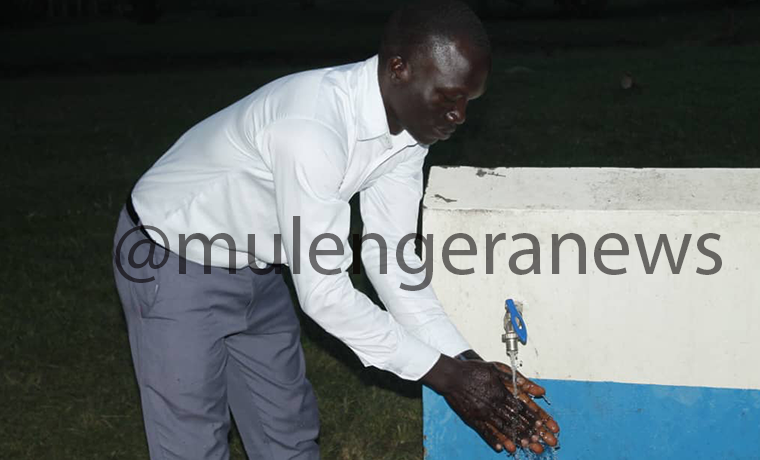
That history makes the difference today almost unbelievable. With the arrival of a piped solar-powered water extension into the school compound, timekeeping has stabilized.
Meals are prepared on schedule. Students stay on school grounds instead of wandering off. Sanitation has improved dramatically, and hygiene-related diseases have plunged.
Bandale says even the community conflicts that once flared around the borehole have vanished, since learners now rely mostly on the new in-compound supply.

The students themselves say the impact is even more profound.
Head Prefect Morish Adrapi remembers days when boys would hike to distant rivers just to bathe, arriving late to classes and enduring reprimands.
The lack of safe water left classrooms filled with unpleasant odors, made concentration difficult, and contributed to widespread ulcers and constant nurse visits. The borehole’s iron-rich water only worsened the health crisis. Today, he says, the school runs smoother though he notes that an additional water point would ease congestion during weekends and meal preparation hours.
Head Girl Winny Neva describes the transformation for girls as “life-changing,” especially after years of facing uncomfortable interactions and conflicts with community members at distant water sources. With water now available inside the compound from morning to night, girls can wash their uniforms, bathe, clean their spaces, and stay safe—without stepping beyond school boundaries.
This revived stability supports a school that has been shaping Ugandan professionals since 1984, producing figures such as Dr. Amabayo, now an associate professor and Head of Physics at Busitema University, and several district leaders from the region.
The lifeline behind this turnaround is part of a massive national effort: one of the 450 solar-powered water supply and irrigation schemes installed across Uganda by the Ministry of Water and Environment through Nexus Green Limited, following President Yoweri Museveni’s directive to expand water access in remote and drought-prone areas.
Yivu Secondary School is powered by the Lamila (Orafia New BH) Solar Water Supply Project serving more than 3,600 people in Alikua Sub-county.
With 54 solar panels, an 80-cubic-meter reservoir, and the capacity to pump 87.5 cubic meters of water daily, the system has replaced years of struggle with steady, clean, reliable water.
For Yivu Secondary School, what once caused conflict, disease, academic disruption, and anxiety has become a symbol of renewal. And for hundreds of learners who now move through their school day cleaner, healthier, and safer, the change is nothing short of a rescue. (For comments on this story, get back to us on 0705579994 [WhatsApp line], 0779411734 & 041 4674611 or email us at mulengeranews@gmail.com).