









 By Mulengera Reporters
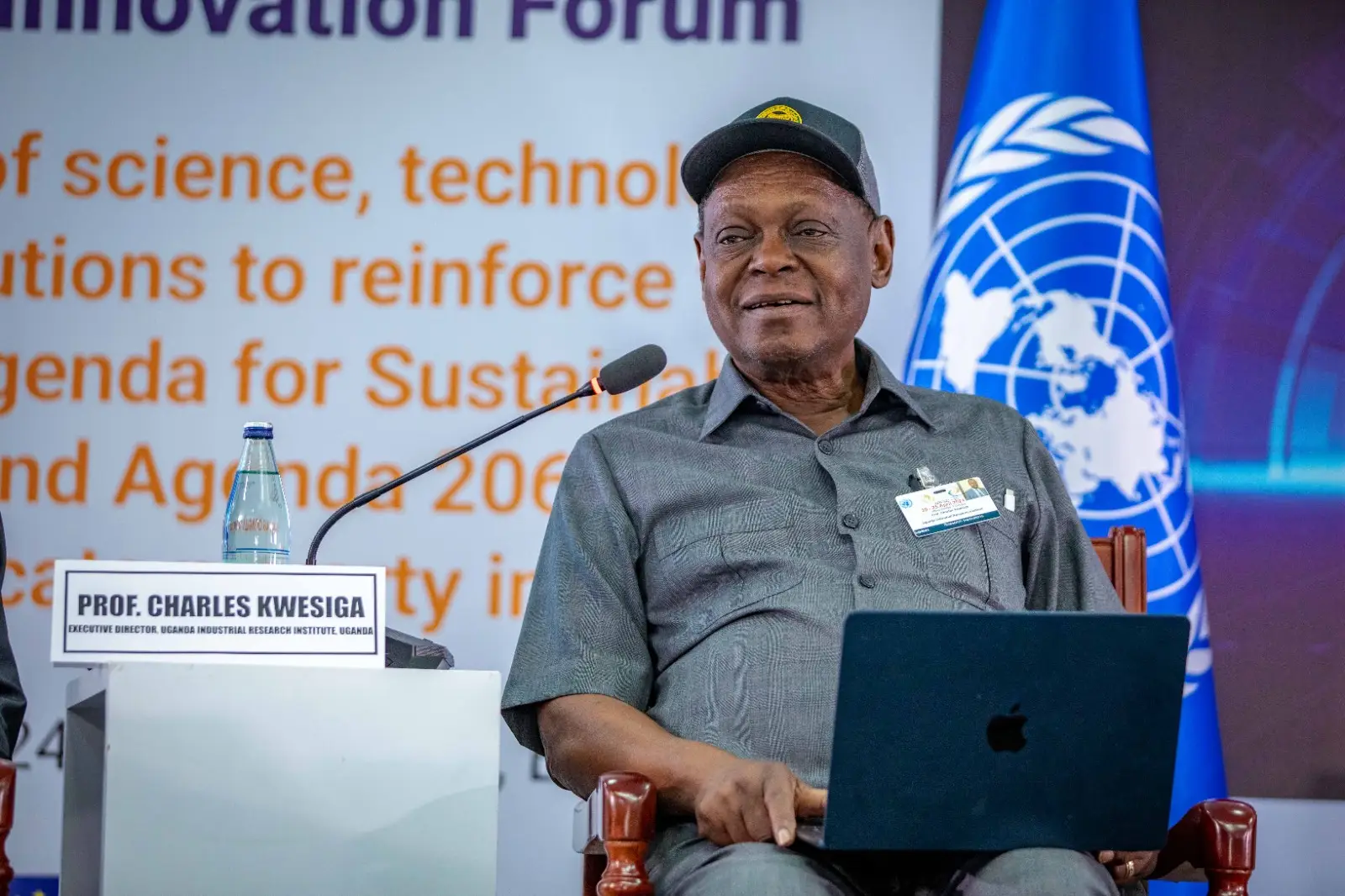
 Prof. Charles Kwesiga, the Executive Director (ED) of the Uganda Industrial Research Institute (UIRI), has urged Uganda’s engineers to embrace resilience, innovation and practical application of technology if the country is to achieve meaningful industrial growth.
He made the call on Friday at Kyambogo University, where he was chief guest at the Women in Engineering Conference, an annual gathering that brought together engineers from government and private sector entities, professors, and student engineers from different universities.
Kwesiga used the platform to remind participants that modernity cannot be achieved without innovation. Drawing from his own experience, he recounted how technology has rapidly evolved, from the days of logarithm tables and slide rules to the age of real-time computing.
As an engineering student in the United States of America (USA) he struggled at first with computers but went on to master programming and even teach it within two years.
He told young engineers that the lesson is that resilience and determination are critical in keeping pace with global technological change.
The ED shared practical examples from his leadership at UIRI, explaining how he found the institution under difficult circumstances but quickly turned it into a centre of excellence.
One of his major interventions was the creation of an Instrumentation Unit. Before this, he said the institute used to bring a technician from Egypt to repair and (or) service a certain machine in the chemistry lab whenever it got a problem.
After realizing how slow and expensive it was, the professor suggested that instead of the technician flying in physically, they could start doing it on teleconferencing as he was sure that his team here was bright enough to work it out and indeed it worked.
Kwesiga said Instead of relying on foreign technicians, he recruited a team of five (5) bright young Ugandan engineers (including graduates from Kyambogo University) and challenged them to convert their theoretical knowledge into practical solutions.
This resulted into the team developing an ECGF device, a gadget designed to monitor and regulate intravenous medication. This innovation cuts down human error in administering treatment.
Kwesiga said it went on to win an international recognition in California, which according to him, was proof that Ugandan engineers can deliver innovations of global standard when given the opportunity and support.
He also recounted the story of one of the young engineers, a Kyambogo graduate he mentored (part of the five he had recruited), who after completing a master’s degree in the UK, was hired by Rolls-Royce.
While he felt disappointed at losing such talent, Kwesiga said it was also a moment of pride, showing that Ugandan engineers can compete on the world stage if nurtured well.
The ED pointed to larger national initiatives under UIRI, such as the 15-acre Industrial Skills and Research Centre at Namanve, which was commissioned by President Yoweri Museveni in 2021.
The facility is aimed at addressing gaps in human capital development and appropriate technology, giving Ugandan engineers the platform to experiment, learn and produce solutions for local challenges.
He went further to highlight ongoing research at UIRI, including work on locally produced glucose monitoring sensors. He said he wears these around his chest, connect them with his cellphone and they help monitor his glucose, hypatention and sugar levele.
Currently, imports the devices from abroad at high cost, yet Ugandan scientists have the capacity to develop them locally. These devices, he said only works for fourteen (14) days.
According to him, producing them here would not only cut costs but also improve access to essential health technology.
In his address, Kwesiga cautioned engineers against embarking on projects that remain incomplete, which he termed “bridges to nowhere.”
Using the example of an abandoned flyover in Cape Town, he stressed that the engineers must adopt a culture of finishing what it starts.
The Women in Engineering Conference provided a critical platform for these reflections. With many young engineers in attendance, the message was that Uganda’s path to industrialization lies not only in policy but in the practical commitment of its technical workforce.
For Prof. Kwesiga, Uganda’s engineers already possess the intelligence and talent needed. What remains is determination, resilience, and a focus on applying knowledge to solve real problems.
With the right mindset and institutional support, he said, Uganda can build technology that competes internationally, while also transforming industries at home. (For comments on this story, get back to us on 0705579994 [WhatsApp line], 0779411734 & 041 4674611 or email us at mulengeranews@gmail.com).