








By Guest Writer
The Government of Uganda has acknowledged that Gender-Based Violence (GBV) poses a significant challenge to the country’s efforts toward sustainable natural resource management.
“We recognise that GBV directly affects our conservation initiatives. In most cases, the victims are women, youth, and persons with disabilities,” said Mr David Okurut, Acting Director of the Department of Environment Affairs (DEA) at the Ministry of Water and Environment.
Mr Okurut noted that women and youth constitute the largest proportion of wetland users in Uganda, making the integration of GBV prevention into conservation programmes a government priority.

“Natural resources are a sensitive issue. In many instances, men claim ownership of wetlands and are often at the forefront of degradation. However, it is women, youth, and persons with disabilities who are actively working in these wetlands and, in the process, become part of the degradation chain,” he explained.
He further emphasised that limited knowledge of GBV prevention continues to undermine government initiatives such as the promotion of alternative livelihoods aimed at ensuring sustainable resource use.
Mr Okurut recommended that GBV prevention and response measures be integrated across the 24 districts implementing the Building Resilient Communities, Wetland Ecosystems and Associated Catchments in Uganda project.
Through the Ministry of Water and Environment (MWE), in partnership with the Ministry of Agriculture, Animal Industry and Fisheries (MAAIF), the government is providing alternative livelihoods to communities voluntarily vacating wetlands in 24 districts of south-western Uganda (Mitooma, Bushenyi, Rukungiri, Sheema, Rubanda, Rukiga, Ntungamo, Kisoro, Buhweju, Kanungu, Kabale, and Rubirizi) and eastern Uganda (Mbale, Kumi, Bukedea, Ngora, Pallisa, Kibuku, Kaliro, Tororo, Butaleja, Butebo, Budaka, and Namutumba).


Former wetland users are receiving support for alternative enterprises such as poultry, piggery, apiary, fish farming, and horticulture. Communities are self-reporting a significant level of benefit.
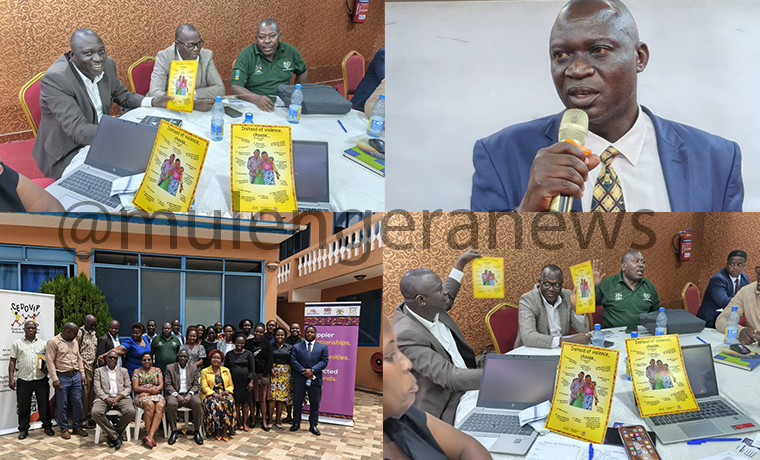
To strengthen these efforts, the government has partnered with the Centre for Domestic Violence Prevention (CEDOVIP) to raise awareness about GBV and its implications for service delivery and environmental conservation. Mr Okurut made these remarks during a follow-up GBV training for Ministry of Water and Environment staff, organised by CEDOVIP.
Mr Tom Okello, National Project Coordinator of the above project, observed that while GBV narratives often focus on women and girls, an increasing number of men are also silently affected. “There is a need to balance interventions to ensure that both women and men receive the necessary support,” he noted.
Ms Josephine Kamisya, Executive Director of CEDOVIP, explained that although men experience acts or threats of violence, the nature and intent often differ from those experienced by women. “Men also experience violence, but it is typically not used as a means of control through fear, as it often is for women. When men experience violence, it is usually a specific incident that ends. Women, on the other hand, live with a continuous threat of violence from men—partners or strangers—because society has normalised male dominance and violence against women,” she said.
Ms Kamisya urged men to open up and report incidents of violence, emphasising that silence perpetuates the problem. She also highlighted that GBV affects not only communities but also government officials. “GBV manifests in several forms that can hinder an individual’s ability to perform effectively. An officer who experiences abuse—whether at home or in the workplace—may struggle to deliver on their duties, and the emotional toll can affect their interactions with the public,” she noted.
She encouraged participants to practice self-care as an essential step toward addressing the impacts of GBV both personally and professionally. (For comments on this story, get back to us on 0705579994 [WhatsApp line], 0779411734 & 041 4674611 or email us at mulengeranews@gmail.com).