





By Mulengera Reporters
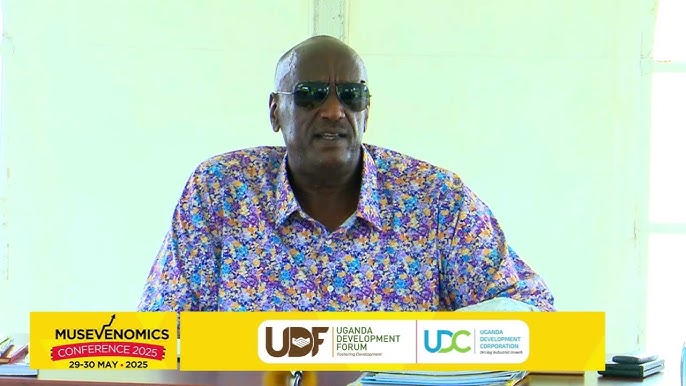
Appearing virtually from Gulu at the 4th Musevenomics Conference, General Salim Saleh issued a passionate and intellectually provocative address, urging Ugandans to confront the distortions in land use that, he argues, threaten to derail the country’s journey toward a modern, fully monetized economy.
Hosted at the Mestil Hotel in Kampala and attended by policymakers, economists, planners, and political leaders, the conference revolved around the six foundational questions posed by President Yoweri Museveni in March 2020, a framework the General says must be revisited “not just in PowerPoint but in practice.”
The Six Questions Guiding Uganda’s Economic Soul-Searching
Gen. Saleh’s address drew from a reflective tone as he recounted how the National Planning Authority (NPA) had once “cooked” him with a PowerPoint meant for the President. The result was a set of six questions that have since become a hallmark of Uganda’s economic self-examination:

- What was Uganda’s economy like in 1900?
- What was it like at independence in 1962?
- How badly did it collapse between 1971 and 1986?
- What was the economy’s state in 1986?
- What is it like today, and why?
- What should it look like when Uganda becomes fully modern?
Rather than rehash the answers, the General zeroed in on one key factor of production—land—arguing that if Uganda fails to correct distortions in its land use, “our ambitions for 10-fold economic growth will remain out of reach.”
“Do We Understand Uganda’s Land Use Balance Sheet?”
In perhaps the most significant turn of the speech, Saleh cited a “short but sharp” advisory note from Dr. Amanda Ngabirano, Chairperson of the Physical Planning Board. Her central question: Does Uganda truly understand how to manage land to feed 60 million people by 2040?
“We’ve been discussing this for almost four years,” Saleh noted, “because 60–80% of the stimuli packages under Musevenomics are land-dependent. If land use is distorted, the entire framework is distorted.”
The General also revealed that public agencies collectively hold over four million acres of land, particularly in Northern Uganda, but often without maximizing its use while tensions continue to grow between conservation needs and productive demands.
The Kapeeka Question – A Personal Twist
With a touch of humour and gravity, Saleh addressed recent inquiries from the Internal Security Organisation (ISO) regarding his ownership of land in Kapeeka.
“Yes, ISO asked me how I came to own Kapeeka,” he said. “Fortunately, I had very good answers. We had already studied the history and utilization of the land also known as the Namunkekera Kansiri Estate.”
He added that expert Eng. Kibuuka, his advisor on land conflict, particularly in Kapeeka, was on standby to elaborate; underscoring how land-related disputes are not just political or legal, but deeply economic.
Stimuli That Worked, But With Limits
Saleh credited several of the country’s economic “stimuli” with bringing Uganda back from collapse including security reforms, privatization, crop diversification, and infrastructural development.
Yet, in classic Saleh fashion, he cautioned against complacency.
“We must now look at land,” he said. “Land is where minerals are, where factories are built, where homes are established. If we don’t handle it right, even the Parish Development Model will not achieve its goals.”
From 68% to 39%: Operation Wealth Creation’s Legacy
Reflecting on his decade-long leadership of Operation Wealth Creation (OWC), the General highlighted the significant drop in Uganda’s non-monetized population from 68% in 2014 to 39% today.
“We were told to find people who had never touched money,” he said. “It was tough, but we made progress.”
A Humble Plea and an Invitation to Gulu
In closing, Saleh invited the conference to consider relocating future editions to Gulu, citing the peace and tranquility of his base.
“Kampala is a bit troubled,” he quipped. “Gulu is calmer. It has a peaceful atmosphere.”
He ended his speech by urging all Ugandans; technical experts, policymakers, private sector players, and ordinary citizens to join the national conversation about land, history, and the future of Musevenomics.
ANALYSIS: A Masterclass in Real Talk
Saleh’s address may go down as one of his most focused interventions in recent years. It was unapologetically personal, historically grounded, and policy-forward. In zeroing in on land, he not only reframed Musevenomics from theory to soil but also subtly challenged both state and society to act, debate, and restructure.
His call: Let us balance the land use sheet or risk becoming a country with grand plans but no ground to stand on. (For comments on this story, get back to us on 0705579994 [WhatsApp line], 0779411734 & 041 4674611 or email us at mulengeranews@gmail.com).