





By Mulengera Reporters
President Yoweri Museveni’s campaign visit to Butebo district in Eastern Uganda last week was marred by a series of unfortunate translation failures, leaving both the president and the crowd struggling to communicate effectively.
This was reminiscent of what happened in Mbale where a furious Museveni protested to organizers when Engineer Godfrey Werikhe, formerly of Rural Electrification Authority (REA) fatally screwed up. The ex-REA Deputy ED had controversially been chosen by the organizers to be the translator but Gen Museveni imploded and kicked him out when things went south as his interpretation skills turned out to be inadequate. Also in Bugiri, the same played out when Woman MP Candidate Eunice Namatende’s translation credentials were found wanting too and called into question.
Back to the Butebo embarrassment: The predominantly Iteso-speaking district, also home to members of the Bagwere tribe, became the backdrop for what one might call an “interpretation crisis.”

Butebo district was carved out of Pallisa to help ease tensions between the Bagwere and Iteso tribes.

However, the rally last week showed that despite the political efforts, linguistic barriers still persist. Museveni, alongside high-ranking officials like Speaker of Parliament Annet Anita Among, had hoped to connect with locals in their native language. But as it turned out, an interpreter mishap led to frustration for everyone involved.
The trouble started when Among, who hails from nearby Bukedea, took the stage. Among, fluent in both Iteso and Lugwere, began her speech in Iteso, clearly aiming to speak to the people in their language.
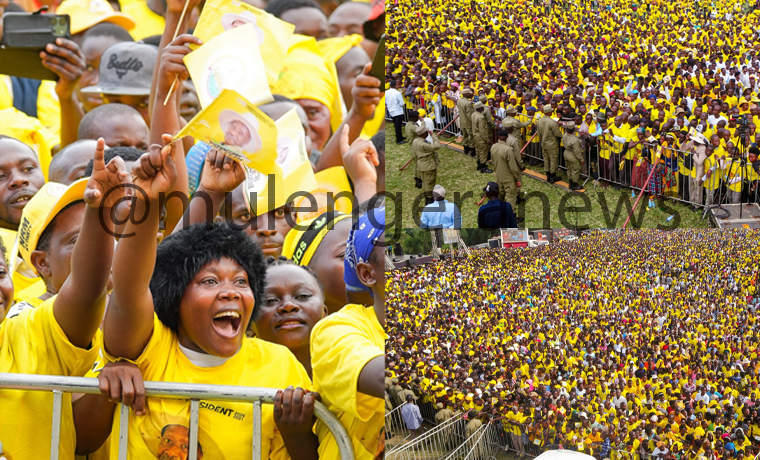
The crowd, donned in yellow NRM shirts, greeted her with enthusiasm. However, the male interpreter assigned to translate her speech into Lugwere or Iteso struggled. He repeatedly mixed up words, unable to convey the message accurately.

The translation problems were so obvious that Among, visibly frustrated, paused and called him out: “But, you are a bad interpreter!” The comment drew laughter from the crowd, but the situation quickly became uncomfortable.
President Museveni stepped up next, eager to engage the people of Butebo. He greeted the crowd with a few words in Iteso, but soon switched to English, hoping for clearer communication. However, things didn’t improve. The male interpreter, still struggling, began to mix in Luganda words, causing confusion among the locals. As the interpreter stumbled through Museveni’s speech, the audience grew more restless, unable to grasp the president’s key points.
It wasn’t until a female interpreter was brought in that the translation situation seemed to improve. But this, too, proved to be a temporary fix, as she quickly left the stage.
At this point, Minister for Science, Technology, and Innovation, the voice of Dr. Monica Musenero, a daughter of the soil stepped in to try and manage the situation, but the earlier breakdown had already taken its toll on the event.
Despite the communication chaos, Museveni went on to deliver his speech, which was packed with transformative promises of development and progress for the region.
He highlighted the government’s ongoing work in bringing peace and stability to the area, recalling how the region had been affected by cattle rustling in the past. Museveni noted the government’s efforts in restoring order and helping the community recover.
He also spoke at length about infrastructure development, detailing the government’s focus on improving roads, electricity, and water supply in Butebo. According to Museveni, 87% of villages in Butebo now have access to safe water, a significant achievement.
He mentioned ongoing projects like the construction of solar-powered irrigation schemes to help boost agriculture in the area.
However, the President’s focus on development and his promises to improve the region’s infrastructure—such as new roads and expanded electricity—were overshadowed by the interpreter fiasco. Many in the crowd struggled to follow his message, as the translation issues continued to plague the event.
Museveni also acknowledged the importance of education in his speech, noting that Butebo now has five government secondary schools, a significant improvement over the past.
He pointed out that, in the past, students from the region had to travel long distances to attend secondary school, but that was no longer the case.
Museveni spoke proudly about the progress the district has made in education, but the crowd seemed more focused on the translation troubles than his words of hope for the future.
Another major point of Museveni’s speech was his promise to improve roads in Butebo, particularly in rural areas. He seemed surprised to learn that some parts of the district, like Patete, still don’t have tarmac roads. He assured the crowd that the government would begin studying the situation and work towards better road infrastructure.
While Museveni’s promises of development were interrupted by interpretation issues, the message was well received by the crowd.
As Uganda moves towards the next election, the issue of language and interpretation could become a significant challenge for political leaders trying to connect with voters in regions with diverse linguistic communities. (For comments on this story, get back to us on 0705579994 [WhatsApp line], 0779411734 & 041 4674611 or email us at mulengeranews@gmail.com).