







By Aggrey Baba
DP President Norbert Mao has been presented as one of the original architects of the consensus-building and power-sharing ideas now being advanced by Gen Salim Saleh and Prof Ogenga Otunnu in their proposed Consociational Democracy Agreement, with his political camp arguing that the document builds on a struggle the Democratic Party (DP) started long ago.
Fred Mwesigwa, Mao’s personal assistant, said the ideas contained in the 137-page proposal were not new to Mao and other DP members who have spent years advocating dialogue, political accommodation and peaceful transfer of power.
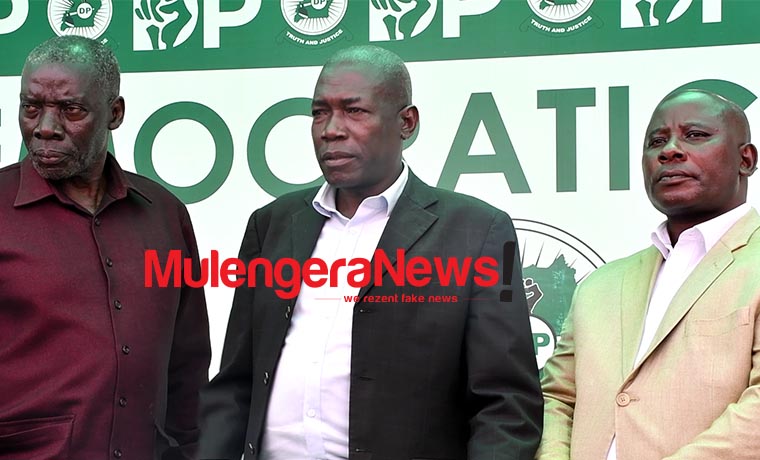
Speaking about the agreement at the party headquarterson Tuesiday, Mwesigwa said Mao’s political thinking had long centred on building consensus among competing political forces rather than allowing electoral victories to give one group exclusive control of the state.
He traced the origins of that approach to the Uganda Young Democrats (UYD) movement, which he said began its political mobilization in 1995, when several of the current political actors were still young activists struggling against the prevailing political order.
According to Mwesigwa, the movement’s original objective was to build a country in which political disagreements could be settled through negotiation rather than violence.
He said the struggle had already contributed to the restoration of multiparty politics, but Uganda now needed another political conversation focused on sharing power and preventing the country from sliding back into cycles of political violence.
Mwesigwa argued that Salim Saleh’s agreement should therefore be understood as an extension of ideas that DP and Mao had promoted for years, rather than an entirely new political invention.
The agreement, authored by Saleh and Prof Ogenga Otunnu following their Jinja political retreat, proposes a broad-based governance arrangement in which competing political, ethnic, religious and other organized interests participate in managing the country.
Its central proposals include a grand coalition bringing political parties into government, proportional representation, minority veto powers and segmental autonomy, under which different groups retain significant powers to manage their own affairs.
Mwesigwa said these principles were consistent with the consensus-building approach that Mao and other DP leaders had advocated long before the current debate emerged.
He challenged Ugandans to stop treating the proposal as the personal property of Gen Saleh and Otunnu, arguing that its ideas should be subjected to wider public scrutiny and improved through contributions from other political actors.
He also insisted that the document should not be imposed on Ugandans, saying every political party and organized group should be allowed to examine it, make proposals and identify areas requiring amendment.
Mwesigwa said the ultimate objective should be to develop an arrangement that allows Uganda to move beyond the winner-takes-all political system, which he blamed for perpetuating political tension and exclusion.
He called for a national consultation process involving political parties, religious and cultural leaders, women, youth, academics, businesspeople, elders, retired judges and former soldiers.
The proposed consultations, he said, should culminate in a national conference before the resulting recommendations are submitted to Cabinet and Parliament for consideration.
Mwesigwa also argued that the document should be translated into different Ugandan languages to allow ordinary citizens to understand its proposals instead of leaving the debate to political elites.
He said Uganda’s political future should not be determined by a few individuals meeting in Kampala, but through a national conversation in which every section of society has an opportunity to participate.
His remarks place Mao and DP within the political ownership debate surrounding Saleh’s proposal, as different political actors seek to establish whether the document represents a genuine national reconciliation initiative or another political arrangement designed by particular interests. (For comments on this story, get back to us on 0705579994 [WhatsApp line], 0779411734 & 041 4674611 or email us at mulengeranews@gmail.com).