






By Ben Musanje
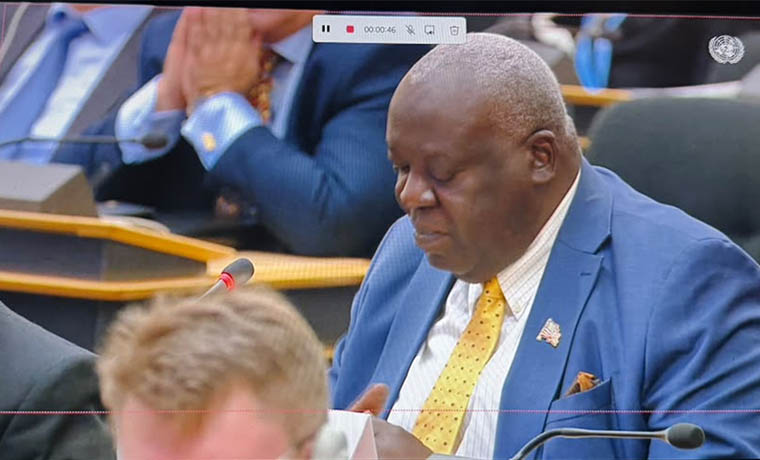
Uganda’s Minister for Relief, Disaster Preparedness and Refugees, Hon. Sam Engola, has challenged the international community to move beyond financial pledges and deliver tangible support to refugees, host communities and countries bearing the responsibility of hosting displaced populations.
Addressing the 77th Session of the United Nations High Commissioner for Refugees (UNHCR) Executive Committee (ExCom) in Geneva, Switzerland, Engola called for renewed political commitment, predictable funding and practical cooperation to address the growing challenges facing refugees and their host countries.
The Minister, who was accompanied by Uganda’s Permanent Representative to Switzerland, Ambassador Marcel Robert Tinaleka, and the Acting Commissioner for Refugee Management, said the international community must translate its commitments into measurable improvements in the lives of displaced people.

His address comes as the world marks the 75th anniversary of the 1951 Refugee Convention, a landmark international agreement that established key principles for the protection of refugees.
Engola noted that the principles of refugee protection, international solidarity and multilateral cooperation are under increasing pressure from complex and protracted displacement crises, coupled with declining or uncertain funding for humanitarian and development programmes.
“As we mark the 75th anniversary of the 1951 Refugee Convention, we do so at a moment when the principles it embodies are under acute strain,” he said.
He emphasised that the Global Compact on Refugees (GCR) remains a critical framework for ensuring that responsibility for refugees is shared more equitably among countries, rather than being left disproportionately to nations hosting large displaced populations.

Uganda, alongside Colombia, France, Japan, Jordan, Switzerland and UNHCR, serves as a co-convenor and co-host of the 2023 Global Refugee Forum, which sought to mobilise international support and strengthen commitments towards refugee protection and inclusion.
Engola said the success of the Global Compact on Refugees should not be measured by the number of pledges announced at international meetings, but by the extent to which those commitments translate into improved living conditions, stronger national systems and greater opportunities for refugees to become self-reliant.
“Pledges are not an end in themselves; they must be matched with adequate resources, translated into implementation, and assessed by the results they deliver for displaced persons and host communities,” he said.
The Minister pointed to initiatives such as Ethiopia’s Makatet and Kenya’s Shirika Plans as examples of nationally led approaches that seek to strengthen refugee inclusion and support host communities.
He said such initiatives demonstrate how the Global Compact on Refugees can contribute to broader efforts, including the 50 by 35 vision and UNHCR-mandated operations.
Looking ahead to the next Global Refugee Forum in 2027, Engola urged governments, development partners, humanitarian organisations and other stakeholders to use the coming period to assess progress, identify gaps and develop realistic commitments that respond to the scale of global displacement.
He called for existing pledges to be fulfilled, with partners clearly demonstrating the impact of their contributions on refugees, stateless persons, host communities and host countries.
He also stressed the importance of predictable financial, technical and material support aligned with the priorities of host countries, while urging greater participation of refugees and affected communities in designing, implementing and monitoring policies that directly influence their lives.
Engola reaffirmed Uganda’s commitment to working with international partners to strengthen refugee protection and ensure that global solidarity produces practical results.
“The road to the 2027 Global Refugee Forum should be used to show that the GCR is not only a statement of solidarity, but a vehicle for concrete progress in the lives of people and communities affected by displacement,” he said.
He urged the international community to sustain its engagement and political leadership to ensure that refugees, host communities and countries welcoming displaced populations receive the support they need. (For comments on this story, get back to us on 0705579994 [WhatsApp line], 0779411734 & 041 4674611 or email us at mulengeranews@gmail.com).