







By Aggrey Baba
During NSSF’s 14th Annual Members’ Meeting on Thursday, Minister for Gender, Labour and Social Development Lt Gen Henry Tumukunde turned the heat on NSSF, challenging its management to do more than celebrate growing savings and record profits for members.
While acknowledging the fund’s strong financial performance, Tumukunde questioned whether NSSF was doing enough to bring more people into the social security system, force non-compliant employers to remit workers’ contributions and use its growing financial muscle to address some of the country’s pressing needs.
“However, is this the best that can be done?” Tumukunde asked, setting a tougher tone at an event that was also meant to give members an account of how their savings had performed during the year.
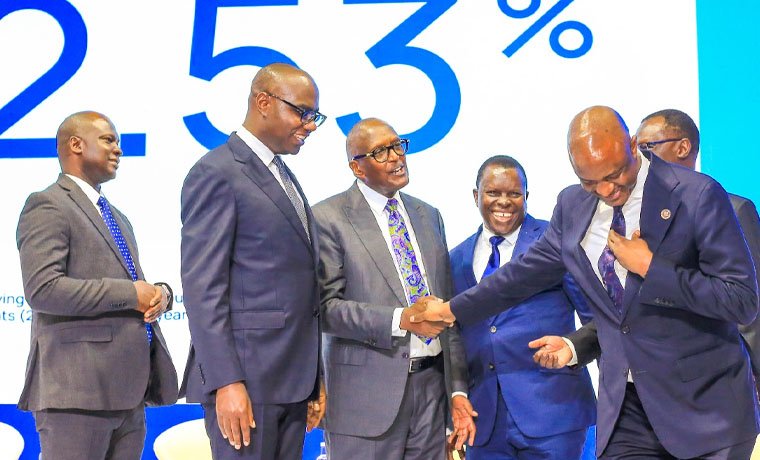
The meeting, held at Serena Kampala Hotel, brought together NSSF leadership, government officials, members and other stakeholders, with the Fund giving an account of its financial performance, investments, services and plans for the future. Managing Director Patrick Ayota presented the Fund’s performance report, while Board Chairman Dr David Ogong also addressed members, while finance Minister Henry Musasizi was there to declare the annual interest rate.
The good news for savers was that NSSF had another strong year, with its assets continuing to grow, income increased sharply and the Fund improved its operations, including reducing the time taken to pay members’ benefits. Membership also increased, while administrative costs came down.
But Tumukunde was not ready to allow those achievements to become the end of the story.
He particularly challenged NSSF over the pace at which it is bringing more Ugandans into the social security system, saying NSSF still has a long way to go given the size of the country’s working population.
NSSF itself has set a long-term target of reaching a much bigger share of working Ugandans, especially those outside the formal employment sector. Its voluntary savings efforts are part of this push.
“Please, when we come here next year, don’t tell me 30%. I will be watching this. I will keep the record,” Tumukunde warned, further demanding a tougher approach towards employers who fail to remit workers’ contributions.
“Don’t be polite about this,” he told NSSF officials, arguing that employers who are required to contribute should not simply ignore their obligations.
His message was that NSSF can’t talk about expanding social security while some employers continue failing to save for their emoyees.
He further praised NSSF for improving the way it works, reducing delays in paying members and keeping its costs under control. He also welcomed the growth in membership and improvements in service delivery, but said the Fund should move faster and also do better.
He then turned to NSSF employees, arguing that workers who help the Fund grow should be properly rewarded.
“How can you be giving this petty cash to somebody who is running billions of dollars?” he asked.
Tumukunde suggested stronger performance-based rewards, including commissions for workers whose efforts bring more contributors into the Fund or help it generate more value.
“If banks give commissions, why can’t you give them?” he asked.
But he also warned that better pay must go together with competence and professionalism, saying NSSF should attract people who can deliver results.
While Tumukunde was putting pressure on the Fund over its wider social responsibility, Finance Minister Henry Musasizi delivered the news many members had come to hear.
Musasizi declared an interest rate of 22.53% for the 2025/26 financial year, meaning UGX5.44 trillion will be credited to members’ accounts. The payout is substantially higher than the previous year’s distribution.
The announcement came after NSSF reported a major improvement in its financial performance during the year, with its income rising sharply and its asset base growing to UGX 2.8 trillion.
Musasizi said the performance shows the growing strength of NSSF and the importance of long-term savings to the economy.
The Finance Minister has previously argued that pension savings can help finance productive investments, infrastructure and other areas needed to grow the economy, provided workers’ money is protected and investments are properly assessed. (For comments on this story, get back to us on 0705579994 [WhatsApp line], 0779411734 & 041 4674611 or email us at mulengeranews@gmail.com).