











By Ben Musanje
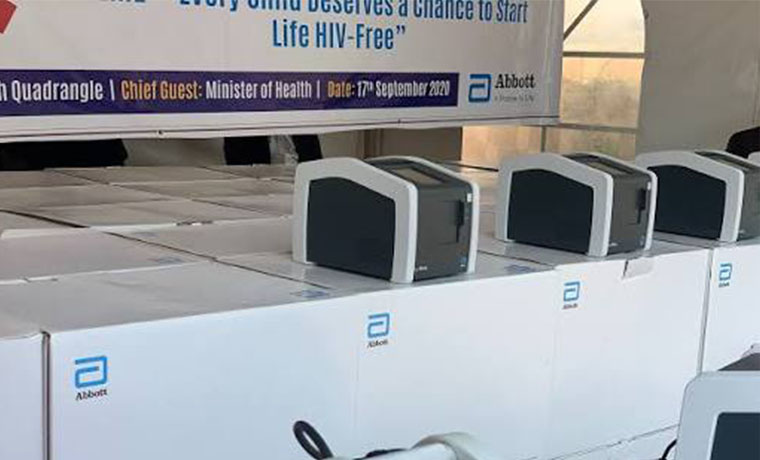
Global healthcare company Abbott has handed over 100 mPIMA point-of-care testing instruments to Uganda’s Ministry of Health, kicking off a nationwide rollout that will see an additional 500 machines deployed to health facilities across the country.
The first consignment was handed over Wednesday at the Ministry of Health’s Department of National Health Laboratory and Diagnostic Services campus in Butabika, Kampala, in a move aimed at expanding access to faster HIV diagnostic services, particularly Early Infant Diagnosis (EID).
Uganda currently has about 315 mPIMA instruments installed across the country. Once the new rollout is completed, the national fleet is expected to rise to approximately 815 instruments.

The remaining 400 machines will be delivered in phases over the coming months in coordination with the Ministry of Health and its technical teams.

The handover ceremony was attended by Minister of State for Health in charge of General Duties, Hon. Anifa Kawooya, U.S. Chargé d’Affaires Mikael Cleverley, the Director of the U.S. Centers for Disease Control and Prevention (CDC), and senior officials from the Ministry of Health, Abbott and Lifecare Diagnostics Uganda.
The expansion comes as point-of-care testing continues to play a growing role in Uganda’s HIV response. By the end of 2025, about half of all Early Infant Diagnosis testing in the country was being conducted at point-of-care sites.
Unlike conventional laboratory systems that may require samples to be transported to central facilities before results are returned, point-of-care molecular testing brings diagnostic capacity closer to patients.

This can significantly reduce delays in determining the HIV status of infants exposed to the virus, allowing health workers and caregivers to initiate treatment and care more quickly where necessary.
Dr Susan Nabadda, Executive Director of Uganda National Health Laboratory Services, said point-of-care testing for viral load and Early Infant Diagnosis is helping transform the delivery of HIV services, especially in resource-limited settings.
“By moving high quality molecular testing to local clinics, hospitals or delivery wards, POCT addresses the critical operational barriers of standard lab networks,” Dr Nabadda said.
Hassan Segujja, an Abbott representative, said the handover represented more than the delivery of equipment, describing it as part of a broader effort to bring advanced diagnostic services closer to Ugandan communities.
“Today is not simply about the handover of 100 instruments, it is about a journey of a shared vision, bringing high quality molecular diagnostic testing closer to patients and communities across Uganda,” Segujja said.
Abbott, through its local partner Lifecare Diagnostics Uganda, will provide technical support throughout the rollout. This will include installation and commissioning of the instruments, training of health workers, preventive maintenance, corrective repairs, spare parts and technical assistance.
Lifecare Diagnostics will also undertake ongoing performance monitoring to ensure the equipment is efficiently and effectively utilised.
Tephy Mujurizi, Executive Director of Lifecare Diagnostics Ltd, said the company would work with the Ministry of Health to build the capacity of testers and provide sustained technical support to health facilities.
“We shall provide technical support in areas of capacity building for testers, installations of these platforms at health facilities, timely services and repair as well as monitoring efficiency and effective utilization of these new innovations through continuous field mentorship and learning,” Mujurizi said.
The United States Government, which has supported Uganda’s efforts to strengthen laboratory systems and expand access to Early Infant Diagnosis, also welcomed the partnership.
U.S. Chargé d’Affaires Mikael Cleverley said the United States had supported Uganda for many years in expanding access to timely HIV diagnosis and treatment.
“A stronger health system in Uganda benefits both Ugandans and Americans,” Cleverley said.
The partnership between Uganda, the United States, Abbott and Lifecare Diagnostics is expected to strengthen the country’s decentralised diagnostic network and contribute to efforts to accelerate progress towards HIV epidemic control.
The deployment also reflects the growing shift towards bringing sophisticated molecular diagnostic technologies closer to communities, reducing dependence on central laboratories and helping health workers make faster decisions about patient care.
Abbott has operated in sub-Saharan Africa for nearly six decades, with its operations now spanning pharmaceuticals, nutrition, diagnostics and medical devices across the continent.
Lifecare Diagnostics Ltd, Abbott’s authorised distributor in Uganda, works with the Ministry of Health to support point-of-care diagnostic services, including training, equipment maintenance and field-based technical assistance across Uganda’s 40 greater districts. (For comments on this story, get back to us on 0705579994 [WhatsApp line], 0779411734 & 041 4674611 or email us at mulengeranews@gmail.com).