











By Guest Writer
The Industrial Court should not be the first place an employee feels genuinely heard, organizations must build credible internal systems that resolve grievances fairly before they escalate into costly litigation.
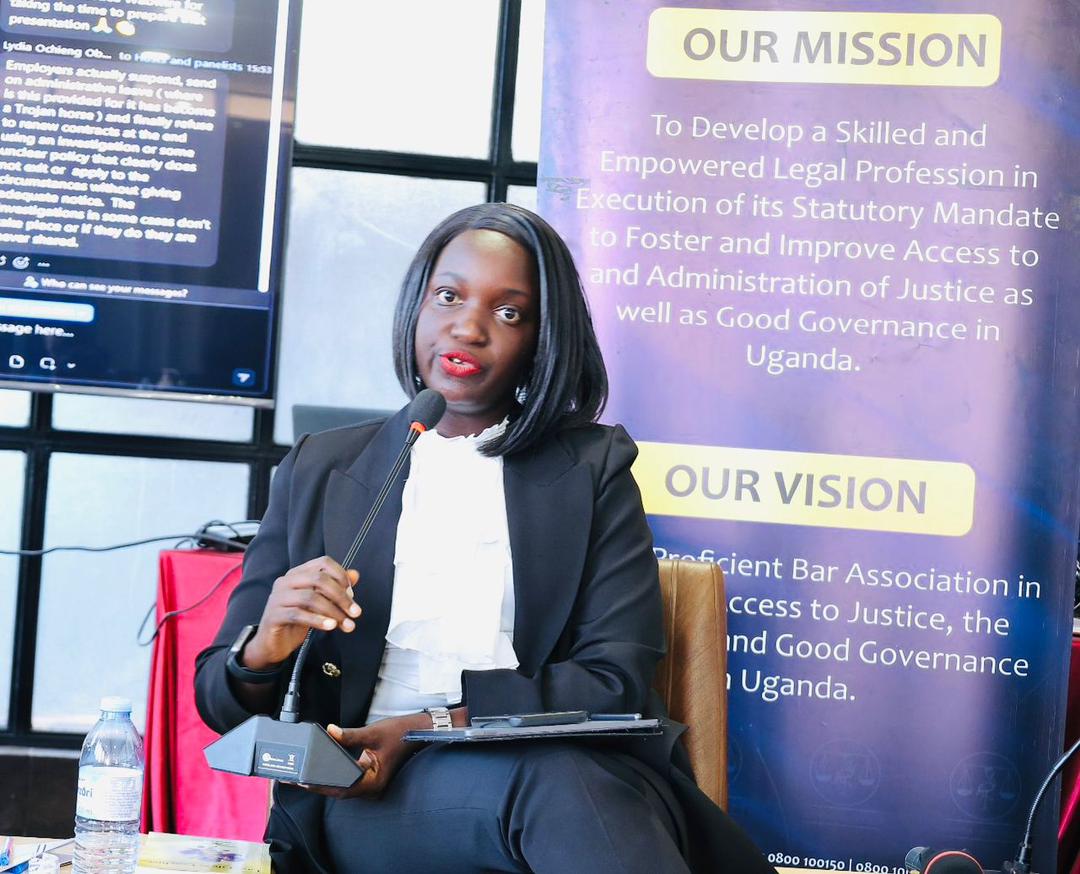
This was the central message as the National Water and Sewerage Corporation (NWSC) joined the national conversation on workplace justice at the Employment & Labour Law Conference 2026.


The two-day conference, held on 27th – 28th August 2026, was organised by the Uganda Law Society (ULS) in partnership with the Uganda Retirement Benefits Regulatory Authority (URBRA). It brought together judges, legal practitioners, employers, and human resource experts to examine emerging trends in employment law.
Representing NWSC, Ms. Brownie Ebal, Manager Litigation & Advisory Services, was a panelist in a high-level session on “Workplace Dispute Resolution from Internal Processes to the Industrial Court and Beyond.”

The panel interrogated a critical question for large employers: When a workplace dispute arises, how can it be resolved fairly, efficiently, and at the earliest possible stage, rather than being allowed to develop into prolonged litigation?
For NWSC, which operates a large and geographically dispersed workforce, the discussion holds significant institutional relevance. The Corporation noted that how workplace disputes are handled goes beyond legal compliance but also affects employee confidence, institutional culture, productivity, management credibility, and ultimately, service delivery.
A key takeaway from the dialogue was the distinction between procedural compliance and genuine fairness.
Ms. Ebal noted that while an employer may have a disciplinary policy, issue notices and keep minutes, that alone does not guarantee fairness. She cited the consistent position of the Industrial Court that a lawful dismissal must satisfy two tests: procedural fairness, whether the employee was treated fairly in the process and substantive fairness or whether there was a valid and supportable reason for the decision.
According to the panel, a genuinely fair process requires that an employee understands the case against them, is given adequate notice, reasonable time to prepare, access to material evidence where necessary, and an impartial consideration of their defense.
“The disciplinary hearing should not be the point at which management merely communicates a decision that has already been made. It must be part of the process through which the decision is actually reached,” the panel observed.
The dialogue also underscored the importance of thorough investigation and proper documentation, with reference to landmark Industrial Court decisions.
In Musimenta v United Bank for Africa, Labour Dispute No. 210 of 2020 UGIC 53, the Court found a dismissal unlawful where there was a variance between the disciplinary allegations and the grounds relied upon for termination, and where the investigation report was not shared with the employee. The case reinforced the principle that an employee must know the case they are answering.
Conversely, in Kavuma v National Social Security Fund UGIC 3, the Court upheld summary dismissal for negligence, finding that where an employer investigates properly, provides written notice, allows sufficient preparation time and opportunity for representation, it can take firm and lawful action.
The panel emphasized that fairness does not make discipline impossible; it guarantees a fair opportunity to be heard before a decision is reached.
Participants also highlighted practical barriers employees face in pursuing grievances, including limited knowledge of procedures, fear of victimization, evidentiary challenges, and cost and time constraints.
The discussion called on organizations to shift focus from asking “How do we win this employment case?” to “What could we have done earlier to prevent this matter from becoming a case?”
This, panelists said, requires early collaboration between Management, Human Resources, and Legal Services, timely documentation of incidents, proportionality in sanctions, and effective use of internal grievance and alternative dispute resolution mechanisms.
In conclusion, NWSC’s participation in the conference reflects its broader commitment to good governance, continuous learning, sound people management, and lawful decision-making.
The dialogue made it clear that good employment practice begins inside the institution with quality investigations, fair hearings, consistent management decisions, and willingness to resolve legitimate grievances early.
For NWSC and other employers, the goal is not merely to have a disciplinary process that can withstand legal scrutiny, but to build a workplace where employees and managers have confidence that when difficult decisions must be made, they will be made fairly, consistently, transparently, and in accordance with the law. (For comments on this story, get back to us on 0705579994 [WhatsApp line], 0779411734 & 041 4674611 or email us at mulengeranews@gmail.com).