












By Ben Musanje
Uganda’s growing digital economy is increasingly exposed to cybercrime that is costing the country billions of shillings, Bank of Uganda Governor Dr. Michael Atingi-Ego has warned.
Atingi-Ego said cyberattacks should no longer be viewed merely as a technical problem, arguing that disruptions to digital systems can quickly translate into financial losses, payment failures and threats to economic stability.
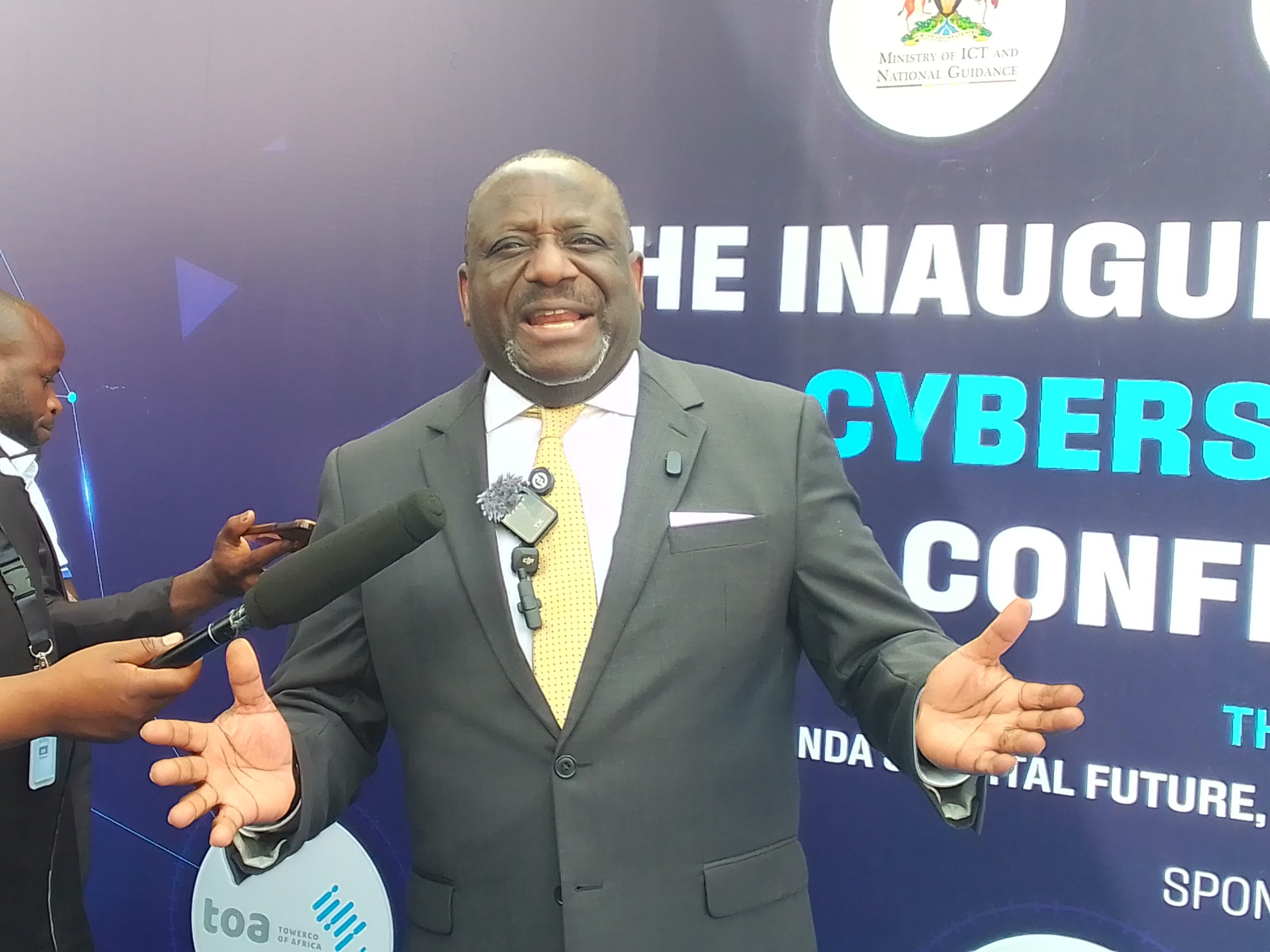
“Cybersecurity is increasingly the principal means by which that trust is earned and kept,” Atingi-Ego said while delivering the keynote address at the inaugural National Cybersecurity Conference in Kampala.
He said Uganda’s digital transformation is creating more opportunities for commerce and financial inclusion, but the growing dependence on interconnected systems is also increasing the potential financial impact of cyber incidents.
According to figures cited by the Governor, reported cybercrime cases in Uganda rose from about 245 in 2023 to 474 in 2024, representing an increase of more than 93 percent, before easing to 412 cases in 2025. The associated financial losses, he said, are running into billions of shillings annually.
The Governor also cited a national assessment by NITAU indicating that roughly four in every 10 Ugandan small and medium-sized enterprises have experienced some form of cyberattack.
Globally, the economic cost is even more staggering, with industry estimates putting the annual cost of cybercrime at about $10.5 trillion, Atingi-Ego said.
Cyberattacks could trigger financial instability
The Governor warned that a cyber incident affecting one part of Uganda’s digital ecosystem could rapidly spread into the financial sector.
“A vulnerability in a telecommunications network can surface as a crisis in financial services,” he said, adding that a cyber incident could escalate within hours from a technical failure into a payment disruption and loss of public confidence.
For the central bank, he said, financial stability has traditionally depended on capital and liquidity. Increasingly, however, it also depends on the availability, integrity and reliability of the digital systems through which money moves.
Atingi-Ego said the Bank of Uganda’s supervisory approach therefore looks beyond individual institutions to vulnerabilities and interconnections across the financial ecosystem.
He noted that the central bank issued cyber and technology risk management guidelines in December 2024, requiring supervised financial institutions to strengthen governance, data protection and security controls.
Trust has an economic price
Atingi-Ego placed public and investor confidence at the centre of Uganda’s digital economy, arguing that trust itself has economic value.
“Trust is not an intangible. It has economic value,” he said, noting that confidence determines whether citizens embrace digital public services, businesses invest in digital platforms and investors commit capital to markets.
Once lost, he warned, trust can be far more expensive to rebuild than it is to protect.
He consequently rejected the idea that Uganda must choose between cybersecurity and technological innovation.
“The real choice is between innovation that is trusted and innovation that is fragile,” he said.
Digital growth brings bigger risks
Uganda currently has an estimated 23 million people online, according to the Governor, while the country’s digital transformation ambitions target 90 percent broadband coverage and 90 percent of citizens accessing services online by 2040.
But Atingi-Ego cautioned that every expansion of the digital economy also expands the potential attack surface.
He urged financial institutions, telecom companies, government agencies and technology providers to strengthen intelligence sharing, conduct joint cyber exercises and develop common resilience standards.
He also challenged leaders to test their preparedness before a crisis rather than discovering weaknesses during one.
“If our primary system fails, if our key technology provider is unavailable for a day, if several institutions are hit simultaneously,” he asked, “who decides who communicates, who coordinates, and how quickly can we restore what matters most?”
The Governor said cybersecurity must ultimately become a boardroom and national policy issue rather than something left to IT departments.
“Build security in, do not build on,” he told delegates.
Atingi-Ego was speaking at the two-day National Cybersecurity Conference organised by the Uganda Communications Commission under the theme “Securing Uganda’s Digital Future: Collaboration, Resilience and Trust.” The conference, held on August 11–12 at the Sheraton Kampala Hotel, brought together regulators, financial institutions, telecom companies, technology firms, security agencies, academics and other stakeholders to address the growing economic and national security risks posed by cyber threats. (For comments on this story, get back to us on 0705579994 [WhatsApp line], 0779411734 & 041 4674611 or email us at mulengeranews@gmail.com).