








By Ben Musanje
The Salvation Army has intensified efforts to combat human trafficking by training community leaders on safe migration, as officials warn that many Ugandans seeking jobs abroad remain vulnerable to exploitation by unlicensed recruiters and traffickers.
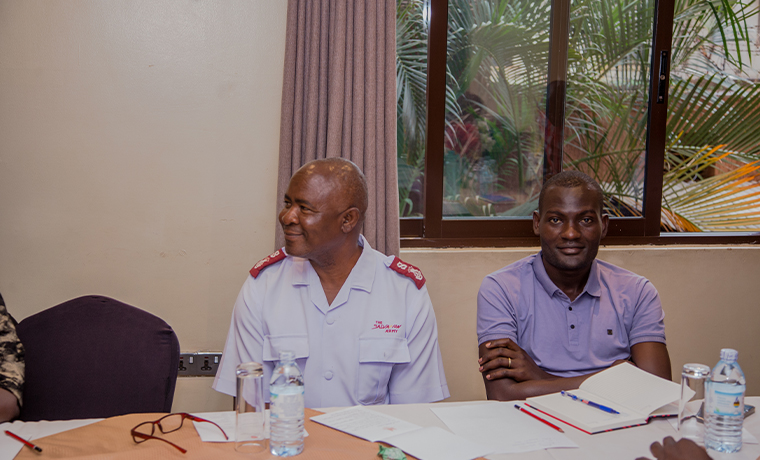
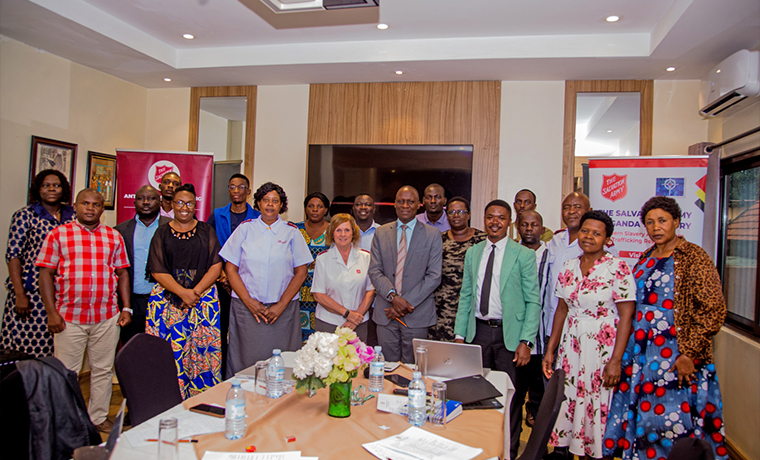
The training, held in Kampala, brought together 20 frontline community leaders from eastern Uganda’s border districts, where the Salvation Army is implementing an anti-human trafficking project. The participants are expected to return to their communities to educate thousands more on legal migration procedures and the dangers of irregular labour migration.
Speaking during the training, Emmanuel Wataka, Project Manager for The Salvation Army’s Anti-Human Trafficking Project, said the initiative is part of a broader strategy to prevent trafficking before it occurs.

“The Salvation Army responds to human trafficking through prevention, research, protection, rescue, return, repatriation and reintegration of survivors,” Wataka said. “Above all, we advocate for better migration policies.”

He said the training was designed to equip community leaders with practical knowledge to guide people intending to seek employment abroad, ensuring they understand government procedures, legal recruitment channels and their rights as migrant workers.
“There are many factors pushing people to leave Uganda in search of work,” Wataka said. “The question is how they can migrate safely without becoming victims of human trafficking.”
Government urges migrants to use licensed recruiters

Officials from the Ministry of Gender, Labour and Social Development led sessions explaining Uganda’s labour migration laws, recruitment procedures and available support services.
Participants were advised to seek employment abroad only through recruitment agencies licensed by the ministry and to verify employment contracts before travelling.
The ministry also publicized the national toll-free hotline 116, which can be used to report suspected cases of human trafficking or labour-related abuse.
Wataka said participants also learnt about government plans to strengthen labour protection through labour attachés posted abroad and bilateral labour agreements with destination countries to safeguard Ugandan migrant workers.
He said discussions highlighted the need for agreements with countries such as India to establish minimum employment standards and wage protections for Ugandans working overseas.
Civil society calls for stronger reforms
The training also attracted labour migration advocates who called for broader reforms to Uganda’s labour export system.
Kenneth Oloka, National Director of the Foundation of Uganda Joint Migrant Workers, praised anti-trafficking organizations for raising awareness but argued that pre-departure preparation for migrant workers still needs significant improvement.
Oloka said current pre-departure programmes resemble orientation sessions rather than comprehensive training.
He proposed that prospective migrant workers should undergo full training before signing employment contracts instead of the current practice where contracts are often signed first.
“People should first be trained, qualify, and then sign contracts,” he said.
Oloka also called for closer collaboration between migrant workers’ associations, anti-trafficking organizations and government agencies to develop practical solutions to labour migration challenges.
While acknowledging progress through bilateral labour agreements with countries such as Saudi Arabia and ongoing negotiations with Qatar, the United Arab Emirates and Jordan, he argued that Uganda’s long-term solution lies in expanding decent employment opportunities at home.
He said poor wages and limited employment continue to push many Ugandans into risky migration channels where they become vulnerable to trafficking and exploitation.
Church leaders to spearhead community awareness
Among those trained was Major John Wabomba, a member of the Salvation Army National Anti-Human Trafficking Task Force and Public Relations Officer for the Elgon District.
Wabomba said the training had equipped participants with practical knowledge on document verification, employment contracts, licensed recruitment agencies and where victims can seek assistance.
He noted that many migrants unknowingly sign contracts written in foreign languages they do not understand, exposing them to abuse once they reach destination countries.
“Anyone can become a victim of human trafficking,” Wabomba said. “People will continue moving in search of better opportunities, but they need to know how to migrate safely.”
He said he would use the training to educate local leaders, church leaders, school administrators and communities across Sironko, Bulambuli, Kapchorwa, Kween and Bukwo districts on safe migration practices.
Community-based prevention
According to the Salvation Army, the anti-human trafficking project focuses on Uganda’s porous border districts, where traffickers often target vulnerable job seekers.
By training local leaders and community volunteers, the organisation hopes to strengthen grassroots awareness and reduce the number of Ugandans falling victim to deceptive recruitment schemes.
The training was officiated by Dr Charles Eguru, Commissioner for Employment Services at the Ministry of Gender, Labour and Social Development, who emphasized the importance of following legal migration procedures as Uganda continues to promote safe and regular labour migration. (For comments on this story, get back to us on 0705579994 [WhatsApp line], 0779411734 & 041 4674611 or email us at mulengeranews@gmail.com).