










By Ben Musanje
Uganda has deployed more than 348,000 migrant workers abroad over the past decade, generating billions of shillings in remittances and easing pressure on the country’s labour market, but government officials say stronger safeguards are needed to combat illegal recruitment and human trafficking.
Speaking during a Training of Trainers on Safe Migration and Safe Job Verification organized by The Salvation Army’s Anti-Human Trafficking Project, Lawrence Egulu, Commissioner for Employment Services at the Ministry of Gender, Labour and Social Development, said the country’s External Employment Programme (EEP) continues to provide employment opportunities for thousands of Ugandans while supporting the economy through foreign remittances.
The programme, introduced in 2005 as a temporary response to rising unemployment, has since become one of Uganda’s key labour market interventions.

According to Egulu, 348,473 Ugandan migrant workers were deployed to overseas jobs between 2016 and March 2026, with the majority taking up employment in Saudi Arabia, the United Arab Emirates, Qatar, Bahrain, Oman, Jordan, Iraq and other Middle Eastern destinations.

He noted that Uganda now has 247 licensed external recruitment agencies, all of which must be owned by Ugandan citizens, undergo security vetting and maintain a bank guarantee of Shs100 million to protect migrant workers.
“The programme has created jobs not only for Ugandans working abroad but also within recruitment companies and related sectors at home,” Egulu said.
The economic contribution of labour migration has also grown steadily. Uganda received more than US$1.5 billion in inward remittances in 2024, with nearly half of the money coming from Ugandans working in the Middle East. Many returning workers have invested in real estate, education and small businesses, contributing to local economic development.

The External Employment Programme has also generated significant government revenue. Between December 2021 and March 2024, the Ministry of Gender, Labour and Social Development collected more than Shs30.3 billion in non-tax revenue through licensing fees, job attestation charges, training accreditation and other regulatory services.
The programme has further boosted demand for passports, with government statistics showing that more than 1,000 passports are issued daily and about 60 percent are processed for people seeking overseas employment.
Despite these gains, Egulu acknowledged that Uganda’s labour market remains under considerable pressure, with an estimated 600,000 to 700,000 people entering the job market every year. The programme, he said, has become an important source of employment for young people, graduates, workers in the informal sector and those who remain unemployed despite having formal education.
However, he cautioned that labour migration must be properly regulated to protect Ugandans from exploitation.
The ministry has strengthened oversight through the External Employment Management Information System (EEMIS), nationwide awareness campaigns, inspections of recruitment agencies and accredited pre-departure training centres, as well as digital complaint platforms where prospective migrant workers can report suspected fraud or abuse.
Government data shows that between July 2019 and February 2020, authorities recovered more than Shs308 million from recruitment companies that had collected money from job seekers without deploying them abroad.
Uganda has also signed bilateral labour agreements with Saudi Arabia, while agreements with Jordan, Qatar and the United Arab Emirates are at various stages of implementation. Negotiations are ongoing with Bahrain, Kuwait, Oman, Germany and Austria to expand opportunities for Ugandan workers while strengthening labour protections.
Egulu said government is seeking to deploy additional labour attachés to key destination countries, including the United Arab Emirates, Qatar, Oman and Jordan, to improve worker protection, verify employment opportunities, resolve labour disputes and assist distressed Ugandans.
He expressed concern over the increasing number of Ugandans using irregular migration routes to countries such as Cambodia, Myanmar, Thailand and Laos, warning that many fall victim to trafficking, forced labour and cybercrime syndicates.
“Unsafe, disorderly and irregular migration is a development failure,” he said. “Migration should be a choice, not something people are forced into because they have no opportunities at home.”
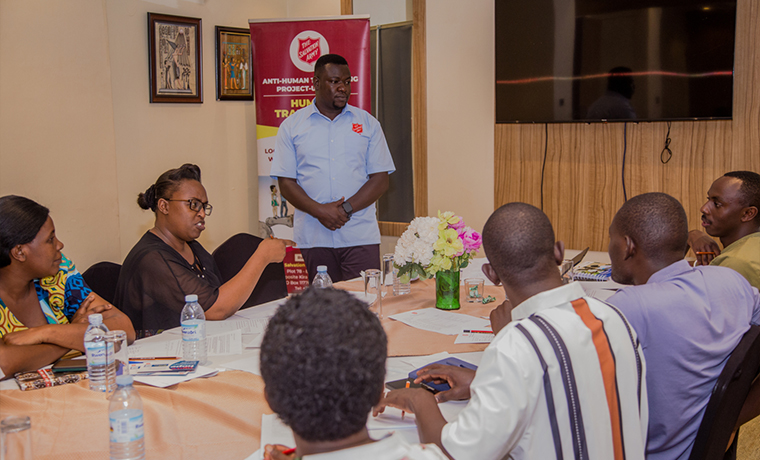
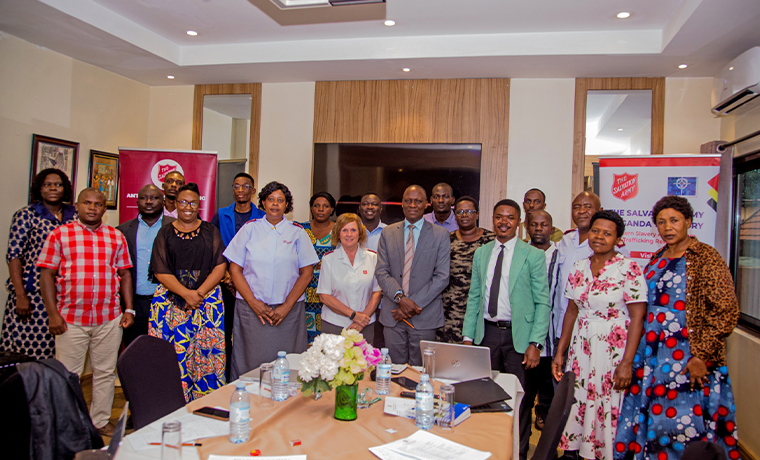
The remarks were made during a capacity-building workshop organized by The Salvation Army Uganda Territory, which brought together community trainers from border districts to strengthen public awareness on safe migration and job verification.
Emmanuel Wataka, Project Manager of The Salvation Army’s Anti-Human Trafficking Project, said the training is intended to equip frontline community leaders with practical knowledge on identifying genuine overseas employment opportunities and protecting vulnerable people from traffickers.
“Many victims are lured by false promises of jobs and better lives, only to end up in situations of exploitation,” Wataka said. “By training community leaders, we are ensuring that more Ugandans receive accurate information before making life-changing decisions.”
Participants were trained on how to verify licensed recruitment agencies, report suspected trafficking through government complaint channels, and educate communities on safe migration practices.
While acknowledging that overseas employment continues to provide valuable economic opportunities, both government and anti-trafficking advocates stressed that Uganda’s long-term priority remains creating decent jobs at home so that working abroad becomes an informed career choice rather than a necessity born out of unemployment. (For comments on this story, get back to us on 0705579994 [WhatsApp line], 0779411734 & 041 4674611 or email us at mulengeranews@gmail.com).