






The Limits of Anti-Corruption Populism: A Friendly Constitutional Warning to Hon. Balaam Barugahara
By Asuman Kiyingi
Hon. Balaam Barugahara Ateenyi has been my longtime friend. We both hail from Kamuli District and have known each other for many years. I have watched his journey from private enterprise into public service and have always admired his energy, patriotism and determination to get things done.

While he was serving at the Ministry of Gender, Labour and Social Development, I visited him and we spent quality time exchanging ideas on building a better Uganda. I congratulate him on his appointment as Minister for Local Government and wish him every success in his new responsibilities.

It is precisely because of that friendship, and because I believe his desire to fight corruption is genuine, that I feel obliged to offer this friendly caution. The challenge before Uganda is not whether corruption should be fought—on that there can be no disagreement—but whether it should be fought in a manner that strengthens, rather than weakens, the constitutional institutions upon which lasting accountability depends.

The Public Appeal: There is little doubt that the energetic field inspections led by Hon. Balaam and his colleague, Hon. Justine Nameere, have captured public attention. For many Ugandans who have endured years of bureaucratic indifference, local-level extortion and poor service delivery, seeing ministers leave their offices to inspect projects, confront officials and demand accountability has been refreshing.
Among the interventions that have captured public imagination are the widely publicised inspections in Mbale District—such as at Naiku Health Centre III, where the Minister reported finding only three of nineteen staff members present by 9:00am and Naiku Primary School, where a physical headcount revealed 705 pupils against an official payroll roster of 1,352. Interventions have similarly targeted inflated land acquisition costs in Namisindwa District, public works in Bulambuli, and Parish Development Model officials accused of extorting beneficiaries. These interventions have understandably resonated with a public hungry for accountability. But public enthusiasm, however justified, should not lead us to confuse political visibility with institutional reform. Public spectacle may expose wrongdoing, but only strong institutions can sustainably eradicate it.
Corruption Is Systemic: Senior lawyer and legislator Hon. Paul Mwiru recently observed that Uganda’s corruption challenge is fundamentally systemic rather than merely personal. I agree.
Corruption persists not simply because dishonest individuals occupy public office, but because institutional incentives, weak oversight, unrealistic budgeting, poor procurement practices and inadequate accountability mechanisms allow it to flourish. Yet there is an even deeper problem. Corruption increasingly exhibits the characteristics of what governance scholars describe as a collective action problem. Where corruption becomes pervasive, individuals often conclude that honesty carries personal costs while dishonesty attracts rewards. Civil servants, contractors, politicians and even ordinary citizens may therefore participate in corrupt practices not because each is uniquely unethical, but because each assumes that “everyone else is doing it” and that refusing to participate merely places them at a competitive disadvantage.
This reality exposes the limitations of anti-corruption strategies that focus primarily on identifying individual culprits. While personal accountability remains indispensable, it cannot by itself transform a system whose incentives reward complicity and punish integrity. Sustainable reform requires changing the institutional environment within which public officials operate.
The systemic character of corruption is further compounded by selective enforcement. Public confidence in anti-corruption efforts is inevitably weakened when lower-level officials are investigated and prosecuted with commendable speed while allegations involving politically influential or well-connected individuals appear to attract hesitation, prolonged delay or no visible action at all. Whether this results from political considerations, institutional constraints or evidential challenges, the public perception of unequal justice is itself corrosive to the rule of law.
The distinction between petty and grand corruption is equally important. Petty corruption often survives because of weak supervision and poor administrative controls. Grand corruption, by contrast, frequently survives because of political protection and institutional capture. It is therefore unsurprising that anti-corruption campaigns often succeed against junior officers while those occupying the commanding heights of political and administrative power remain beyond the practical reach of ordinary enforcement mechanisms.
Closely related is the State’s recurring unwillingness—or, in some instances, inability—to pursue the most powerful actors within corruption networks. Grand corruption rarely succeeds through the actions of junior officials alone. It ordinarily involves sophisticated networks of political patronage, administrative protection and economic influence. Unless accountability extends across the entire chain of responsibility—from junior officers to senior decision-makers—the fight against corruption risks becoming episodic, selective and ultimately ineffective.
Mwiru also reminds us that while public attention is often directed toward district officials and lower-level administrators, much larger questions of public financial management—including substantial classified expenditures that receive limited public scrutiny—remain largely beyond the reach of these highly publicized inspections. Sustainable reform therefore requires attention to the entire accountability chain rather than its weakest links.
A similar concern was raised by civil engineering practitioner Immanuel Ben Misagga, and echoed formally by the Uganda Institution of Professional Engineers (UIPE). Pushing back against ministerial field detentions—such as the recent arrest of the Bulambuli District Engineer over Shs 500 million bridge works—the professional body cautioned that publicly condemning or detaining technical officers before completion of technical audits risks criminalizing structural underfunding or procurement flaws instead of investigating their root causes. Engineering audits, procurement reviews, and professional regulatory inquiries must precede executive conclusions about criminal culpability.
Institutions, Not Spectacle: This distinction has not gone unnoticed within government itself. Drawing on his civil service experience, Information Minister Dr. Chris Baryomunsi recently contrasted ministerial enforcement styles with his own policy of “supportive supervision.” Recounting a recent unannounced night inspection at Mbarara Regional Referral Hospital where he encountered severe absenteeism and long patient queues, Dr. Baryomunsi noted that despite public pressure to order immediate arrests, he deliberately declined. His rationale was clear: executive oversight must focus on administrative correction and identifying system bottlenecks rather than arrest-driven spectacle.
The contrast is straightforward. Populist enforcement seeks immediate public approval through dramatic interventions. Constitutional governance seeks durable accountability through evidence, professional investigation, due process and institutional independence. One may generate headlines; the other builds the rule of law.
This is not an argument against vigorous enforcement. Rather, it is an argument that enforcement must remain firmly anchored in law.
When public officials are publicly condemned or subjected to executive directives before competent authorities have completed investigations, constitutional safeguards become vulnerable. The principles embodied in Articles 28 and 42 of the Constitution—including the right to a fair hearing and to lawful and procedurally fair administrative action—exist precisely to ensure that accountability is achieved through justice rather than expediency.
As the Supreme Court emphasized in Ken Lukyamuzi v. Inspector General of Government & Attorney General (Constitutional Appeal No. 2 of 2007), even constitutional oversight bodies remain bound by the requirements of due process and natural justice. The decision underscores that the fight against misconduct must itself conform to constitutional safeguards.
The Constitutional Risks: The constitutional dangers of substituting institutional process with executive populism deserve careful consideration.
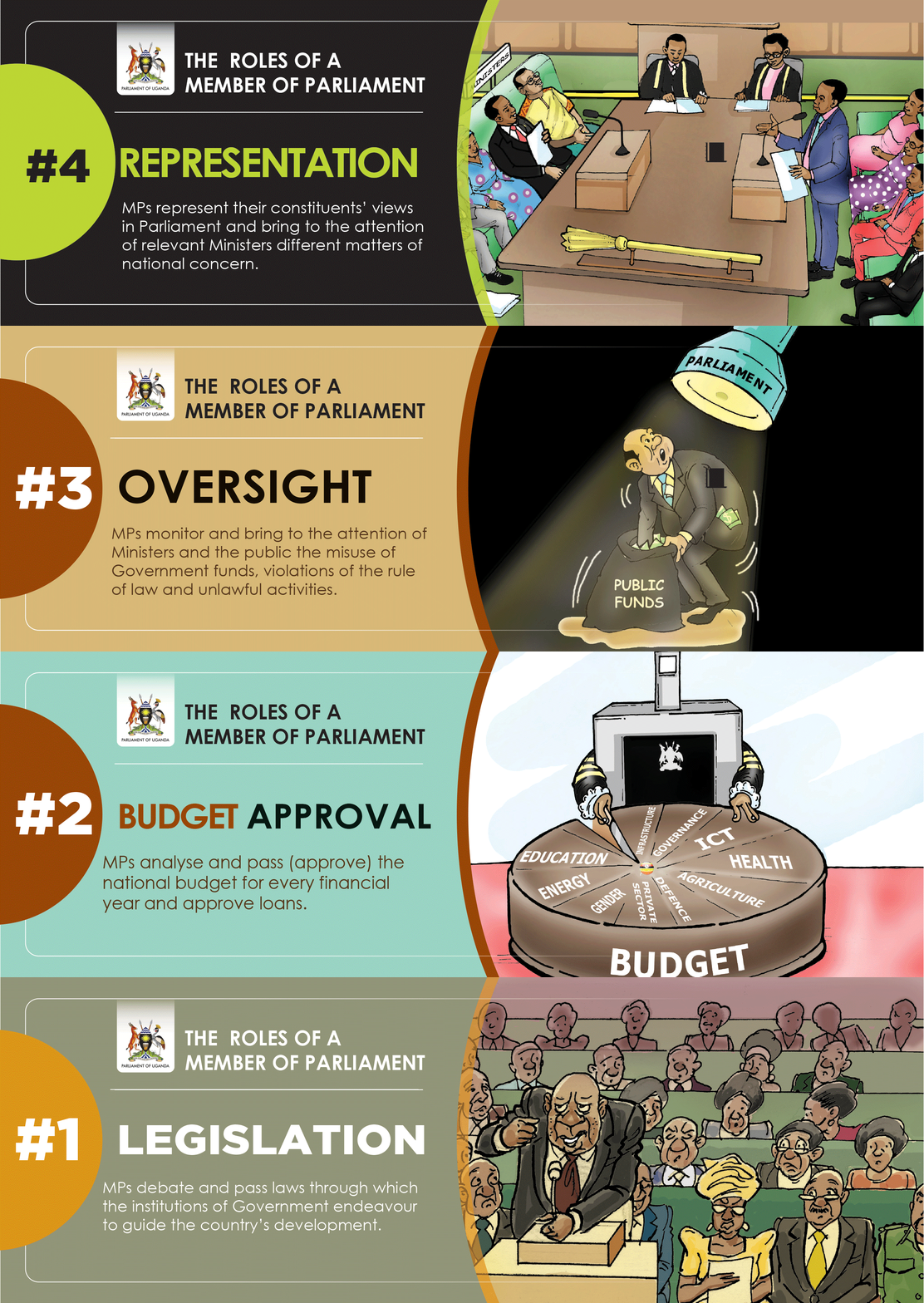
Marginalizing Constitutional Institutions: Uganda deliberately distributes accountability functions among specialized bodies. The Inspectorate of Government investigates corruption under Article 225. The Auditor General audits public expenditure under Article 163. The Director of Public Prosecutions exercises independent prosecutorial authority under Article 120. Political leaders must supervise policy implementation, but they are neither statutory investigators nor judicial officers. When executive ministers bypass these boundaries, it inevitably provokes institutional friction—as demonstrated when local leaders, including Mbarara City Mayor Robert Kakyebezi, publicly reminded visiting ministers that political oversight cannot usurp the statutory mandate of trained investigators.
Exposing the State to Civil Liability: Where arrests or detentions occur without sufficient authority or proper investigative procedures, the State becomes vulnerable to actions for false imprisonment, malicious prosecution and related constitutional claims. The resulting compensation and judgment debts ultimately burden taxpayers, undermining the very objective of protecting public resources.
Normalizing Arbitrary Executive Power: Public approval, however overwhelming, cannot become a substitute for legality. As Deputy Speaker Rt. Hon. Thomas Tayebwa suggested in a widely circulated statement, popular support may sometimes be viewed as sufficient justification for immediate executive action. That proposition, however attractive in moments of public anger, carries significant constitutional risks. If today’s public enthusiasm can justify bypassing established procedures against an official believed to be corrupt, tomorrow the same logic can be turned against an innocent civil servant or political opponent.
Constitutional democracy is designed precisely to restrain power when popular passions are at their highest. This principle was forcefully underscored by the Supreme Court in Attorney General v. David Tinyefuza (Constitutional Appeal No. 1 of 1997), where the Court reaffirmed that all public power is exercised subject to the Constitution and the rule of law. The Constitution does not permit executive convenience, political popularity or administrative expediency to displace statutory procedures or constitutional guarantees.
Cultivating Command-Style Governance: Article 208 of the Constitution establishes the principle that Uganda’s security institutions must remain subordinate to constitutionalism, professionalism and civilian authority. Although the current inspections are civilian initiatives, the concern is not the inspections themselves, but the constitutional culture they may inadvertently encourage if executive command increasingly eclipses institutional process.
History demonstrates that constitutional decline rarely begins with dramatic constitutional amendments. More often, it begins with the normalization of exceptional measures, the weakening of due process and the growing public belief that efficiency or quick results are sufficient substitutes for legality. Once that culture takes hold, the distance between civilian constitutional governance and command-style administrative practice narrows considerably, eroding the traditions of constitutional restraint upon which democratic government depends.
A Friendly Call to Action: My purpose is neither to discourage Hon. Balaam nor to diminish the importance of confronting corruption. Uganda desperately needs courageous leaders prepared to demand accountability. To that extent, he deserves commendation.
But courage alone is not enough. Constitutionalism requires that power be exercised through institutions capable of outlasting individual office holders.
The Ministry of Local Government has an opportunity to leave a lasting legacy by strengthening procurement systems, insisting upon realistic project budgeting, empowering district internal audit mechanisms, improving contract supervision and ensuring that suspected criminal conduct is systematically referred to the Inspectorate of Government, the Police and the Director of Public Prosecutions for independent investigation and prosecution. Equally important is restoring accountability within the existing administrative architecture.
Chief Administrative Officers, Resident District Commissioners, Deputy Resident District Commissioners, Assistant Resident District Commissioners, District Internal Security Officers, Gombolola Internal Security Officers and other public officials are already entrusted with monitoring government programmes, detecting abuse and reporting misconduct. If these institutions discharged their statutory responsibilities effectively, many of the failures now attracting ministerial intervention would have been identified and addressed long before ministers arrived on the scene. Strengthening these existing accountability structures would produce far more durable results than relying on periodic ministerial inspections alone.
Uganda’s struggle against corruption will not ultimately be won by replacing institutions with personalities, however energetic or well-intentioned. Durable accountability depends upon professional investigations, independent prosecutors, competent auditors and impartial courts. Ministers can inspire reform, but they should resist assuming roles that belong to investigators, prosecutors and courts.
The true test of constitutional leadership is not whether it punishes the guilty swiftly, but whether it does so without weakening the institutions that protect the innocent. Corruption must indeed be defeated, but it will only be defeated sustainably when the Constitution and the institutions it created remain at the centre of that struggle. The writer is a Senior Advocate and former Minister. (For comments on this story, get back to us on 0705579994 [WhatsApp line], 0779411734 & 041 4674611 or email us at mulengeranews@gmail.com).