







By Ben Musanje
The Minister of Gender, Labour and Social Development, Maj. Gen. (Rtd) Henry Tumukunde, has vowed to dismantle child trafficking networks operating across Uganda after shocking revelations emerged of children being moved from Karamoja villages and exploited on the streets of Kampala.
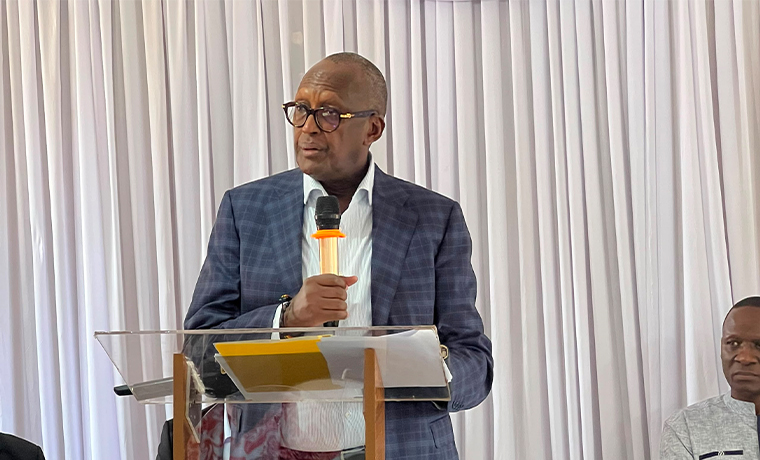
Tumukunde made the remarks during the National Multi-Stakeholder Dialogue on Combating Trafficking in Persons held at the John Paul II Justice and Peace Centre in Nsambya, where government officials, civil society organizations and anti-trafficking actors discussed the growing threat of human trafficking and child exploitation.
The minister said authorities must go beyond arresting individual offenders and instead trace the entire trafficking chain, including those who finance, recruit and transport victims.

He said dismantling trafficking requires following every link in the network, from the people who identify and lure vulnerable children to those who facilitate their movement and profit from their exploitation.

Tumukunde said he was already compiling information on trafficking operations and pledged to pursue the matter until the networks behind the exploitation of children are brought to justice.
His remarks followed disturbing testimonies from anti-trafficking organizations, which revealed that domestic trafficking has become a major challenge, with children from Karamoja among the most affected victims.

Maureen Muwonge, Country Director of Dwelling Places, an organization involved in rescuing and rehabilitating trafficking victims, told the dialogue that many children from Karamoja are trafficked to urban areas, including Kampala, where they are forced into street begging and other forms of exploitation.
The organization revealed that cases reported in 2025 largely involved domestic trafficking, with 558 children among the reported victims.
She said Karamoja remains one of the areas most affected by child trafficking, although children from other districts are also recruited and transported to cities where they are exploited.
Muwonge further disclosed that traffickers continue to change their methods and routes whenever communities become aware of their activities, allowing them to continue moving children despite interventions.
According to Dwelling Places, about 900 children have been resettled into schools in Napak District over the past two years as part of rehabilitation and reintegration efforts.
The organization also raised concerns over exploitation of children in Kampala’s informal settlements, including Katwe and Kisenyi, where some children are forced to beg during the day and subjected to sexual exploitation at night.
Officials were further told that some vulnerable young mothers are manipulated into providing babies who are then used for street begging, with infants reportedly hired out to attract sympathy from members of the public.
The Human Trafficking Institute also warned that domestic trafficking is more widespread than international trafficking, with victims often moved within Uganda under false promises of employment.
Julia Zabu, the institute’s Legal Programs Manager, said some Ugandans have been recruited from one district and transported to another after being promised jobs, only to be confined and exploited.
She said law enforcement efforts have often concentrated on arresting middlemen while the individuals controlling the trafficking networks remain unidentified.
Zabu also highlighted emerging forms of exploitation, including online sexual exploitation, where young girls are allegedly placed in private residences and forced to perform sexual acts online for foreign audiences in exchange for money.
She said some victims in such cases were aged between 17 and 25, warning that cases involving minors constitute aggravated child trafficking.
Zabu revealed that police had previously raided a suspected exploitation facility and recovered computers, webcams and mobile money transaction records believed to be linked to trafficking activities.
However, she challenged authorities to ensure that such operations result in successful prosecutions and accountability for those behind the crimes.
Responding to the concerns, Tumukunde called on anti-trafficking organizations to share intelligence and documentation with government agencies to strengthen investigations and prosecution.
He said cooperation between the Ministry of Gender, Ministry of Internal Affairs, police, civil society organizations and other stakeholders was necessary to dismantle trafficking networks.
The minister emphasized that Uganda’s fight against human trafficking must focus on identifying and prosecuting the people at the top of the criminal chain rather than only dealing with low-level actors.
Stakeholders at the dialogue called for stronger coordination, improved enforcement and increased protection of vulnerable communities, particularly children from areas affected by poverty and insecurity.
Tumukunde said the government would work with partners to ensure that child trafficking networks are disrupted and that rescued victims receive rehabilitation and support to rebuild their lives. (For comments on this story, get back to us on 0705579994 [WhatsApp line], 0779411734 & 041 4674611 or email us at mulengeranews@gmail.com).