






By Asuman Kiyingi
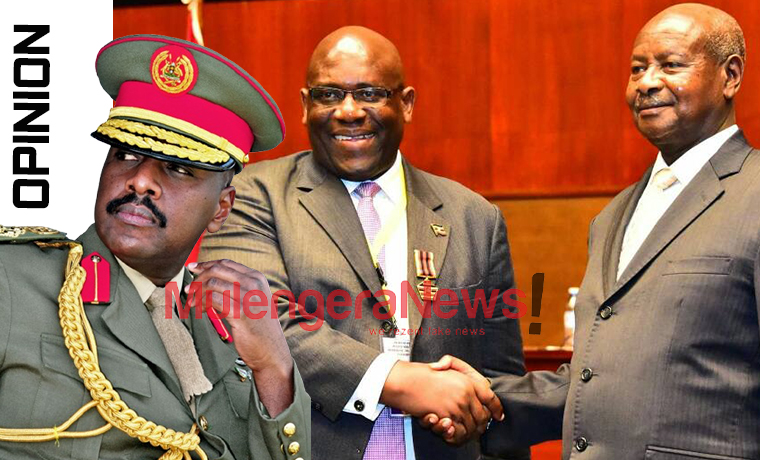
In a strongly-worded op-ed piece titled “The Republic in Chains: The Mutation into a Family Affair,” senior lawyer and former Museveni Minister Hon Asuman Kiyingi has predicted bad days ahead for Uganda unless Ugandans begin paying adequate attention and deliberately come together to push back against the impending ascendance to the Presidency by President YK Museveni’s son, Gen MK.
In his missive, Kiyingi, who lately has been very outspoken on the governance issues in Uganda, makes reference to several other African countries whose governance index has been steadily declining as a result of Museveni-like long-serving Presidents developing dynastic tendencies.

The verbatim version of Kiyingi’s op-ed piece is reproduced hereunder, in its original form:

I am sure some readers may not have read my article in The Monitor last week—The Republic in Chains and How to Reclaim It. That is understandable. But what is now unfolding across our continent makes its central warning impossible to ignore. The corrosion we spoke of is now declaring itself. This is not merely a political shift; it is a constitutional emergency.
We are witnessing the quiet conversion of republics into patrimonial estates. Power is no longer merely retained; it is being treated as an incorporeal hereditament—a piece of property to be bequeathed. The language of constitutions remains, but their spirit is being hollowed out, replaced by the archaic logic of dynastic succession.

Let us not soften this with polite terminology. This is not “stability.” It is the betrayal of the Social Contract. A republic stands on a simple, uncompromising principle: Public office is a public trust, not a private asset. No office is owned. No seat is reserved. No bloodline is entitled.
The moment a presidency is curated to facilitate a relative—be it a son, daughter, or in-law—the republic is no longer merely weakened. It is repudiated. This is no longer theoretical; it is a visible continental drift toward Neo-Patrimonialism: In Cameroon, Paul Biya has reconfigured the architecture of state power to position his son at the center of the succession apparatus.
In Equatorial Guinea, Teodoro Obiang has effectively formalized a “Vice-Presidency of the Bloodline,” installing his son with sweeping control over the coercive instruments of the state.
In the Republic of Congo and Eritrea, we see the same “personalization of continuity,” where sons serve as diplomatic and strategic proxies, blurring the line between state duty and family loyalty.
In Uganda, while the formal titles differ, the trajectory is uncomfortably aligned. The elevation of General Muhoozi Kainerugaba to the commanding heights of the military places him within visible proximity to ultimate political authority. When the “Commanding Heights” of the state become a family training ground, the meritocratic foundation of the Republic collapses.
Dynasties are not instruments of service; they are instruments of preservation. Under a dynasty, the state becomes a shield against accountability, the national treasury becomes an inheritance, and elections are reduced to ritualistic endorsements of decisions already made in the “Family Council.”
This is how constitutionalism dies—not in a sudden crash, but through calculated familiarity. A son is appointed here, a portfolio entrusted there, command consolidated quietly. Before long, succession is no longer a democratic question; it is a fiduciary arrangement.
The consequences are as grave as they are predictable. Proximity replaces merit. Institutions are subordinated to loyalty. Politics becomes a “closed circuit” where entry is determined not by conviction, but by surname.
Worse still, such systems are inherently volatile. When power is confined to a family, political competition becomes existential. Losing office is no longer a normal democratic outcome; it is a threat to the family’s survival. This transforms politics into a desperate struggle from which nations rarely emerge unscathed.
History teaches us that the transition from a personalized state to a dynastic one never leads to renewal. It leads to rupture. A republic that prepares heirs has already begun to abandon itself. Uganda must not walk this path. We have endured too much to surrender our future to the logic of inheritance. Our Constitution is not a family charter. Our armed forces are not a household guard. Our presidency is not an heirloom.
If the republic is in chains, then the creeping normalization of familial succession is the forging of the final links. It must be resisted—not with caution, but with the firm re-assertion of our status as citizens, not subjects. May Uganda have the wisdom to see this danger, the courage to reject it, and the resolve to ensure that our Republic remains exactly that: Res Publica—a matter of the people. The writer is a Senior Advocate and former Minister. (For comments on this story, get back to us on 0705579994 [WhatsApp line], 0779411734 & 041 4674611 or email us at mulengeranews@gmail.com).