






By Ben Musanje
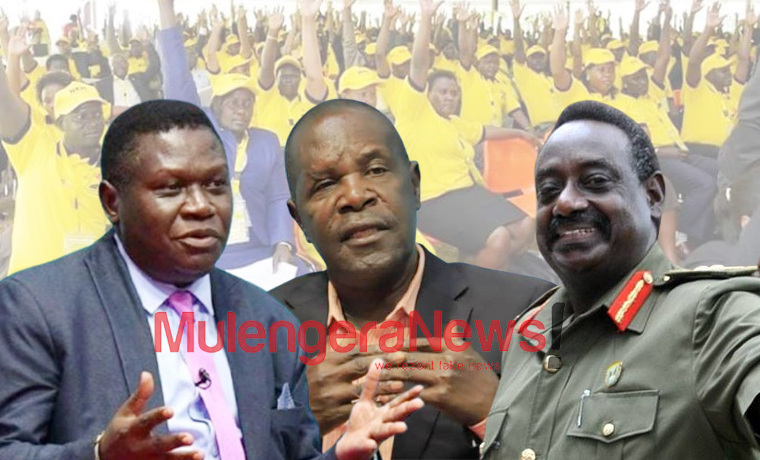
A political storm has erupted in Uganda on social media after Justice Minister and Democratic Party President Norbert Mao was invited by the ruling party to address its parliamentary caucus ahead of the Speakership race, a move that has triggered a fierce and controversial clash between retired General Gen. David Sejusa and former Government Spokesperson Ofwono Opondo.
What looked like normal political invitation given the binding agreement between the ruling National Resistance Movement (NRM) and DP, quickly exploded into a war of words on “X”, exposing deep divisions, old grudges, and sharp disagreements over power and strategy.
The former Intelligence Chief Gen. David Sejusa came out strongly, making it clear he had avoided speaking about the Speakership contest because it had been reduced to personalities instead of real political ideas. But Mao’s sudden entry into the picture changed everything.

Sejusa argued that Mao is not just another candidate. He insisted that the Democratic Party leader brings a completely new political force from outside the ruling National Resistance Movement, something that could reshape the entire contest.

According to Sejusa, this is where many are getting it wrong — especially people like the former Uganda Media Center (UMC) Executive Director Ofwono Opondo.
He warned that dismissing Mao is political blindness. In his view, the ruling party must think beyond its usual circles if it wants to strengthen its grip on power. Mao, he said, carries a section of the opposition with him, and that makes him a powerful factor in the race.
Sejusa pushed the argument further, raising the sensitive issue of regional balance. He pointed out that key government positions are already dominated by certain regions, and questioned who is currently representing Northern Uganda at the highest level.

He mocked critics of Mao, saying they clearly failed “political algebra,” a statement that immediately drew fire.
Ofwono Opondo did not take it lightly.
The former Government Spokesperson fired back with sharp and personal attacks, questioning Sejusa’s credibility and reminding him of past political and military failures. He brought up the 1997/98 fallout when Sejusa attempted to leave the army, claiming he lost that battle and is no longer capable of making any serious impact.
Opondo also took a swipe at Sejusa’s past exile in the United States, saying he eventually returned quietly — a remark clearly meant to undermine the General’s authority.
In a tone mixing sarcasm and warning, Opondo told Sejusa that his past ’30 years” arrogance no longer fits in today’s Uganda, even as he addressed him as an “elder brother and comrade.”
That only made things worse.
Sejusa responded with visible anger, telling Opondo to stay out of his affairs and warning him to go slow. He also threw a jab at Uganda’s past political actors, suggesting they should be humble.
The clash quickly spilled beyond the two men, drawing in political commentators and analysts who took sides in the escalating drama.
Political analyst Charles Rwomushana advised Sejusa to ignore Opondo altogether, recalling past incidents where President Yoweri Kaguta Museveni reportedly dismissed claims made by Opondo about the General.
But others were far more aggressive.
Janice Kyakundwa openly attacked Opondo, praising Sejusa’s record of service while accusing Opondo of lacking merit and rising through questionable means.
Enos Nzyotho mocked Opondo’s response, accusing him of exposing ignorance in public.
And Prof Jamil Mujuzi added fuel to the fire, describing Opondo as one of the most hot-tempered public figures in the country.
At the center of it all remains Norbert Mao — whose invitation to address the ruling party when NRM has the incumbent Speaker of Parliament Annet Anita Among has now become more than just a political event. It has turned into a trigger for a wider power struggle, raising questions about alliances, strategy, and the future of Uganda’s political direction.
What began as a simple move ahead of the Speakership race has now exploded into a loud, bitter, and very public confrontation.
And as Gen. David Sejusa and Ofwono Opondo continue tearing into each other on social media, one thing is clear — this is no longer just about Mao.
It is about power, control, and who gets to shape Uganda’s political future. (For comments on this story, get back to us on 0705579994 [WhatsApp line], 0779411734 & 041 4674611 or email us at mulengeranews@gmail.com).