







By Guest Writer
In the month the world celebrates women, Uganda’s two most powerful voices in science and technology have done something more lasting than be celebrated; they have agreed and activated a joint roadmap to ensure that a digitally connected Uganda becomes an economically rewarded one. NDP 4’s ATMs are finally talking to each other. This is how.
That is not a warning from a foreign development report. It is the challenge Uganda has set itself — and this week, two of the country’s most senior technology leaders did not merely discuss it. They signed off on a collaboration roadmap, and declared it already operational. Uganda is, by most measures, increasingly connected.

Mobile penetration is rising. Internet access is expanding. Digital payments are threading through markets, schools, and hospitals. But connectivity alone is not wealth. A nation can be online and still be left behind — if the devices it uses are made elsewhere, the platforms it depends on are owned elsewhere, and the value its digital activity generates is captured and taxed elsewhere. The connection exists. The economic reward does not. Not yet.

It is March. Across Uganda and the world, institutions are marking Women’s Month with speeches, galas, and carefully curated panels. But in a meeting room at the National ICT Innovation Hub in Kampala this week, something more durable than a celebration was taking place.
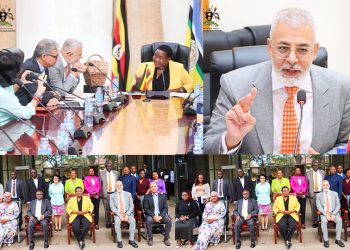
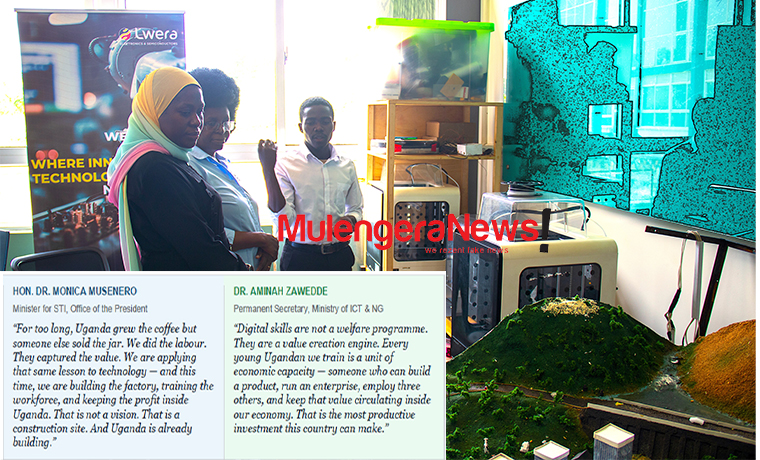
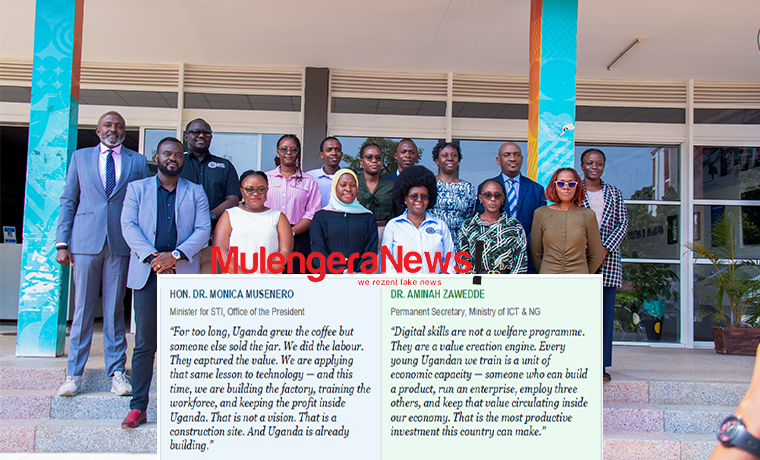
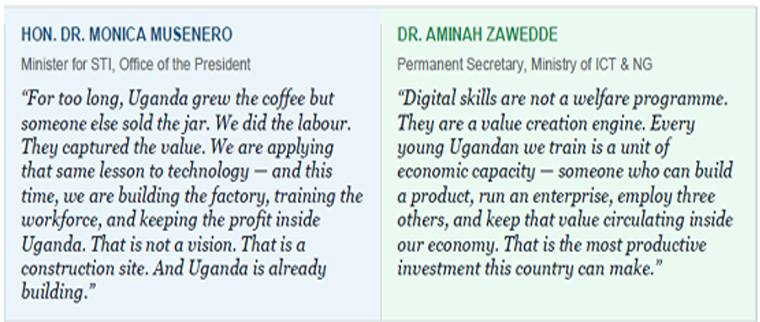
Hon. Dr. Monica Musenero, Minister for Science, Technology and Innovation in Uganda’s Office of the President, and Dr. Aminah Zawedde, Permanent Secretary of the Ministry of ICT & National Guidance, sat down together; and left with something concrete: an agreed, operational collaboration roadmap between their two institutions.

Their shared subject: producing digital value. Capturing it. Retaining it. And, critically, converting it into jobs for a country whose young population’s patience with unfulfilled economic promises is running measurably thin.
The roadmap is agreed. It is already moving. Uganda has seen its share of frameworks that did not survive the signing ceremony. This one is different; and the difference is deliberate. The collaboration roadmap agreed between MoICT and STI-OP is not a future commitment.
It is operational. Focal persons have been designated in both institutions. Joint projects are identified. Timelines are live. What makes this roadmap structurally significant is what it connects. NDP 4 envisions Uganda’s economy being driven by interlocking engines — each ministry, each agency, each value chain acting not in isolation but as part of a coordinated national machine. For years, those engines have been running in the same direction but on separate tracks.
The MoICTSTI roadmap is the coupling mechanism. It is how the ATMs (Agro-Industrialization, Tourism Development, Mineral-based Industrial Development (including Oil and Gas), Science, Technology, and Innovation (including ICT)) of NDP 4; the institutions through which Uganda’s industrial ambition gets financed, built, and deployed; finally operate as one system.
Connected — but not yet rewarded The uncomfortable truth beneath Uganda’s digital progress story is this: being a consumer of technology and being a producer of it are two entirely different economic positions. Every smartphone imported, every software license paid to a foreign vendor, every cloud service billed from a data center in Europe or America represents value leaving Uganda. The connectivity is real.
But so is the economic disconnection — the gap between using the digital economy and owning a piece of it. This is the gap the MoICT-STI roadmap is explicitly designed to close — not by retreating from globalization, but by building the productive capacity that earns Uganda a seat at the table as a maker, not merely a market. NDP 4’s industrial logic is unambiguous: Uganda cannot grow wealthy by exporting raw inputs and importing finished goods.
The ore must become the component. The crop must become the product. The code must become the platform. Value must be produced here, captured here, and retained here — by Ugandan hands, on Ugandan machines, through Ugandan enterprises that pay Ugandan taxes and employ Ugandan youth. The roadmap agreed this week is the institutional wiring that makes that possible. What women’s leadership looks like when it is structural Uganda has heard the arguments for women in Science, Technology, Engineering, and Mathematics many times over.
What has been rarer is the sight of women not just arguing for a seat at the table, but redesigning the table itself. Dr. Musenero and Dr. Zawedde carry technical and administrative credibility built over entire careers in science, public administration, and technology governance. The symbolism lands anyway — and it lands hardest on the young woman in an engineering lecture at Makerere, or debugging code at a NiiH bootcamp in Nakawa, wondering whether the economy being built around her has a place for what she knows.
In Women’s Month 2026, the most powerful message Uganda’s government is sending to its daughters in science is not a statement. It is two women deciding, together, how a country stops being digitally connected but economically disconnected — and then drawing up a roadmap to get it there. “The girls in our STEM classrooms do not need more inspiration. They need institutions that are ready for them when they graduate. That is what Dr. Musenero and Dr. Zawedde are building — together.” (For comments on this story, get back to us on 0705579994 [WhatsApp line], 0779411734 & 041 4674611 or email us at mulengeranews@gmail.com).