










By Ben Musanje
Before sunrise settles over Kampala, the city’s taxi parks are already alive.
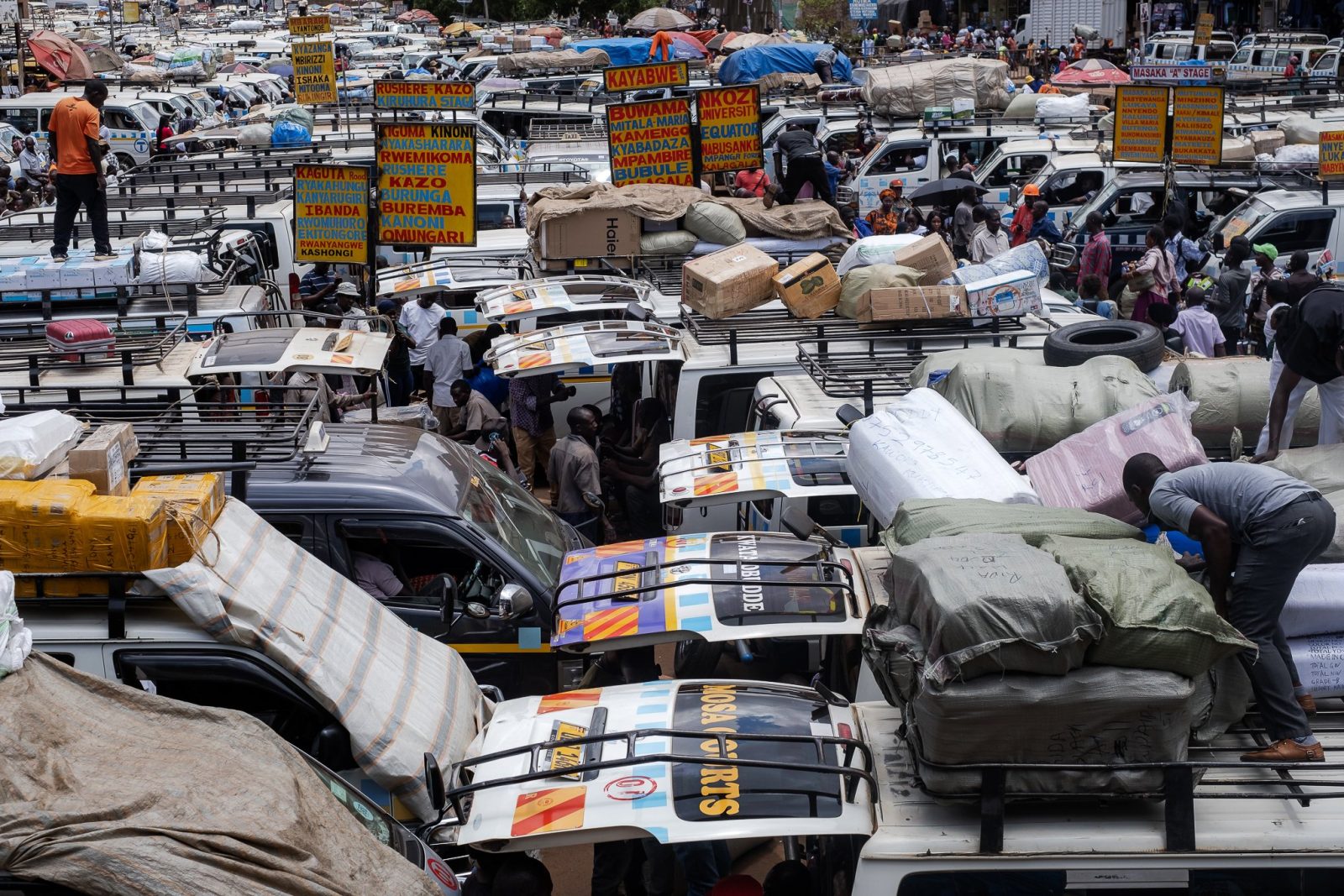
Engines idle in long rows of white commuter minibuses, their blue stripes marking them as Uganda’s public service taxis. They sit bumper-to-bumper, noses pointed toward narrow exits that will soon release them into the morning rush. Conductors slap the metal sides of vans and shout destinations into the dusty air.

“Kireka! Banda! Bweyogerere!”

The calls overlap until they become a steady roar. Diesel fumes hang low between the vehicles. Torn seats peek through sliding doors. Passengers squeeze through narrow corridors that were never meant to be walkways. Hawkers weave through the crowd carrying roasted maize and boiled eggs. A small radio crackles somewhere in the background while two conductors argue loudly over whose turn it is to load passengers.
This is how Kampala wakes, amid diesel fumes, shouted destinations, and the quiet urgency of people trying to earn a living before the traffic tightens its grip on the day.
Behind every steering wheel sits someone doing the arithmetic of survival.

Drivers wake before dawn to secure a place in the queue. For many, sleep is short, interrupted, and rarely restorative. The workday stretches through long hours of navigating traffic, uncertain earnings, rent, school fees, and taxi levies, including annual payments of about UGX 720,000. Passengers today mean dinner tonight.
Yet inside the noise of the taxi parks lies a story that has remained largely invisible.
A new study by Dr. Linda Jovia Kyomuhendo, a medical doctor and graduate of the Master of Public Health programme at Makerere University School of Public Health, has uncovered high levels of psychological distress among minibus taxi drivers operating in Kampala’s major taxi parks.
In a cross-sectional survey of 422 drivers across Old, New, Kisenyi, Usafi, Namirembe, Nakawa, and Nateete taxi parks conducted in March 2026, nearly two-thirds screened positive for symptoms of depression (65.6%), more than 70 percent reported anxiety, and an estimated 82 percent experienced stress.
The findings point to a largely overlooked occupational health concern within the city’s informal transport sector, where long working hours, economic pressure, poor sleep, and prior road accidents are closely linked to mental strain.
Across Uganda, an estimated 400,000 taxis move millions of passengers every day, forming the backbone of the country’s informal transport system. Yet surprisingly little is known about the psychological toll on the drivers who keep that system running.
That gap in knowledge is what drew Dr. Kyomuhendo into the unpredictable world of Kampala’s taxi parks.
Born on 23 July 1994 to Mr. Muhigwa Lawrence and Ms. Kataito Jacqueline, she grew up in Hoima District in western Uganda. Her early education took her from St. Christina Nursery School to Budo Junior School before continuing to Trinity College Nabbingo and later Mount Saint Mary’s College Namagunga for Advanced Level, where she studied Biology, Chemistry, and Mathematics.
In 2014, she earned a government scholarship through the Public Universities Joint Admissions Board and enrolled at Busitema University to pursue a Bachelor of Medicine and Bachelor of Surgery, graduating in 2019.
Her interest in public health deepened during her internship at Masaka Regional Referral Hospital. The wards were often full of road traffic injuries, complications of chronic diseases, severe malaria in children, and obstetric emergencies that might have been prevented with earlier intervention.
Many of the crises doctors were treating, she realized, had begun long before patients reached the hospital.
“They were symptoms of deeper problems,” she recalls.
Public health offered a way to investigate those deeper causes. In 2022 she enrolled in the Master of Public Health Distance programme at Makerere University School of Public Health, where students are trained to examine health challenges not only at the bedside but across entire populations.
Guided by Associate Professor Lynn Atuyambe of Community Health and Behavioural Sciences and Juliet Kiguli, a senior lecturer at the school, Kyomuhendo began exploring research questions rooted in everyday life in Uganda’s cities.
Taxi drivers soon captured her attention.
Uganda’s road transport system is dominated by motorcycles and 14-seater minibus taxis. About 15,000 operate in the Kampala Metropolitan Area alone, navigating congested roads, polluted air, erratic traffic patterns, and workdays that begin before dawn and often stretch deep into the evening.
“They are important in Uganda’s transport industry,” Kyomuhendo says. “Yet they seem to be overlooked in our society.”
While commuting across Kampala during her studies, she began noticing the lives of taxi drivers more closely. Arguments between passengers and conductors were common. When tensions rose, someone in the crowd would eventually mutter the same question in Luganda:
“Oba abasajja ba takisi baabaki?” — loosely translated as What is wrong with taxi men?
The question lingered.
In June 2024, social media campaigns marking Men’s Mental Health Awareness Month pushed her to think about the issue differently. What if the impatience, aggression, or frustration passengers sometimes observed was linked to deeper mental strain?
“They carry the responsibility for passengers’ lives every day,” she says. “Yet very little attention is paid to their own well-being.”
The working environment itself offers clues.
Data from Kampala Capital City Authority show that between 2019 and 2024, geolocated crash data revealed a dangerous road environment in which taxi drivers operate daily. During that period, 1,878 vulnerable road users, including pedestrians, motorcyclists, and cyclists, were killed in crashes involving motor vehicles.
Buses and minibuses were linked to 281 of those deaths, many involving pedestrians and motorcycle occupants. Fatalities were heavily concentrated along major corridors such as Jinja Road, Kibuye–Natete Road, Bombo Road, and Ggaba Road. For pedestrians, some of the most dangerous stretches included Gayaza Roundabout at Kalerwe and Kyebando Police Post along the Northern Bypass and Entebbe Road, where fatality densities reached as high as 27 to 28 deaths per kilometer.
These conditions form the high-risk traffic environment in which taxi drivers work daily, competing for space with pedestrians, boda bodas, and other vehicles along crowded arterial roads.
To understand how these pressures affect drivers, Kyomuhendo designed a study surveying 422 male taxi drivers across seven major taxi parks. Using a multistage sampling approach, the research gathered information on socio-demographic characteristics, occupational conditions, lifestyle habits, use of habit-forming substances, medical history, and environmental exposures.
Mental well-being was assessed using the Depression Anxiety Stress Scale (DASS-21), a widely used screening tool in mental health research.
Conducting the interviews meant stepping into one of Kampala’s most unpredictable workplaces.
“The atmosphere was survival for the fittest,” Kyomuhendo recalls.
The fieldwork also produced moments that stayed with her long after the questionnaires were completed.
One driver burst into laughter when asked how he coped with stress.
“I don’t drink or smoke,” he said, before joking that multiple relationships were his way of managing the emotional pressure of the job.
The answer was not part of the questionnaire, and both laughed. Yet the moment revealed something deeper: humour often hides exhaustion.
Another driver told her he had spent years buying herbal medicine for a hernia that never healed. Every month he spent nearly 100,000 shillings hoping the treatment would eventually work. Kyomuhendo advised him to seek hospital care instead.
“Sometimes people spend far more trying to manage a problem than it would cost to treat it properly,” she explains.
When the data were finally analyzed, the numbers told a troubling story.
Nearly two-thirds of the drivers screened positive for symptoms of depression. More than 70 percent reported anxiety. Over 80 percent experienced stress.
Drivers who had been involved in road accidents during the previous year were significantly more likely to report depression. Chronic medical conditions and family history of mental illness also increased risk.
Sleep deprivation emerged as one of the most powerful predictors. Drivers who consistently slept fewer than seven hours per night were far more likely to report anxiety and stress.
Economic security also played a major role. Drivers who owned their vehicles were significantly less likely to experience anxiety compared with those who rented taxis or paid daily remittance fees to vehicle owners.
In other words, psychological distress followed the same lines as economic pressure.
The implications stretch beyond the drivers themselves.
Mental health affects concentration, reaction time, and decision-making—abilities essential for safe driving in a city known for congestion, unpredictable traffic, and frequent road hazards, including flooding.
“If drivers are anxious or sleep-deprived,” Kyomuhendo says, “there is a risk they may struggle to follow traffic rules or respond quickly to hazards.”
In a transport system that carries millions of passengers daily, the mental well-being of drivers becomes not only an occupational health issue but also a matter of public safety.
During interviews, another pattern emerged. Few drivers openly described themselves as depressed or anxious. Instead, stress appeared in jokes, casual references to alcohol or relationships, or long pauses followed by silence.
Men’s mental health remains a difficult subject in many communities.
“Men’s mental health is a serious public health issue that should not be ignored,” Kyomuhendo says.
For Kyomuhendo, the research has changed how she sees Kampala itself.
Where many passengers notice impatience or congestion, she now sees the pressures shaping the lives of the men behind the wheel.
“It made me appreciate the men who show up every day and work hard despite their struggles,” she says.
One driver she interviewed summed up the reality of the job quietly.
“People will not help you unless they know the problems you are facing.”
By late afternoon, the taxi parks remain just as crowded as they were in the morning. Conductors still shout destinations into traffic. Engines idle in long rows of white vans waiting for passengers. Drivers lean against steering wheels, hoping the next arrival will finally fill the vehicle.
Kampala keeps moving because they do.
Most passengers step into these taxis thinking only about where they are going—work, home, school, or the market. Few stop to consider the pressures carried by the people behind the wheel.
Yet Kyomuhendo’s research suggests that beneath the noise of the taxi parks and the constant honking on the city’s streets lies something quieter and far less visible: a heavy burden of stress, anxiety, and depression.
Every morning the vans will still line up bumper-to-bumper. Conductors will still shout destinations into the air. Kampala will still climb inside and move.
But if nearly half a million taxis help keep Uganda moving every day, a question remains hanging over the city’s busiest streets:
Who is protecting the minds of the people behind the wheel? (For comments on this story, get back to us on 0705579994 [WhatsApp line], 0779411734 & 041 4674611 or email us at mulengeranews@gmail.com).