








By Mulengera Reporters
For decades, the people of Bulaza village, Kigando parish, Kigando Sub County in Kyankwazi District lived a life many Ugandans can only imagine.
While most villages struggled with dirty water and sickness, Bulaza faced another strange and painful problem: villagers had to compete with cattle for water from a muddy trench.
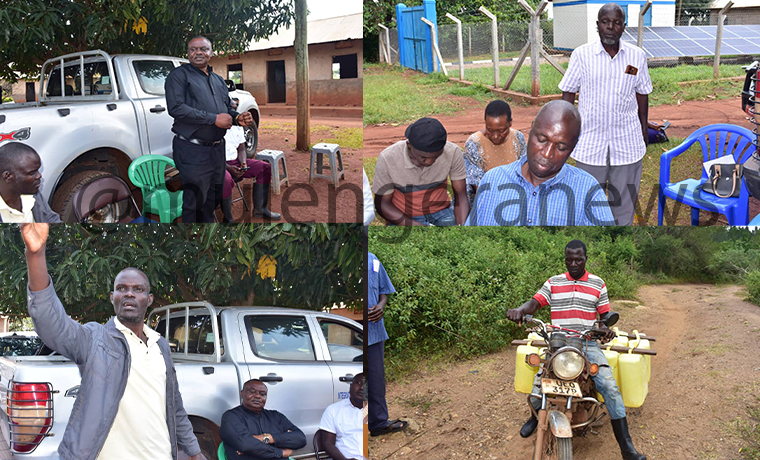
Clever Nsenga, the District Councillor for Kigando Sub County and a son of Bulaza village, remembers the suffering clearly. He says that in the 1990s, elders walked 14 kilometers to Mpongo wetland just to find water. As a Primary Seven pupil in 1998, he would ride the family bicycle all the way to Mpongo to bring water home.

The Balaalo cattle keepers had dug a trench that carried water from the wetland to a dry area where both cows and people gathered. More than 10,000 cows crowded there daily, desperate to drink. Many even died of thirst, making the place even dirtier and more unsafe.

Villagers waited for the cows to finish drinking before they filled their jerrycans with the same dirty water. Nsenga says the water was so filthy that no normal person would drink it by choice, but they had no other option.
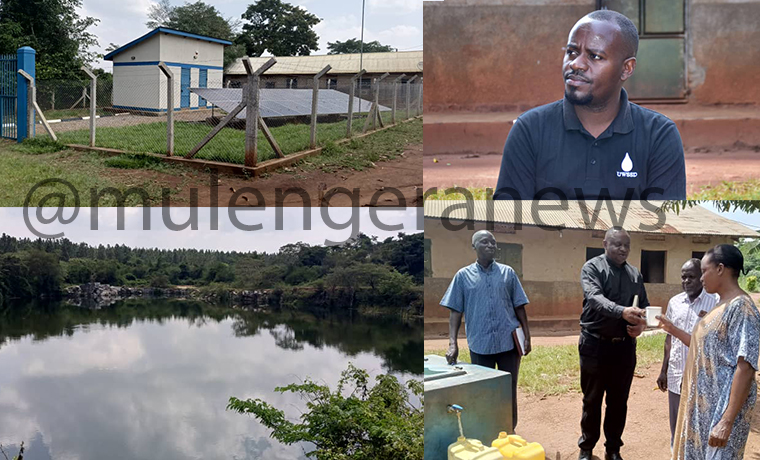
A small relief came years later when the Kampala–Hoima road was built. A huge stone was dug out, leaving a pit that collected water. Even though a person once died in the pit, people continued using it because it was closer—only 3 kilometers away instead of 14. Mother Care Health Centre became the place where many villagers went for treatment of waterborne diseases.
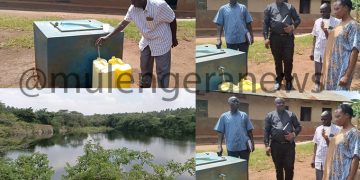
But their worst days are now behind them. The Ministry of Water and Environment has given Bulaza a new Solar Powered Water Supply System, constructed by Nexus Green under a national project funded by UK Export Finance and the Government of Uganda.

The project is part of a massive initiative worth over 111 million Euros to install more than 450 solar-powered water and irrigation systems across Uganda.
Reverend Father Leonard Katsigazi, the Catholic Priest who had long struggled to bring clean water to the village, welcomed the project with joy. Today, he serves as chairman of the water user committee and praises President Yoweri Museveni for including Bulaza in the project. He also thanked the Ministry of Water and Environment for fulfilling the President’s directive with what he called “a clean heart.”
The impact is already visible. Nsenga, who is also Chairman of the Parents and Teachers Association (PTA) at Trinity Primary School, says children in schools like Kigando Public School, home to 600 learners—are now clean and healthy. Private schools such as Immaculate Primary School, Busaana Primary School, Ebenezer Primary School and God’s Care Primary School, which has about 250 pupils, have seen similar change. Diseases have reduced, and children can now bathe regularly.
The water system now serves Bulaza, Kyambogo and Kigando villages. Residents from Busaana and Kakyamanga even walk a kilometer to fetch this clean water. But Nsenga says more villages like Busaana, Mbogobiri, Bwebitoomi, Kamukyope, Kakindu, Kabada—some as far as five kilometers away—and Kigabwa still desperately need clean water. He says cows are still dying in some of these areas, and the villagers are ready to work with the Balaalo to ensure the cattle also benefit.
George Musisi, the President of Taps for the Bulaza Solar Powered Water Supply System, says the water has never stopped flowing since the system began. He is already working to extend water to his own farm and says many business owners like bar owners, lounge operators and restaurant workers are asking for water taps. The only challenge is that people need bigger pipes to get water to their homes, but the pipes are expensive. One person needs up to 600 meters of pipe, something only the government can afford.
Sarah Kikomeko, the Treasurer of the water user committee, says they collect 100 shillings per 20-liter jerrycan to help with maintenance and repairs. She says this is much cheaper than the 1,000 shillings some residents used to spend to buy clean water per jerrycan.
Alex Musisi, Secretary of the water user committee and Head Teacher of Trinity Primary School, says he sees a big change in children’s performance in class. He could not hide his happiness when talking about how life has improved.
He joins Nsenga in asking the government to extend water to more villages still suffering. He says they checked prices in Hoima and found that one 100-meter roll of pipe costs 450,000 shillings, which is too expensive for villagers.
Musisi says they will handle this water project carefully so they do not lose it like the maize processing machine the village once received from the government but later lost due to poor management.
For Bulaza, clean water is no longer a dream. It is now a reality—one that has turned suffering into hope and restored dignity to a village that once shared water with cows. (For comments on this story, get back to us on 0705579994 [WhatsApp line], 0779411734 & 041 4674611 or email us at mulengeranews@gmail.com).