


By Otim Nape
In a dramatic and highly charged moment in Bundibugyo, Uganda, religious leaders and political figures gathered to praise President Yoweri Kaguta Museveni’s leadership while calling for more support for their district.
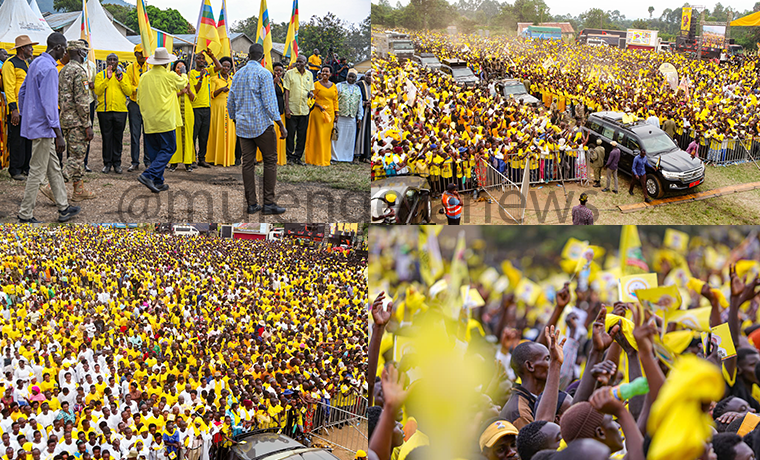
The event, which turned into a grand spectacle, was filled with fiery speeches, prayers, and promises of overwhelming votes in the upcoming 2026 general elections.
At the heart of this fervor was the revered Right Reverend Barnabas Tibaijuka, the first Anglican Bishop of West Rwenzori Diocese, who led a powerful prayer for the President.
The atmosphere was thick with anticipation as Tibaijuka stood before thousands of the National Resistance Movement (NRM) supporters, thanking God for the peace and prosperity Uganda has enjoyed under Museveni’s reign. “Lord God, I pray you reign amidst us, continue to strengthen our president, to give him the wisdom to lead this country,” Tibaijuka prayed passionately, his voice rising above the crowd. The crowd responded in unison, echoing their hope for continued guidance from the Almighty.
Tibaijuka, clearly supportive of the President, invoked divine blessings for Museveni, who was present at the rally, stood with other local dignitaries, including Reverend Father Patrick from Bugombwa Catholic Parish and Sheikh Suleyman Ibada, representing the Muslim community. The presence of such diverse religious leaders underscored the unity being championed at the event.
But the event wasn’t just about prayers and pleasantries. The Chairperson of the NRM in Bundibugyo District, David Kabbyanga, took to the stage with a mixture of gratitude and clear demands.
Kabbyanga expressed his immense satisfaction with the promises already delivered under Museveni’s leadership. “Your Excellency, we have been following you on TV, and we are extremely happy for the work you have done,” he began, his words a prelude to a long list of achievements touted by the NRM government in Bundibugyo.
Kabbyanga highlighted key milestones like the establishment of the Kokua Factory, the creation of Wendera District, and the large-scale distribution of funds for infrastructure development.
However, the crowd seemed most energized when Kabbyanga shifted his tone, passionately requesting more investments. “We need special consideration for Bundibugyo’s roads,” he pleaded. “The terrain here is treacherous, and the one billion funds allocated for road construction are barely enough to cope with the damage caused by mudslides.”
But Kabbyanga’s speech wasn’t just about complaints. He painted an optimistic picture of the future, citing the overwhelming support the district had for the President. “Come January 15, 2026, Bundibugyo will give you an overwhelming 100% vote, Your Excellency. We promise you that,” Kabbyanga declared with great confidence, his words resonating deeply with the crowd, which roared in approval.
The spectacle continued with Museveni himself taking the stage, his voice steady as he reflected on the journey Uganda had taken from war-torn chaos to relative peace. “You people who live along the country’s borders know the true meaning of peace,” he told the gathered masses. “Many across the border have died, their property destroyed, their time wasted. Uganda was once like the DRC, but when the NRM took leadership, we stabilized the country.”
Museveni’s words were a call to arms for the nation to remain united, despite the increasing pressures of divisive politics. He warned against those seeking to tear the nation apart, urging local leaders to focus on service delivery and accountability, rather than petty politics.
He drew a sharp contrast between Uganda’s peaceful trajectory under NRM and the ongoing conflict in neighboring countries, positioning his government as the anchor of stability in the region.
On a more personal note, Museveni spoke about the immense challenges that came with building Uganda’s infrastructure, particularly the road networks. “We once had no money, and we had to barter sorghum with Yugoslavia just to build roads like the Kampala–Mubende road,” he said, reflecting on Uganda’s early struggles.
He made a solemn promise that the dilapidated Fort Portal–Bundibugyo road, a key issue for many in the district, would soon be repaired, despite the delays that had caused frustration among local leaders.
He explained that these delays were due to competing demands from other parts of the country, but insisted that Bundibugyo would not be left behind.
While the day’s speeches and prayers served as a platform for leaders to express their gratitude and hope for continued development, it was clear that Bundibugyo’s future was firmly tied to President Museveni’s leadership.
His supporters, ranging from religious figures to political leaders, were all united in the belief that Uganda’s future success lay in his hands. The demands were clear: more roads, more factories, more water, and more investment in the district’s future.
But the underlying message was one of unwavering loyalty to the President, and an unshakable confidence that, with Museveni at the helm, Bundibugyo would continue to flourish.
As the rally drew to a close, it was evident that Bundibugyo had made its wishes known. (For comments on this story, get back to us on 0705579994 [WhatsApp line], 0779411734 & 041 4674611 or email us at mulengeranews@gmail.com).





