

By BM
In a dramatic twist that’s shaking Uganda’s media industry to its core, as the Executive Director of the Uganda Communications Commission (UCC), Nyombi Thembo, has issued a bold call to none other than the Chief of Defense Forces, Gen. Muhoozi Kainerugaba, to expedite a bold and controversial plan: send journalists to Kyankwanzi for ideological orientation and national values training.
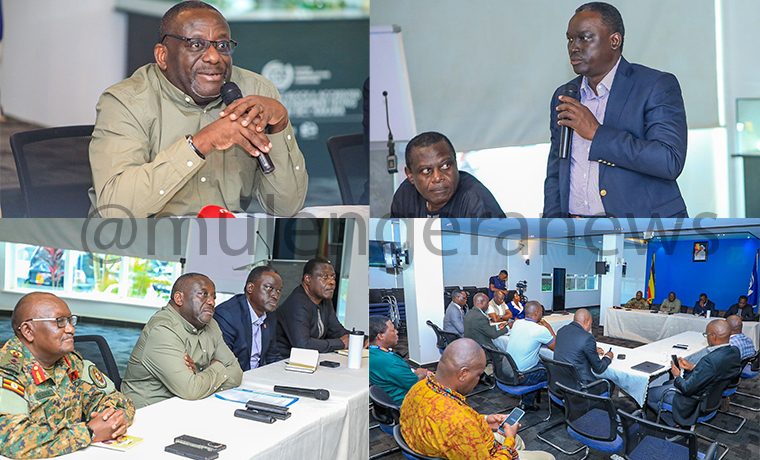
The bombshell proposal, made during a tense meeting with media sector managers in Kampala on Friday, has sent shockwaves through the media fraternity.
According to Nyombi, the move is a necessary step in ensuring that journalists fully understand and align with Uganda’s national priorities.

He argued that the press must play a more constructive role in nation-building and avoid content that promotes division, misinformation, or public unrest.

“Journalists are key partners in national development,” Nyombi stated. “Taking them to Kyankwanzi for orientation will strengthen their understanding of our country’s priorities and promote responsible reporting that reflects patriotism.”
The UCC boss insisted that the proposed training is not about controlling the media, but about empowering it.
According to him, Kyankwanzi a location deeply associated with ideological training for the National Resistance Movement (NRM) leadership would offer journalists a unique opportunity to understand Uganda’s vision and challenges from a leadership perspective.
He said this initiative is rooted in three pillars: professional growth, patriotism, and the ability to balance freedom of expression with national interests.
Nyombi’s remarks have reignited a fiery debate that has been smoldering for months. Back in February 2025, Gen. Muhoozi, then the Senior Presidential Advisor for Special Operations, issued a directive during a high-level meeting attended by government officials, including the Minister for Youth and Children Affairs, Balaam Barugahara.
The directive called for media leaders to undergo orientation at Kyankwanzi to be educated on their responsibilities to the nation and the dangers of disseminating harmful or misleading information.
Muhoozi stated that the training would be designed to instill a sense of accountability among media professionals while helping them understand the broader consequences of what they publish or broadcast.
According to him, journalists must appreciate the fine line between freedom of expression and national security.
While Muhoozi’s earlier call was met with a mixed reaction, Nyombi’s latest push to operationalize the plan has intensified the national conversation.
During the February meeting, Balaam Barugahara had attempted to downplay the ideological implications of the plan.
He clarified that the training in Kyankwanzi was not an attempt to convert journalists into supporters of the NRM, but rather an effort to raise the standard of journalism in the country.
He emphasized that credible, accurate, and contextual reporting is crucial for a stable society, especially in the era of social media misinformation.
Still, critics of the plan are not convinced. Leaders of Media Associations view the proposed training at Kyankwanzi a location synonymous with political indoctrination as a covert attempt to rein in media freedom under the guise of patriotism and professionalism.
Journalists and civil society organizations have raised concerns that such initiatives could be used to intimidate dissenting voices and blur the lines between state propaganda and independent journalism.
Despite the backlash, Nyombi did not hesitate to air his frustrations with certain media practices.
He specifically condemned media houses that, in his view, irresponsibly broadcast scenes of chaos, including confrontations between police and protesters, without offering adequate context.
“You cannot keep showing police firing tear gas without telling the public what provoked it. That kind of reporting fuels unrest and undermines law enforcement,” Nyombi said firmly.
His comments were echoed by Uganda People’s Defense Force (UPDF) Spokesperson Brig. Gen. Felix Kulayigye, who supported the Gen. Muhoozi’s proposal and stressed the importance of a disciplined media in safeguarding national unity.
Kulayigye called on journalists to show more love for their country and exercise caution in their reporting, warning that unchecked media narratives could threaten national cohesion.
As public interest in the proposal grows, all eyes are now on Gen. Muhoozi, who has yet to publicly respond to Nyombi’s renewed call.
With his earlier directive still on the table, his next move could determine the future direction of Uganda’s media landscape.
The Kyankwanzi plan, if implemented, would mark an unprecedented intervention by the state into media capacity-building.
Supporters say it’s a necessary reset to curb misinformation and restore journalistic integrity. Opponents, however, warn it could set a dangerous precedent for state overreach into press freedoms.
As Uganda continues to navigate the complexities of a rapidly evolving media environment, the battle lines are being drawn between those who believe in patriotic journalism and those who fear a slippery slope toward controlled narratives.
One thing is clear: the struggle for the soul of Uganda’s media has entered a new and unpredictable chapter. (For comments on this story, get back to us on 0705579994 [WhatsApp line], 0779411734 & 041 4674611 or email us at mulengeranews@gmail.com).