


By BM
Ugandan human rights lawyer Eron Kiiza has once again ignited national debate this time not from inside a courtroom, but from behind his desk and across social media.
In a bold tweet that quickly went viral, Kiiza declared he would not appear before High Court Judge Emmanuel Baguma, sparking a storm of reactions and renewed scrutiny over judicial impartiality in politically sensitive cases.
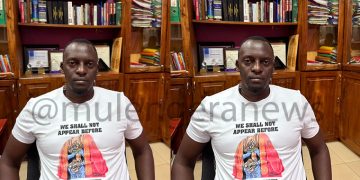
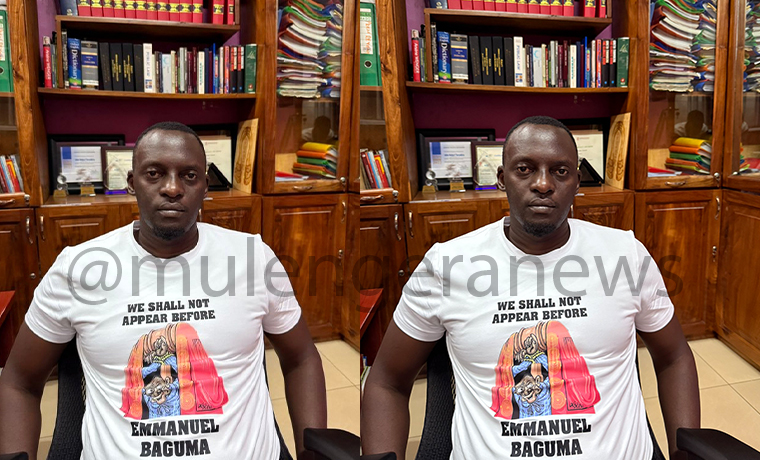
The tweet featured a striking image of Kiiza seated comfortably in an office chair, surrounded by bookshelves, dressed in a white t-shirt printed with the words: “WE SHALL NOT APPEAR BEFORE EMMANUEL BAGUMA.”
In the center of the message is a provocative image of a judge wearing a red robe, shackled in handcuffs, a visual metaphor critics say speaks volumes about perceived injustices in Uganda’s legal system.
Kiiza’s caption was equally sharp: “Since it makes no sense.”
Support poured in almost instantly. “I fully support you on this counsel,” wrote Henry Misagga.
Serah Tusiime chimed in, “Well done senior counsel. Indeed, it makes no sense.”
Yusuf Kayole added, “We shall not bow to anyone,” while Elidz Mzak went further: “Indeed appearing before that big headed man is a wastage of time.” Yet not all responses were supportive. One user, Colinez, simply replied, “You never learn,” hinting at Kiiza’s long history of confrontation with the justice system.
That history is what lends weight to this moment. Earlier this year, in January 2025, Kiiza was convicted by the General Court Martial for contempt of court during proceedings involving opposition politicians Dr. Kizza Besigye and Hajji Obeid Lutale Kamulegeya.
The nine-month sentence drew sharp criticism both domestically and internationally, as legal observers questioned the legitimacy of trying a civilian lawyer in a military court.
After spending more than 80 days behind bars, Kiiza was granted bail on April 4 by Justice Michael Elubu of the High Court.
The judge noted that Kiiza’s appeal had “substantial grounds,” and the decision to release him was met with cheers from supporters who filled the courtroom that day.
His bail terms included a UGX 20 million cash bond, UGX 50 million non-cash sureties, monthly reporting to the court, and the surrender of his passport.
Those who stood surety for him were no ordinary supporters. Among them were his wife, Sylvia Tumwebaze, a data manager at Hima Cement; Dr. Busingye Kabumba, his cousin and a respected law lecturer at Makerere University; and fellow lawyer Primah Kwagala, Executive Director of the Women’s Probono Initiative.
Their involvement signaled both personal and professional faith in Kiiza’s cause.
Now, his refusal to appear before Justice Baguma has put fresh focus on the integrity of the judiciary.
Judge Baguma is currently overseeing the treason case against Dr. Besigye and Hajji Lutale.
The case was transferred to the High Court in April but saw no progress for 106 days, until pressure from the defense triggered a hearing date.
A subsequent bail application was swiftly dismissed by Baguma, who argued that no proof had been provided to show the accused were remanded by the military court, an assertion the defense strongly contests.
In response, lawyers from Lukwago & Co. Advocates filed a formal request asking Judge Baguma to recuse himself, citing what they described as a “reasonable apprehension of bias.” They pointed to procedural delays, dismissive rulings, and a growing lack of public confidence in the fairness of the process.
The Judiciary has yet to officially respond, but the pressure is mounting.
For Eron Kiiza, the battle appears far from over. His white t-shirt has become more than just a garment, it’s a symbol of defiance, resistance, and a call for accountability in a system many believe is drifting away from justice.
Whether his protest will shift the course of this high-profile case remains to be seen, but one thing is clear: the conversation is no longer confined to the courtroom.





