






 By Mulengera Reporters
“To be relevant as a nation in this twenty-first century, youths must be empowered in such a way that no obstacle can stand in their way,” Bamigboye Olurotimi once said. Indeed, empowerment is crucial to the socio-economic transformation of any society. In this era of climate change, where nearly every segment of the population has become vulnerable, youth empowerment has become more crucial than ever. Well aware of this, the government of Uganda, with support from the Green Climate Fund (GCF) and the United Nations Development Programme (UNDP) under the Building Resilient Communities: Wetland Ecosystems and Associated Catchments in Uganda Project, is making strides in youth empowerment to become more aware of the impacts of climate change.
The project promotes sustainable wetland use and management through the conscious building of resilient communities, while also providing alternative livelihoods to nearly every segment of the population that has become vulnerable. Youth empowerment has become more crucial in communities. This has involved protracted stakeholder engagement, with most youth now aware that the fight against climate change cannot be won without their contribution. Irimbi Fish Youth Farming Group, in Irimbi ‘A’ village, Mpensia parish, Mazuba Sub-County, Namutumba district, is one such determined group of youth who are now taking issues of sustainable wetland management seriously through designing local initiatives that promote wetland-wise use principles. Wetlands play a crucial role in addressing climate change impacts.
Mr. Sowed Lukwago, the chairperson of the group, explains what drives them. “When government officials came here to mobilise and sensitise communities on the dangers of degrading the Mpologoma wetland system, they told us to voluntarily leave the wetland so that it could regenerate and provide its functional services. We heed the call.” “We were growing rice. We noticed our actions were severely affecting the wetland ecosystems. We were also told that even if we vacated the wetland, we would still have access to the wetland and use it in a sustainable manner, such as establishing mini-irrigation schemes, or engage in fish farming at the periphery of the wetland,” Lukwago adds.
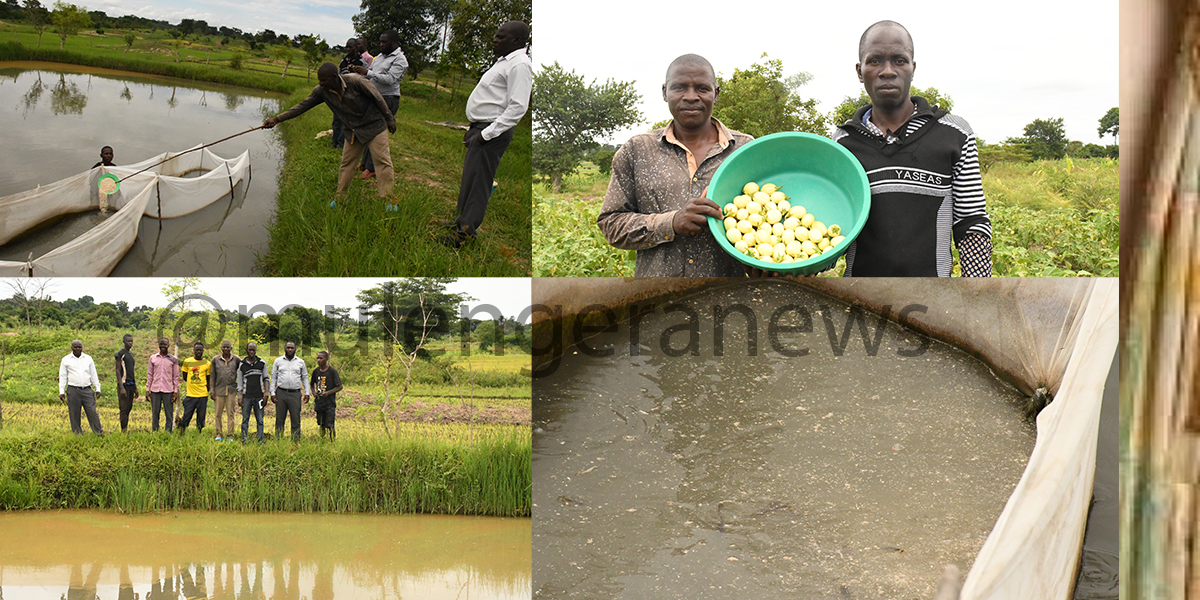
Upon understanding the importance of wetlands and the attendant effects of wetland degradation, Lukwago then took the initiative to mobilise other youth in his community who formerly earned a living from the wetland. They manually established four fishponds at the periphery of the wetland, but near a reliable water source. They stocked them using fingerlings (catfish)captured from the Mpologoma wetland and fed the fish using feeds made out of locally available materials.

Driven by the desire to become resilient to climate change, the group further lobbied for capacity-building opportunities, which they received through another development partner, Food for the Hungry. “As you can see, we are trying to do fish farming here, so that we can better our lives. Since we started this venture three years ago, other community members have wished they could be part of our initiative. We expect to start registering a good harvest, and we will do better than we are now. Our challenge, though, is feeding,” Lukwago said.
This level of determination from the next generation is impressive and has attracted interest from the government. “We have decided to support this initiative because they understood our message and put it into practice. So, we are now supporting the group with technical expertise, fingerlings, feeds, and equipment for irrigation so they can manage their other enterprises, like horticulture. Dauda Ikaaba, the GCF project focal person in Namutumba district, said. Namutumba is one of the 24 districts of the southwestern and eastern regions implementing the GCF-funded project. (For comments on this story, get back to us on 0705579994 [WhatsApp line], 0779411734 & 041 4674611 or email us at mulengeranews@gmail.com).