








By Mulengera reporters
What started as a good thing, bringing fast internet to every home and office, has now become a problem for Kampala and nearby towns. Roads and neighbourhoods in Kampala, Wakiso, Mukono and Mpigi are now full of crooked poles and tangled wires from different telecom companies.
It’s not only spoiling the beauty of the city, but also creating safety risks for the public.
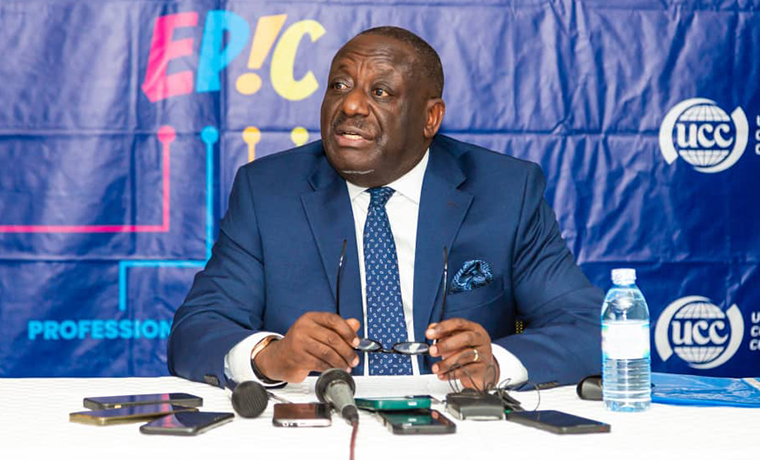
Now the Uganda Communications Commission (UCC) has come out strongly to restore order.
In 2021, UCC introduced guidelines to help telecom companies share infrastructure like poles and underground cables instead of each one digging and installing their own.

The idea was to reduce the clutter and save space. But unfortunately, many companies ignored the rules and continued to work in an uncoordinated way.

As a result, UCC has started carrying out audits in areas most affected by this mess. These inspections aim to push companies to merge their installations where possible.
New technical rules have also been introduced to control how poles are put up (from how tall they should be, how far apart they must stand, how trenches are dug, to how cables are marked).
This, according to UCC, will not only improve safety for the public but also make our cities more organised and attractive.

In April this year, a high-level working group was formed, bringing together bosses from NITA-U, Uganda Electricity Distribution Company Limited (UEDCL), and major telecom companies. They are now working together to encourage infrastructure sharing and reduce duplication of work.
UCC and its partners have also turned to underground cable networks as a better option. These underground corridors are not only safer but also protect the city’s appearance.
Thanks to support from the Ministry of Kampala Capital City and Metropolitan Affairs, Ministry of Works and Transport, National Water, and the ISP community, underground cable systems have already been planned and rolled out in Kampala and parts of Wakiso, Mukono and Mpigi.
This model (where many service providers share the same underground space) is being referred to as a kind of “carpooling for cables,” saving money, preventing unnecessary digging, and keeping the environment clean.
UCC believes that the key to solving this problem is not just forcing people to follow rules, but getting everyone to work together in good faith. And the message being sent here is “Share more, dig less.”
If all stakeholders cooperate, Uganda can continue expanding internet access without turning its towns into construction zones.
The future, according to UCC, lies in planning better, sharing more, and respecting the look and order of our cities. That way, we can stay connected and still keep Kampala and other towns clean and organized. (For comments on this story, get back to us on 0705579994 [WhatsApp line], 0779411734 & 041 4674611 or email us at mulengeranews@gmail.com).