







By Mulengera Reporters
In a move to close the digital gap in Uganda’s education system, the Uganda Communications Commission (UCC), through its Uganda Communications Universal Service and Access Fund (UCUSAF), has officially launched a pilot project aimed at boosting digital learning in rural primary schools.
This latest initiative is being rolled out in partnership with Nkumba University and is designed to harness community structures and digital technology to improve teaching and learning.
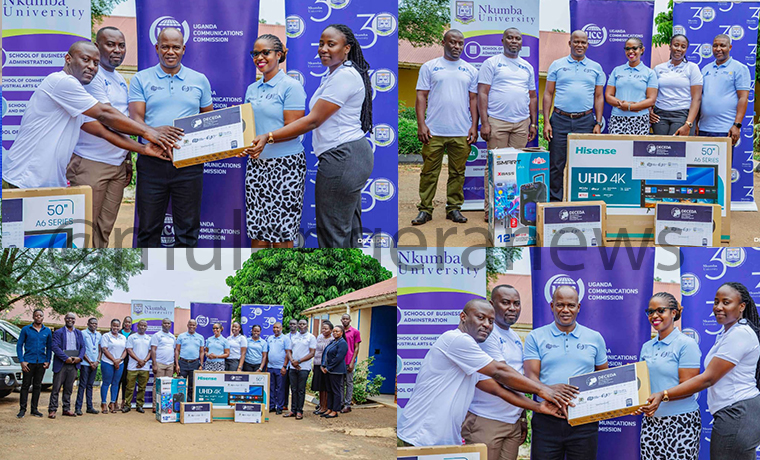
The pilot project was unveiled with a send-off ceremony for ToTs who are set to implement the programme across 31 selected primary schools countrywide.
The launch, which took place on Tuesday, July 8, was graced by the Vice Chancellor of Nkumba University, Professor Jude Lubega, and attended by UCC officials including Immaculate K. Amanya, Senior Officer for Partnerships, and Patra Asiimwe, an intern attached to the Commission.
Under this initiative, each participating school will be equipped with a 50-inch television set, a wireless speaker, and a network router to support multimedia learning.

Additionally, six “anchor schools” will receive a laptop and a conference camera to enable real-time live streaming of lessons to other institutions. At least three teachers from each school will receive digital literacy and technical training from the ToTs to ensure smooth implementation of the project.

The DECEDA programme directly aligns with Section 5 (s) of the Uganda Communications Act, 2013, as well as UCUSAF Strategy IV objectives 2 and 5. These frameworks focus on increasing digital access and promoting collaborative efforts to ensure no Ugandan learner is left behind in the digital era.
Speaking at the flag-off event, UCC’s Immaculate Amanya underscored the urgency of bridging the education technology gap.
“The Commission recognises that quality education is no longer possible without digital access. DECEDA provides a practical roadmap to bring ICT-enabled learning into classrooms that have long operated without these vital tools,” she said.

According to officials, the 31 schools were carefully selected in consultation with the Ministry of Education and Sports, based on need and readiness to adopt digital learning. The training, content delivery, and support will build on an earlier platform, known as the Holistic E-Learning Platform (HELP), which was developed to support rural learning through multimedia instruction.
Nkumba University is expected to play a central role in developing localised digital learning content, overseeing training, and monitoring impact throughout the rollout. According to Prof. Lubega, the partnership goes beyond just technology.
“We are laying a foundation for a digitally literate and empowered generation. The tools are important, but equally vital is the support we give to teachers to use them effectively,” he stated.
Among its broader goals, the DECEDA project seeks to improve access to quality learning materials, support classroom instruction with multimedia content, and create a culture of content sharing between schools through a digital network. This means that rural learners, who often have limited access to textbooks and qualified instructors, will soon be able to access standardised lessons and resources through technology.
UCC hopes to use DECEDA as a model for wider rollout, with plans already in motion to scale the project to more schools, establish a central hub for content creation and storage, and conduct a follow-up study to evaluate how digital tools are influencing learning outcomes.
This intervention adds to the Commission’s broader efforts to digitise education. UCUSAF has so far provided over 1,400 government-aided secondary schools and tertiary institutions with computer labs across Uganda.
A separate E-Classroom pilot, targeting primary schools in Buikwe, Nakasongola, and Mpigi districts, is also underway and is expected to be officially launched by September 2025.
If successful, DECEDA could signal a turning point in how public education is delivered in Uganda’s rural areas, where access to electricity, internet, and learning resources remains low. UCC officials say the long-term goal is not only to digitise rural schools but also to create an inclusive digital learning ecosystem where every child, regardless of background, can learn, grow, and thrive.
As the demand for ICT-integrated learning continues to grow, projects like DECEDA show that with the right partnerships, strategy, and commitment, the digital transformation of Uganda’s education system is not just possible, but already underway. (For comments on this story, get back to us on 0705579994 [WhatsApp line], 0779411734 & 041 4674611 or email us at mulengeranews@gmail.com).