







By Our Reporters
The year was 2013 when then President Museveni’s press secretary Tamale Mirundi, who craved and liked controversy, went bareknuckle on the Catholic Church leadership in Uganda.
In his latest book titled “DIVINE CURSE,” Mirundi took advantage of then ongoing crisis in Ugandan Catholic Church to claim existence of a curse in Ugandan Catholic Church. He linked this curse to historical conflict between the Church and Mengo, the political and administrative seat of Buganda kingdom.

Mirundi claimed that, just like in Mengo’s case, people shouldn’t be surprised with those days’ events in the Catholic Church. State House sources then revealed that Mirundi had prepared this book much earlier but all of a sudden decided to market it very aggressively following the storm that Father Anthony Musala’s claims, alleging that several priests and Bishops had become sexually active, had sparked as of that year 2013.

In his book, Mirundi stated that the Catholic Church cursed Mengo to revenge against marginalization of Catholics in sharing political positions at Mengo. Though one side (showing only the Church cursing Mengo), Mirundi’s book speculated that it’s possible the curses past Catholic Church leaders directed at Mengo could have backfired resulting the scandal that was choking then Archbishop Cyprian Kizito Lwanga-led Catholic Church.
DETAILS
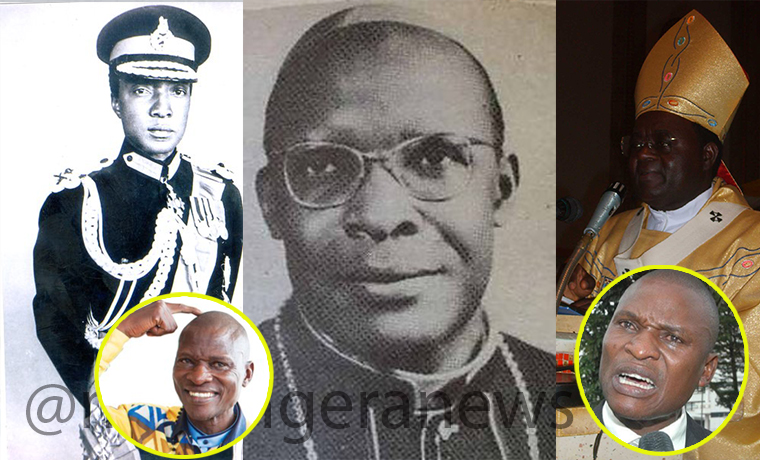
From the very onset, Mirundi asserted that disgruntled clergy in the Catholic Church over 50 years ago directed “divine curse” at Mengo which still lives under this curse. Mirundi’s small yellow book went on to cite 10 major instances from the two institutions’ acrimonious history to prove that the mistreatment of the Catholic Church leaders caused Mengo and Catholic Church to direct curses at each other. The 23-page book cited pioneer Catholic archbishop Joseph Kiwanuka as one of the victims of targeted witch-hunt by Mengo especially in run up to independence and in the first 10 years that followed.

Without showing whether it was the official Mengo position or not, the book revealed that much of the violence against Catholics was orchestrated by Kabaka Yekka (KY, a Mengo party) militants who believed Catholics were an obstacle to Mengo’s advancement.
In this well researched article, we reflect on Mirundi’s evidence regarding the alleged divine curse under which he claimed the two institutions continued to live under as of that time (2013).
Coincidentally, Mengo and Catholic Church officially perceived Mirundi to be their enemy number 1. Despite the alleged divine curse, the two institutions, for some time now, have been trying to forget their past and reconcile.
BACKGROUND
Mirundi’s book begun by citing Catholics like ex-Katikkiro Mulwanyamuli as people who ate big at Mengo in the 1990s not because the kingdom’s perception of Catholics had changed but for totally different reasons.
Joseph Byalike Musoke served as Katikkiro under the Sabataka Advisory Council in the 1980s all the way to Mutebi’s coronation time in 1993 but Mirundi argued he served under difficult circumstances created for him by haters at Mengo who loathed the fact that he was a Catholic.
Mirundi pointed out that there was no way Musoke could excel as Katikkiro and portray Catholics properly because of his frail age. It was deliberate, Mirundi said, to appoint such a senile Catholic so that his failures and mistakes would be used to prove that Catholics can’t make good Katikkiro at Mengo.
Mulwanyamuli, according to the book got Ddamula (power symbol for Katikkiroship) from Joash Mayanja Nkangi not because Mengo wanted to integrate Catholics but because Kintu Musoke, who was a powerful Museveni minister then, wanted to use him (Semwogerere) for proxy purposes in his wars against Nkangi who was intending to contest with him for Kalungu West Seat in CA.
That Kintu Musoke, who at that time had a lot of influence on Kabaka Mutebi, convinced the king of the need to reconcile Catholics back and proposed two names of potential Katikkiros including Semwogerere and JB Kawanga. Mutebi had initially preferred JB Kawanga who was more experienced then having been an MP and a roommate of President Museveni at the Ntare and Dar-es Salaam University. However, Kawanga declined and the seat went to Mulwanyamuli.
Mirundi’s essay also revealed that the Catholic Church-Mengo acrimony intensified in the 1890s, having begun much earlier during Kabaka Mwanga’s time. Mwanga’s accepting to become a Catholic (under Capt Lugard’s influence) riled a protestant clique at Mengo that was led by influential Katikkiro Sir Apollo Kaggwa.
The Kaggwa group connived and toppled Mwanga with the backing of Britain. Since then, the well-researched Mirundi book asserted that, protestants plotted to dominate all the positions-especially that of the Kabaka and Katikiro-at Mengo.
ANTI-SEMWOGERERE PLOT
The book revealed that, angered by Mulwanyamuli’s appointment, a group of disappointed protestants entrenched within Mengo met the Kabaka and asked him to sack him. They were led by Bp Yokaana Mukasa, the father of Gertrude Njuba, one of Museveni’s private secretaries.
Saying it would back fire, Mutebi declined and they plotted to confuse Semwogerere into resigning voluntarily. They plotted to tell him how it was risky to be a Katikkiro in a newly revived Buganda kingdom. One of the people at their secret meetings shared this information with Kintu Musoke who told it to Semwogerere. Thus when many elders approached him advising that he abdicates, Semwogerere flatly refused the advice.
Mirundi asserted that then a group of influential Muslims led by Moses Kigongo and Sheikh Ali Kulumba supported Mulwanyamuli’s position not to quit. Semwogerere, who previously never liked to serve at Mengo, was now in financially a very desperate position. Sembule bank, where he had been a senior manager, was crumbling and his hopes of becoming Museveni’s run-mate (read VP) in 1996 elections had waned after CA delegates dropped that requirement.
That his tenure as Masaka Special District Administrator (SDA) had ended on a sad note after soldiers nearly beat him up and defied his directives not to take over civilians’ ranches in Masaka-Ankole cattle corridor. Museveni didn’t come to his rescue against the rampaging soldiers. Previously he had curiously lost his MD job at National Housing and Construction Corporation. So he joined Mengo at a time he had gradually started falling out with his old school friend President Museveni.
It’s believed that he agreed with PK Semogerere to use Mengo platform to prepare himself to run against Museveni in 2001 on DP ticket. His being Catholic and DP notwithstanding, Mulwanyamuli excelled as a Katikkiro. And Mirundi, who for many years was a close confidant to the Kabaka, revealed in his essay that Mulwanyamuli always played advisory roles to the Kabaka and would often over turn his directives if he believed they would be counterproductive.
That this boldness won for him a lot of admiration amongst influential groups like tradition healers and radicals uniting under Bazukulu ba Buganda association. His only crisis came in 2005 when his team accepted regional tier. This annoyed not just ordinary Baganda but even the royal family members including the Kabaka who believed Mulwanyamuli wanted to groom himself as the supreme Katikkiro for the regional tier, something that would elevate him over and above the Kabaka.
That is how KY remnants within Mengo (majority of them Protestants) got the opportunity to have him sacked and brought in Dan Muliika who was a protestant. They hoped to use him to undo all good things Mulwanyamuli had done. Mirundi claimed that the KY remnants also ensured that Mulwanyamuli was dropped along with all high flying Catholics in his cabinet including versatile JC Muyingo and Robert Sebunya among others.
OLD CATHOLIC RIVARLIES
Mirundi’s book showed that the anti-Catholic hostility Mulwanyamuli faced was nothing new. His book showed that this witch-hunt dates back to the 1950s and beyond.
It’s alleged that KY diehards at Mengo wanted Uganda’s independence delayed yet the Catholic Church wanted it as soon as possible because they saw it as the only way to halt political marginalization.
To prove this political marginalization, the Mirundi book cited Matayo Mugwanya, a catholic, who won the MP Seat for Mawokota in Buganda parliament in the 1950s but he was blocked by KY advisors to Mutesa II. It said that KY hardliners at Mengo wanted independence delayed because they feared the new government wouldn’t tolerate the impunity with which they acted against Catholics who pointed out their excesses and financial impropriety.
Whereas Catholics, who later coalesced around DP, believed in direct, open and competitive elections, KY operatives sought to hide behind Kabaka’s name to blackmail voters and win elections. Under Archbishop Joseph Kiwanuka, the Catholic Church was confident its people would trounce KY operatives in elections because the Catholic Church had greatly impacted lives.
It had schools and hospitals which in some cases were better than those of government. This contrasted with KY operatives whose backer Mengo had never built any such social amenities. On realizing, especially after the Second World War, that competitive electoral democracy was inevitable, Protestants at Mengo resolved to form a political party (KY) to rival Catholic Church-backed DP.
That they first named it “Mabega wa Buganda” before renaming it “Mabega wa Namulondo.” The Mirundi book says that the Catholic Church leaders ensured these two names didn’t attract the mass attention founders anticipated and that is how the name KY (Kabaka Yekka) came about.
KY’s biggest undoing was that enlightened Baganda perceived it as feudalistic and seeking to blackmail everybody by saying that whoever didn’t join them was in rebellion against the Kabaka. KY promoters not only viewed Catholic leaders with suspicion, they unleashed open violence onto them, Mirundi noted in his book.
Archbishop Kiwanuka’s open hostility to the impunity with which KY operatives operated was another blow to this anti-Catholic party, the book asserted.
BP KIWANUKA GRIEVANCES
He was a competent leader and his insistence that Godly matters came first in people’s lives and Kabakaship second won him enemies and curses at Mengo. He was an able leader who united the factions that were plaguing the Church at the time of his ascendance to the throne.
One faction was based at Nsambya and another at Rubaga. Because Nsambya was initially patronized by the British Catholics, the leadership there was initially very loyal to what KY stood for.
Kiwanuka united the two factions and the Church began speaking unanimously against KY impunity against Catholics, according to Mirundi’s book. This gradually demystified Mengo’s claim that Kabakaship came first and God second. Thus when Kiwanuka turned up at Bulange for a special Lukiiko session called to brief Kabaka’s subjects about the outcome of Lancaster (pre-independence) talks in 1962, the battle lines between his Catholic Church and the Kabaka Mutesa II had clearly drawn.
Mirundi stated that in his speech, Mutesa made veiled attacks on Kiwanuka saying “even some of our arch rivals are here in our midst today.” The gallery roared against Kiwanuka hoping consistent booing would force him to flee the Lukiiko. He didn’t but on coming out after the session KY hardliners had deflated the tires of his Mercedez Benz car which had been parked in Bulange compound.
Mirundi revealed that the Archbishop cried and refused to accept a lift from anybody. He also refused to communicate to the Cathedral to send him another car. Instead, he left behind the car and walked back to Lubaga on foot. As he did, Mirundi claimed, he raised his hands to the heavens saying “Buli Kigere kyentambudde Mengo alikisasulira [Mengo will pay for every foot I have walked today].” There was a resolution in the national parliament condemning the mistreatment of the Archbishop in that Lukiiko sitting.
MORE CLASHES
That wasn’t all. Mirundi, who was well schooled on the history of the two powerful institutions, added that one time Kabaka Mutesa (Mutebi’s father) visited Christ the King SS, a leading Catholic Church owned second school in Kalisizo Masaka, and after the visit one of his aides insisted on eloping with a very beautiful young girl.
That on hearing about it Bp Kiwanuka, who was the patron of the school, drove his car and camped in Lwera where he waited for the Kabaka convoy. When it came, he blocked the road with his car and directly protested to Mutesa who forced his aide to surrender the girl to the Bishop. Many KY operatives rode on that to bad mouth the Bishop as someone disrespectful of the king.
The much feared Kiwanuka (feared because of his extra ordinary spiritual powers) had prior to that incident clashed with colonial authorities. He was driving from Masaka to Kampala and the Masaka District Commissioner (a Muzungu) rebuked him for blocking him from overtaking. Unable to recognize the man he was rebuking, the DC told Kiwanuka “you are like a Monkey.” A furious Kiwanuka called on the name of Virgin Mary and cursed the DC who ran mad and fled to Kenya where Governor Andrew Cohen followed him and had him punished for undermining Africa’s first black Archbishop who boasted of continental reverence because of his pioneering role.
CONSCRIPTION INTO KY
Mirundi wrote more about Mengo-Rubaga politics revealing that on realizing DP was attracting more members than their party, KY operatives began cutting banana plantations for Catholics and marginalizing them in all spheres of life. Bp Kiwanuka protested by writing an open letter to Mutesa which was also prominently published in Catholic Church-owned Munno newspaper.
A furious Mutesa, according to Mirundi’s book, ordered for Kiwanuka’s arrest but the Bishop survived because he had just left for a conference in Canada. Instead Mutesa’s soldiers found there Monsignor Joseph Sebayiga who was acting in the Bishop’s place and brutally arrested him.
Mirundi wrote that the news went around Buganda that Bp Kiwanuka had been arrested and there was an outpouring of grief and anger. In their thousands, Catholics, according to the book, rioted as they carried stones and spears to defend themselves against KY. On reaching the Cathedral, they found then Vicar General Emmanuel Nsubuga (he later became cardinal) who calmed them down. He herded them inside the Cathedral, locked them up and led them into a long mass that was followed with a rosary he led himself.
Mirundi observed that Nsubuga used this to buy time as he waited for Prince Badru Kakungulu (Kassim Nakibinge’s father) who he had requested to prevail on Mutesa to re-think his strategy and immediately release Sebayiga. He ordered the rioters to surrender all their weapons at the altar and he prayed for them. Thereafter he urged them to emulate Christ and forgive KY saying violence would only breed more violence against Catholics.
That before the rosary ended, a message came through that, at Kakungulu’s pleading, Sebayiga had been released. As they returned home, Catholics spontaneously rioted denouncing Mengo for arresting Sebayiga and making it clear that Kabakaship came second and their God first.
KIWANUKA RETURNS
Days later, Bp Kiwanuka returned to the country and found thousands of Catholics lining up Entebbe road to cheerfully receive him back as their hero. “I’m not a coward that is why I’m back. Let Chwa’s son [Mutesa] arrest me if that is okay with him. He is my son because we brought him up,” Mirundi quoted the Archbishop as telling cheerful supporters at Entebbe.
On reaching Rubaga, Kiwanuka led a mass after which he declared a State of emergency in the Church and announced a Novena [nine days of fasting and prayer] saying there was need to cleanse and re-dedicate the Church to Virgin Mary for protection against its enemies in KY who he said wanted to annihilate it.
He made triumphant countrywide tours calling on Catholics to stand up to KY’s impunity and defend their rights. Anglican head, Bp Brown publicly supported Catholics’ right to defend themselves against KY’s impunity. Mutesa gave an apology but it was rejected by the Catholic Church authorities, saying it came too late. Kiwanuka warned that, unless tamed, KY’s violence would discredit and destroy the Buganda Kingdom leadership in the long term.
VIRGIN MARY STATUE
Mirundi asserted that in its efforts at self-defense, the Church petitioned Vatican whose authorities sent the mystery statue of the Virgin Mary. The statue, which stands at the Cathedral to this day, was clandestinely brought into the country. According to Mirundi’s book, there are only two such statues in the whole world and were made purposely to defend the Church by revenging on those tormenting it.
It will be recalled that, being the very first Black African Archbishop on the continent, Kiwanuka had a lot of influence in Vatican, the global seat of the Catholic Church. Whereas one was brought to Uganda, Mirundi’s book claims the other statue was taken to Latin America. When it arrived at Lubaga, the leading clerics had an emergency meeting to decide how to utilize it.
Some believed it would cause irretrievable curse to the kingdom if the statue was unleashed on Mengo and Bp Emeritus Adrian Kivumbi Ddungu of Masaka is one of those who opposed unleashing the thing on Mengo.
This, according to Mirundi’s book, undermined his standing in the church and that is how Ddungu ended up trailing behind the likes of Emmanuel Nsubuga and Wamala (in the queue to replace Kiwanuka) yet these were by far his juniors in terms of being favored at Vatican and being schooled in theological and liturgical matters. In fact, Ddungu (RIP) had mentored these two.
STATUE POSITIONED
Eventually the meeting decided that Mengo’s hostility should be reciprocated in the same currency. The statue, it was decided, should be positioned in the direction of Lubiri in Mengo. According to the book, it always emitted strange fires into the Lubiri at night, something that is believed to have sealed Mengo’s fate.
One time a mob of KY activists stormed the Cathedral to dismantle the statue but the mission flopped after they got suddenly paralyzed and saw an army of heavily armed white men shooting at them. They fled and vowed never to raid again.
Thereafter, panicky Mengo bosses, according to the book, sent a delegation to Rubaga to plead for the statue’s removal but the clerics refused. They instead argued that the Statue was facing the Kisenyi slum to annihilate prostitution there and that it had nothing to do with Kabaka’s palace at Mengo. Sometime in 2012, the Mirundi book claims that, Museveni’s aide Mirundi talked about this story on Top Radio and panicky Mengo bosses pressed Katikkiro JB Walusimbi to plead with the Bishops at Rubaga to call a news conference and refute the claims but the request was flatly rejected. Moments later, Mirundi claimed to have got phone calls from some clerics urging him not to be intimidated by fanatics at Mengo.
RAPE ALLEGATIONS
Mirundi’s book also quotes an experience when KY men hired a married man to accuse Bp Kiwanuka of raping his wife who had gone to his house for prayers at Rubaga Cathedral. The man dragged the Archbishop to court after KY operatives allegedly paid him some money. This was someone whose school fees Kiwanuka had paid as he used to do for many other needy people.
During the much publicized trial, the man alleged that he had heard his wife in ecstasy, having a good time with the Bishop, as he (the accuser) stood in the compound. During the trial, the tribunal drove to Rubaga to grill Kiwanuka from his residence. They went with the accuser whom they asked to wait at the point where he had heard his wife being shafted by the Bishop.
Inside the residence, the tribunal never grilled Kiwanuka about the rape allegations and to prove the Bishop’s accuser had indeed heard him shaft his wife, they asked the man if he had heard what they discussed with the bishop as he waited in the compound.
He said he had heard them grill the Bishop about the rape allegations yet they hadn’t. That is how it was concluded that the charges were mere concoctions to defame the man of God. The case was dismissed and Kiwanuka was exonerated but he never forgave KY for soiling his image, according to the Mirundi book whose contents Mengo as of that time [2013[ dismissed as mere fabrications and propaganda.
OBOTE KNEW BETTER
The book went on to reveal that, because he knew the statue’s infallible powers, Obote prevailed on his soldiers led by Oyite Ojok in the 1980s to refrain from coming near the Statue. This was in 1983 when they raided the Cathedral to flush out Kayira rebels who were hiding there.
From here the Kayira rebels would bomb the military barracks in Lubiri, something the military council resolved to protest to then Cardinal Nsubuga about.
Whereas the Oyite Ojok’s men beat up people and some clerics at the Cathedral for harboring rebels, they carefully avoided antagonizing the statue because Obote had known its power and warned them not to dare.
They went as far as beating up patients in Rubaga hospital and disconnecting those on drips in search for the rebels.
Nsubuga later explained to Obote II government in a Munno newspaper article regarding why it was possible for Kayira’s men to use the Cathedral without his permission.
He reminded Oyite Ojok how Obote-leaning Kikoosi Malum men successfully used the Cathedral to launch an attack on Amin’s strategic positions in 1979. “Do you remember ever securing permission from me for you to do that?” Cardinal Nsubuga sarcastically asked Ojok in the article.
CURSES PROVED
The Mirundi book concluded that especially Bp Kiwanuka’s curses befell Mengo and continue to. It cites the day he died. He called all leading bishops for a meeting during which he told them “I’m going to meet God in the presence of Virgin Mary today. I will present a petition against Mengo for judgment and if God judges against me, you will know and if he rules against Mengo you will see signs immediately.”
Basing on the fact that the very day Kiwanuka died is the very day Obote attacked the Lubiri, the book concludes that God agreed with Kiwanuka that Mengo deserved punishment. The Mirundi book also cited the fact that a fugitive Mutesa after the invasion was abandoned by his KY henchmen and had to seek refuge in Rubaga Cathedral as proof for Kiwanuka’s curses. (For comments on this story, get back to us on 0705579994 [WhatsApp line], 0779411734 & 041 4674611 or email us at mulengeranews@gmail.com).