






By Aggrey Baba
President of the the republic of Uganda, Yoweri Tibuhaburwa Museveni has launched a renewed campaign against corruption, pledging to make it a central priority of his next five years in office.
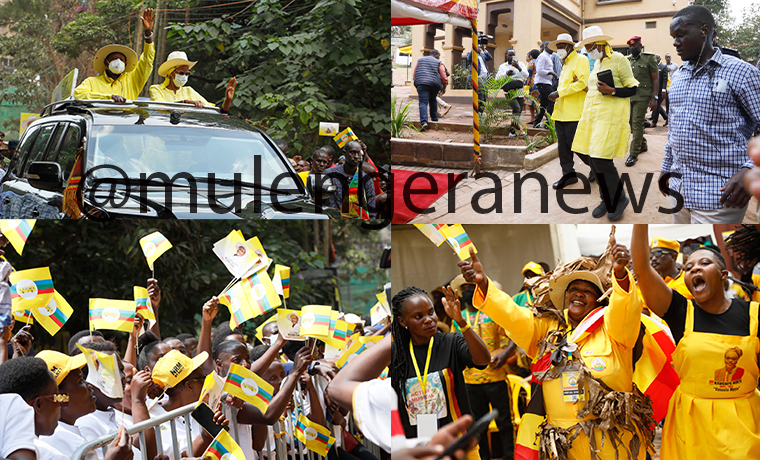
He said this, after officially picking nomination forms for both NRM party chairman and presidential flag bearer in the upcoming general election, signaling a clear intention to address what he described as a persistent and dangerous threat to the country’s development.
Held on Saturdays at the NRM electoral commission in Kampala, the event drew the presence of top government and NRM leaders including Vice President Jessica Alupo, Speaker Anita Among, and Deputy Speaker Thomas Tayebwa.
Also present was First Lady Janet Kataaha Museveni, who accompanied her husband in a show of unity and continuity at the heart of the ruling party.

Museveni said the decision to return to the race was influenced by overwhelming public support, noting that during his recent countrywide engagements on the Parish Development Model (PDM), citizens across various regions had passed resolutions and signed petitions urging him to continue leading the the country, which, according to him, reaffirmed the need for experienced stewardship in the face of both internal and global challenges.

At the heart of his message was a strong warning about corruption, which he described as unacceptable, especially within a government that claims to be in charge.
Museveni indicated that the upcoming kisanja (term), if granted, would focus heavily on eliminating corrupt tendencies in both public administration and political systems. He expressed concern that corruption continues to divert public funds, reduce service delivery efficiency, and erode public trust, and emphasized that decisive leadership is needed to restore discipline within government officials.
The President also cautioned citizens against participating in electoral bribery, arguing that voters must reject candidates who use money to buy positions and instead choose leaders based on competence, character, and commitment to serving the public. For him, bribery in elections not only undermines democracy but also installs half-baked leaders who ultimately become conduits for more corruption and mismanagement.

While rallying the NRM party structures ahead of 2026, Museveni revisited his long-standing message about the dangers of personality-based politics, reiterating that the strength of a nation should lie in its institutions and collective leadership, not in individuals seeking personal power.
He called on the party faithful to avoid the temptation of egotism, noting that even the strongest leaders achieve little without teamwork and strong systems.
In making the case for his continued leadership, Museveni also pointed to the country’s stability and regional role in peacebuilding, which he attributed to the firm foundations laid by the NRM over the last forty years.
He positioned himself as a generational bridge, someone ready to guide the younger population (bazzukulu), and their parents through the next phase of national transformation.
While the pledge to fight corruption is not new, its placement at the forefront of the 2026 campaign could reflect growing pressure from both within the party and the public, following several high-profile scandals in recent years.
It also serves as a challenge to the next wave of leaders within the NRM, many of whom are perceived as out of touch or compromised by the very corruption Museveni now seeks to confront.
His candidacy sets the tone for yet another election cycle anchored in experience, legacy, and promises of reform, but what remains to be seen is whether the declared war on corruption will bring real change, or whether it will be remembered as another campaign message in the Pearl’s long political journey. (For comments on this story, get back to us on 0705579994 [WhatsApp line], 0779411734 & 041 4674611 or email us at mulengeranews@gmail.com).